
Orquestre insights de IA em ações

Tendências
Categories
Striving for 85% Localization in Fighter Jet Development
Striving for 85% Localization in Fighter Jet Development
Breakthroughs in Aerospace Engine Technology
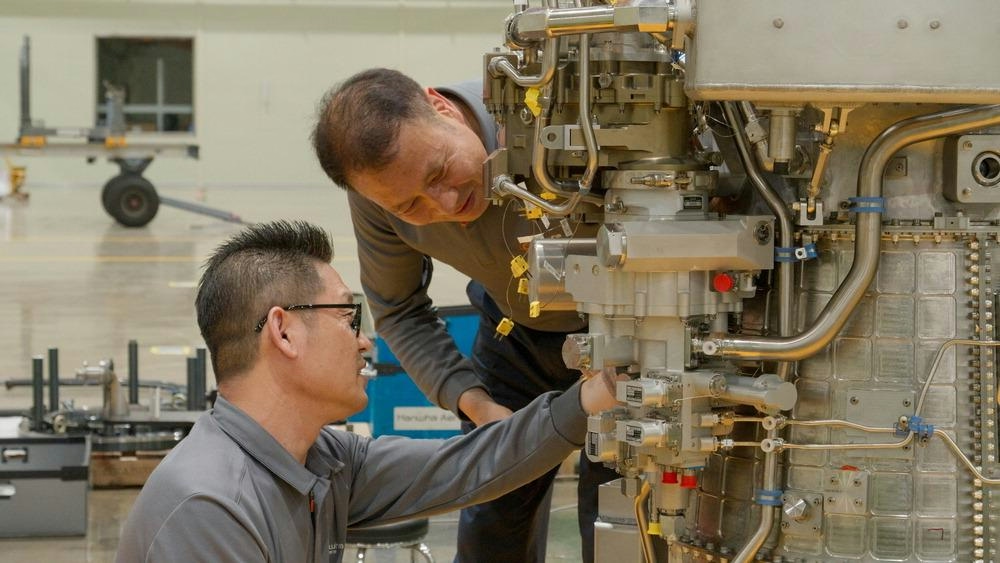
At Hanwha Aerospace’s Changwon Business Establishment 1 in Changwon, Gyeongsangnam-do, South Korea, a significant advancement in aerospace technology was recently unveiled. On June 6, the company showcased two prototype long-life aerospace engines: a 5,500-pound-class turbofan engine measuring approximately two meters in length, and a 1,400-horsepower turboprop engine. These engines represent South Korea’s first independent development of powerplants capable of thousands of hours of repeated operation, marking a departure from the short-life engines traditionally used in missile systems.
This milestone underscores South Korea’s transition from merely localizing unmanned aircraft engines to pursuing full self-sufficiency in advanced aerospace engine technology. The 5,500-pound-class turbofan engine is intended for integration into a low-observable unmanned aerial vehicle (UAV) squadron tasked with reconnaissance, electronic warfare, and attack missions, operating in conjunction with the KAI KF-21 Boramae fighter jet. Meanwhile, the 1,400-horsepower turboprop engine will power medium-altitude UAVs designed for extended surveillance and reconnaissance operations.
Both engines have completed assembly and initial test runs, with further ground and flight testing scheduled. Upon successful development, South Korea aims to deploy an unmanned aircraft system powered entirely by domestically developed engines. The long-term objective is to achieve 85% localization of parts, reflecting broader ambitions within the nation’s defense industry to enhance technological independence and reduce reliance on foreign suppliers.
Challenges and Global Context
Achieving such a high degree of localization in fighter jet development presents considerable challenges. The complexity and cost associated with developing advanced, sixth-generation aerospace technologies can strain even the most established aerospace sectors. South Korea’s efforts are emblematic of a wider global trend, as seen in initiatives like the Global Combat Air Programme (GCAP), led by the United Kingdom, Italy, and Japan. While GCAP offers an alternative to American, Chinese, and Russian fighter jets, its ambitious technological demands and financial burden have raised questions about the feasibility of meeting similar localization targets.
These challenges are not unique to South Korea. Other countries, including Indonesia, have reportedly reconsidered their manufacturing strategies, sometimes opting to purchase off-the-shelf warplanes rather than engage in co-production of advanced jets such as the KF-21. Market dynamics are also evolving, with growing interest in European-led defense programs driven by their geopolitical significance. For Europe, successful defense modernization depends on balancing innovation with established manufacturing capabilities and maintaining effective international partnerships.
Jung Hyeong-dong, head of Hanwha Aerospace’s Changwon Business Establishment 1, highlighted the strategic importance of these developments, stating, “Independence in aerospace engine technology is a core element of self-reliant national defense and will provide a foundation for expanding the defense export market without restrictions or approvals from other countries.”
As South Korea advances its aerospace capabilities, the pursuit of 85% localization in fighter jet and engine development remains an ambitious goal that reflects the shifting dynamics of the global defense landscape.

Etihad and Swissport Extend Global Partnership

Sepehran Airlines B737 Returns to Mashhad After Tyre and Engine Issues

Etihad Deploys Widebody Fleet to Meet Strong Demand

Korean Air Finalizes $36.2 Billion Deal with Boeing

Australia’s RFDS Queensland Section Orders Six King Air 260Cs

Korean Air Finalizes Order for 103 Boeing Jets and Engines

Embraer E195-E2 Features Distinctive Engine Placement Among Regional Jets

What Passengers Can Expect on Boeing’s New 777X Jet

How Ethiopian Airlines Became Africa’s Leading Carrier Amid Gulf Competition

Joby Aviation Extends Autonomous Flight Capabilities with Cross-Country Tour
