
Orquestre insights de IA em ações

Tendências
Categories
Sustainability Shifts from Corporate Pledges to Infrastructure Investment Amid Changes in Aviation, AI, and Natural Capital
Sustainability Shifts from Corporate Pledges to Infrastructure Investment Amid Changes in Aviation, AI, and Natural Capital
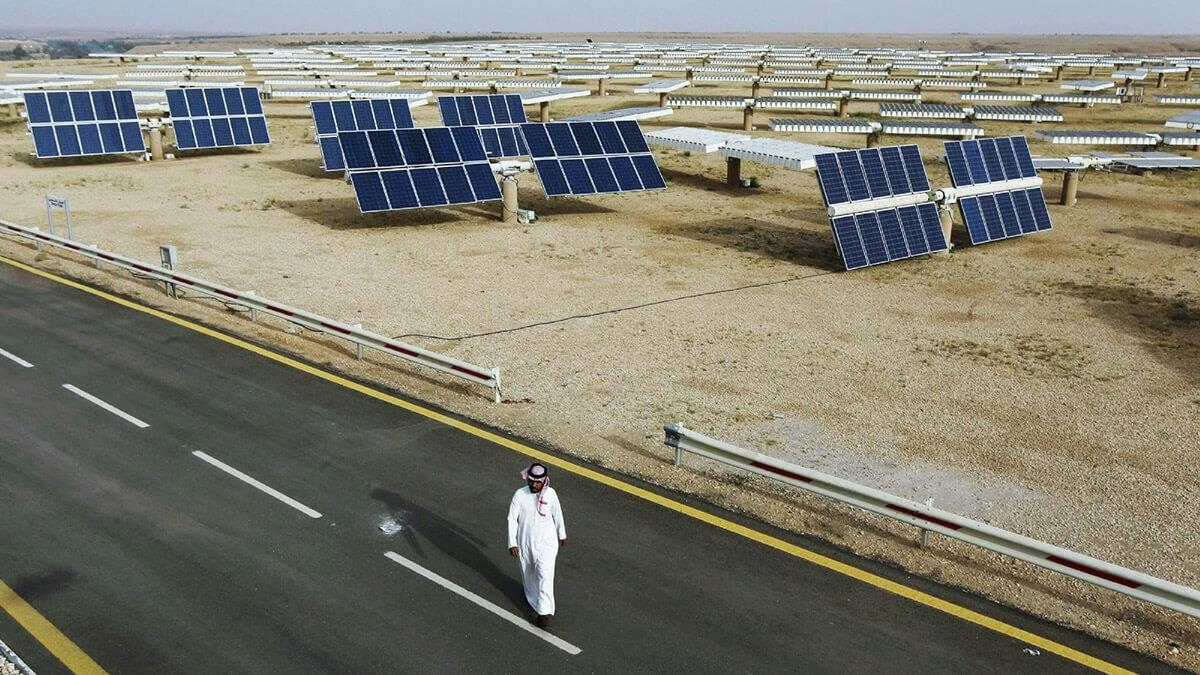
Sustainability investment is increasingly moving beyond symbolic corporate pledges, becoming a decisive factor in infrastructure development, financing strategies, and resource management across key industries. Innovations in sustainable aviation fuel, renewable energy integration for data centers, advanced water management techniques, and the emergence of natural capital markets illustrate how both private and public sectors are responding to intensifying environmental challenges.
This transformation is visible across a broad geographic spectrum, from Latin America and the United States to Southeast Asia, where businesses now regard emissions reduction, energy security, water availability, and ecosystem valuation as integral commercial priorities rather than peripheral environmental concerns. In regions such as Africa, where infrastructure gaps and limited access to climate finance persist, these global trends offer valuable insights into embedding sustainability within investment frameworks.
Aviation: From Pledges to Concrete Action
The aviation industry, long recognized as one of the most difficult sectors to decarbonize due to the limitations of battery technology and direct electrification for long-haul flights, is beginning to implement tangible sustainability measures. A notable development is the framework agreement between Syzygy Plasmonics and the International Finance Corporation (IFC) to explore sustainable aviation fuel projects across Latin America. Syzygy’s innovative light-driven technology, combined with the IFC’s role as a development finance institution, highlights the importance of bridging the gap between pilot technologies and commercially viable, bankable projects.
Globally, airlines and manufacturers are adopting diverse strategies to reduce their environmental impact. Initiatives such as the United Kingdom’s ‘Operation Blue Skies’ and electric air service trials in Norway and Sweden exemplify proactive efforts to advance sustainable aviation. Collaborations between major players like Airbus and Air Canada on sustainable aviation fuel projects further demonstrate industry commitment. Meanwhile, companies such as Bombardier are enhancing transparency by publicly disclosing their full environmental footprints. For emerging markets, particularly in Africa where aviation demand is expected to grow, success will hinge on developing the necessary infrastructure, securing reliable electricity supplies, establishing feedstock supply chains, implementing certification systems, and attracting long-term capital investment.
AI and Data Centers: Emerging Sustainability Pressures
The rapid expansion of artificial intelligence (AI) is introducing new sustainability challenges, especially concerning the energy and water demands of data centers. ENGIE’s recent 48-megawatt solar power purchase agreement with data center operator QTS in Texas exemplifies how operators are increasingly relying on long-term renewable energy contracts to address rising electricity consumption and associated emissions. As AI drives demand for high-performance computing, data centers face growing pressure from investors and customers alike to minimize their environmental footprint.
However, renewable energy procurement addresses only part of the sustainability equation. Data centers also require substantial water resources for cooling, which can place significant strain on local utilities. Companies such as Gradiant are expanding their focus on water management solutions tailored to data centers and semiconductor manufacturing facilities, reflecting heightened concerns about the capacity of communities to support expanding digital infrastructure in terms of both energy and water availability.
Investment Challenges and Market Uncertainty
The transition from corporate sustainability pledges to substantial infrastructure investment entails significant financial commitments and inherent risks. Fitch Ratings has cautioned about the potential for a market correction in the AI sector, noting that uncertainties surrounding AI’s long-term revenue prospects could complicate investment decisions. Market responses are likely to be uneven, with some sectors advancing rapidly while others adopt a more cautious approach.
As sustainability increasingly becomes a core element of commercial strategy, the dynamic interplay between technological innovation, financing mechanisms, and regulatory frameworks will be critical in determining how effectively industries can achieve environmental objectives while managing economic risks. This evolving landscape underscores the imperative for coordinated action among corporations, investors, and governments to ensure that sustainability commitments are translated into practical, scalable solutions.

Etihad Airways Suspends Airbus A380 Flights on Key Route

Aditya Birla Group Seeks Approval for Aircraft Leasing in GIFT City

Qatar Airways Highlights Innovation and Connectivity at Arabian Travel Market 2026

Hong Kong's Five-Year Plan Includes Andrew Fan's Aircraft Parts Processing Hub Proposal

ACIA Aero Leasing Delivers ATR72-600 to Air Nostrum

RTX Appoints Jill Albertelli as Head of Pratt & Whitney

TAT Technologies Joins Beyond Aero Hydrogen Aircraft Program

AURAK Study Highlights Barriers to Air Taxi Adoption in Emerging Economies

Xiamen Air Selects Altitude for 787 Maintenance at Heathrow

Etihad and Swissport Extend Global Partnership
