
Orquestre insights de IA em ações

Tendências
Categories
The Impact of AI on the Global Aviation Industry
The Impact of AI on the Global Aviation Industry
The aviation sector is experiencing a profound transformation driven by the rapid integration of artificial intelligence (AI) technologies. Airlines, original equipment manufacturers (OEMs), and airports worldwide are increasingly adopting AI to enhance real-time decision-making, operational efficiency, and passenger experience. This expansion is fueled by the convergence of AI with aviation-specific technologies such as computer vision, natural language processing (NLP), and machine learning, resulting in a market growing at a double-digit pace.
AI in Air Traffic Management and Urban Air Mobility
As global air travel recovers and passenger numbers rise, airports face mounting pressure to manage increased throughput with limited resources. AI is poised to revolutionize air traffic management (ATM), especially as airspace becomes more congested with the emergence of drones and electric air taxis. Traditional radar and controller-based systems are approaching their operational limits, whereas AI-powered platforms can process real-time flight data, weather conditions, and potential conflicts with far greater speed and accuracy.
Recent initiatives highlight AI’s expanding role in this domain. EUROCONTROL has piloted AI-based traffic prediction tools capable of forecasting aircraft trajectories up to 20 minutes ahead, thereby reducing mid-air conflicts and runway congestion. In the United States, NASA’s Airspace Technology Demonstration-2 (ATD-2) project achieved a 38% reduction in taxi times at Charlotte Airport by employing AI for surface management. This advancement not only lowered CO2 emissions and fuel consumption but also generated direct cost savings for airlines.
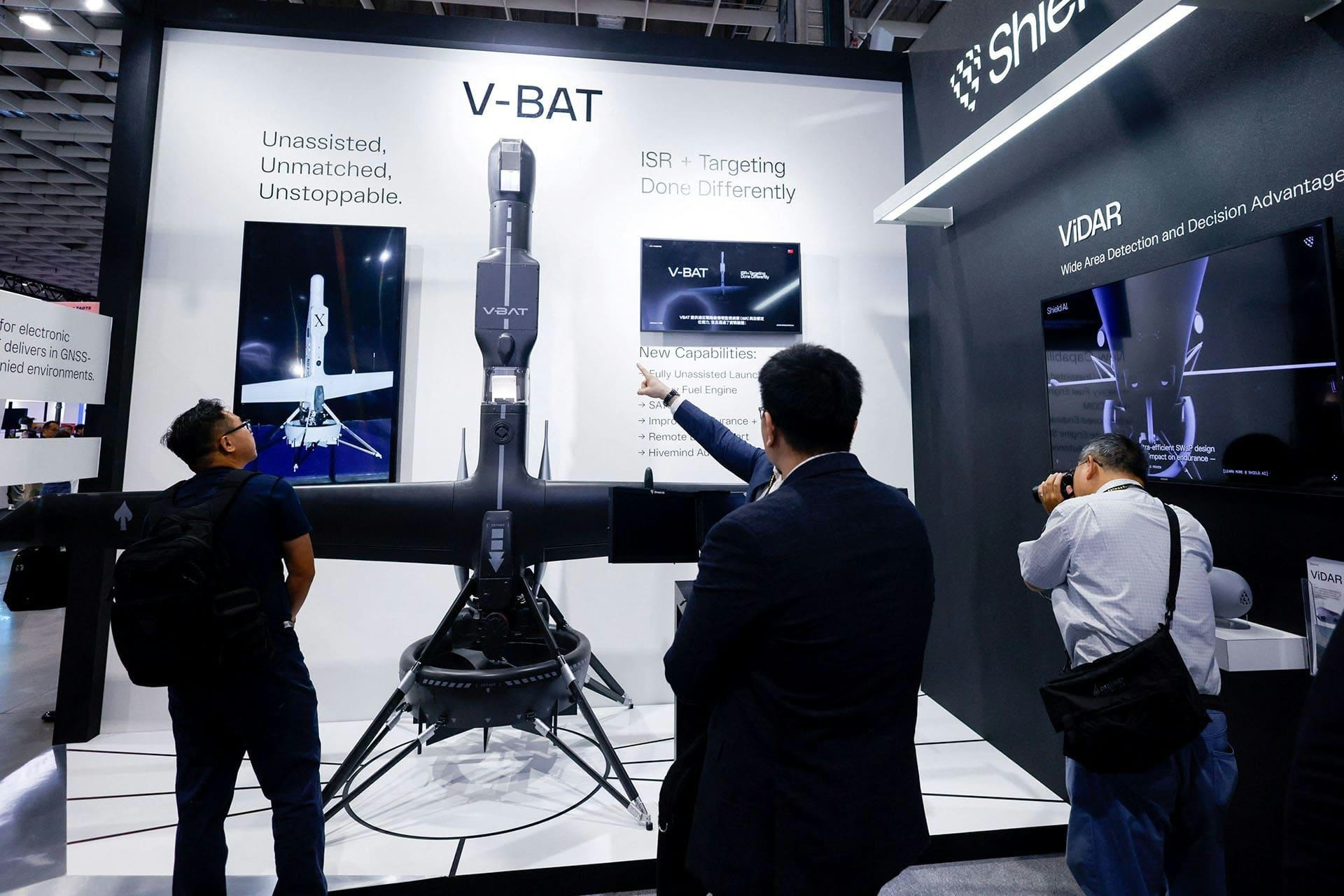
Urban air mobility (UAM) represents another critical frontier for AI application. Companies such as Joby Aviation and Wisk Aero are developing fully autonomous electric vertical takeoff and landing (eVTOL) aircraft that depend on AI for obstacle avoidance, route planning, and communication with smart infrastructure. NASA’s National Campaign for Advanced Air Mobility utilizes AI models to simulate UAM traffic at scale, ensuring safety and regulatory compliance. AI also facilitates dynamic flight path rerouting, airspace deconfliction, and integration with unmanned traffic management (UTM) systems.
With the International Air Transport Association (IATA) projecting that air traffic will double by 2040, the urgency for AI-enhanced ATM solutions is clear. Whether through AI-driven tower operations at major hubs or algorithmic conflict resolution in urban corridors, the future of scalable and safe airspace growth will depend heavily on advanced AI systems.
AI’s Role in Air Cargo and Emerging Challenges
The air cargo sector, which contributes over 12% of airline revenues, is also undergoing significant change due to AI. In 2023, global air cargo volumes exceeded 65 million metric tons, yet profitability remains constrained by capacity limitations, volatile demand, and reliance on manual processes. AI-driven forecasting, dynamic pricing, and route optimization are increasingly employed to address these challenges. Machine learning models trained on historical shipment data and external variables can now predict freight demand and yields up to two weeks in advance, enabling more agile and efficient capacity management.
Despite these advancements, the rapid adoption of AI in aviation presents notable challenges. There are growing concerns about a potential AI investment bubble that could lead to reversals in spending, declines in equity prices, and bond defaults. Market dynamics may also shift as competition intensifies, particularly with Chinese AI firms offering high-quality services at lower costs. The concentration of essential AI inputs among a few global technology giants could further restrict market entry for smaller players. Moreover, the opaque "black box" nature of AI complicates the detection of anti-competitive behaviors such as collusion or exclusionary conduct, which could adversely affect industry competition.
As aviation systems become increasingly dependent on interconnected digital infrastructure, addressing these economic and regulatory risks will be as critical as harnessing AI’s transformative potential.

Etihad Airways Suspends Airbus A380 Flights on Key Route

Aditya Birla Group Seeks Approval for Aircraft Leasing in GIFT City

Qatar Airways Highlights Innovation and Connectivity at Arabian Travel Market 2026

Hong Kong's Five-Year Plan Includes Andrew Fan's Aircraft Parts Processing Hub Proposal

ACIA Aero Leasing Delivers ATR72-600 to Air Nostrum

RTX Appoints Jill Albertelli as Head of Pratt & Whitney

TAT Technologies Joins Beyond Aero Hydrogen Aircraft Program

AURAK Study Highlights Barriers to Air Taxi Adoption in Emerging Economies

Xiamen Air Selects Altitude for 787 Maintenance at Heathrow

Etihad and Swissport Extend Global Partnership
