
Orquestre insights de IA em ações

Tendências
Categories
TTW Releases List of Top 50 Airlines for 2026
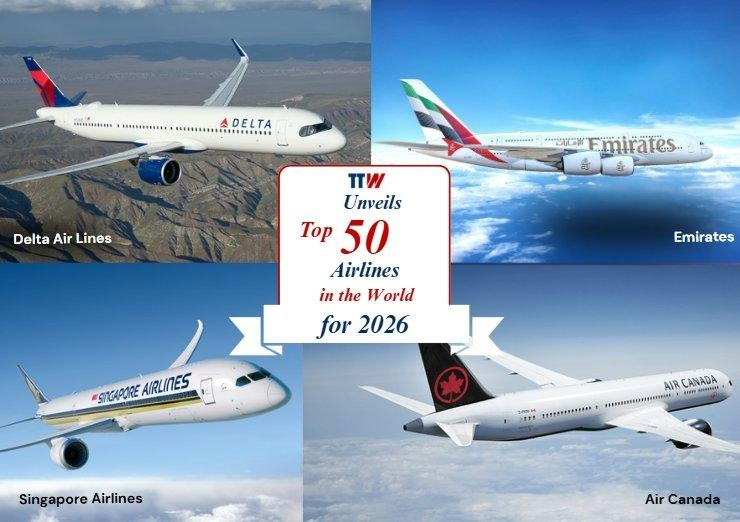
TTW Releases List of Top 50 Airlines for 2026
New York City, April 18, 2026 – Travel And Tour World (TTW) has published its definitive ranking of the Top 50 Airlines in the World for 2026, providing an insightful overview of the carriers driving the future of global aviation. The report highlights the transformative efforts underway across the industry, including fleet modernization, enhanced passenger comfort, and the introduction of next-generation onboard experiences. This evolving landscape features a diverse mix of established full-service carriers alongside nimble low-cost and hybrid operators.
Industry Growth and Economic Impact
The study emphasizes the critical role airlines play in facilitating global trade, tourism, and economic integration. As the aviation sector embarks on a new phase characterized by smart, sustainable, and highly connected growth, airlines are expanding their networks, innovating premium services, and harnessing technology to meet shifting passenger demands. Passenger numbers are projected to exceed 4.7 billion in 2026, with global aviation revenues expected to surpass USD 964 billion. This growth is supported by a strong recovery in long-haul and corporate travel, alongside increased demand in premium cabins. Business and premium economy segments are forecasted to generate between 35 and 38 percent of passenger revenue, while load factors are anticipated to stabilize between 82 and 87 percent. International air traffic is expected to grow annually by 6 to 8 percent, with the sector’s contribution to global GDP projected to exceed USD 1 trillion per year.
Fleet renewal remains a central focus, with over 2,100 new aircraft deliveries scheduled by 2027, promising fuel efficiency improvements of up to 25 percent. Low-cost carriers now represent 31 to 33 percent of global capacity, while airline alliances control more than 60 percent of international traffic. Industry-wide investments ranging from USD 45 to 60 billion are being directed toward infrastructure upgrades and sustainability initiatives, including commitments to net-zero emissions and the adoption of sustainable aviation fuel (SAF).
Challenges and Market Dynamics
Despite these positive trends, the industry faces significant challenges. A potential megamerger between United Airlines and American Airlines could substantially alter competitive dynamics at key hubs such as O’Hare International Airport. This consolidation raises concerns about increased costs and potential declines in passenger experience. Market reactions have been mixed; some investors worry about reduced competition, while others anticipate opportunities for enhanced market dominance. Rival carriers may respond by expanding their networks or negotiating more favorable terms to safeguard their market positions.
Compounding these challenges are global jet fuel shortages, particularly in Asia and Europe, which threaten to cause flight cancellations and capacity reductions, thereby disrupting international travel plans. Regional carriers are also confronting uncertainty. TAP Air Portugal’s future remains unclear despite recent profitability, while Malaysia Airlines is actively pursuing growth through new routes to China and Japan.
Innovation and Passenger Experience
Across all regions, airlines are making substantial investments in digital infrastructure, artificial intelligence-driven operations, and customer-centric innovations aimed at delivering seamless and intelligent travel experiences. Enhanced connectivity, real-time updates, and integrated airport-to-airline services are becoming indispensable for today’s global travelers. The report underscores the increasing importance of reliability, sustainability, and innovation for all aviation stakeholders, including business travelers, leisure tourists, corporate mobility programs, and event organizers.
By focusing on operational efficiency, environmental responsibility, and passenger satisfaction, the world’s leading airlines are reinforcing their competitive positions in an industry that is both rapidly evolving and intensely competitive.

Etihad Airways Suspends Airbus A380 Flights on Key Route

Aditya Birla Group Seeks Approval for Aircraft Leasing in GIFT City

Qatar Airways Highlights Innovation and Connectivity at Arabian Travel Market 2026

Hong Kong's Five-Year Plan Includes Andrew Fan's Aircraft Parts Processing Hub Proposal

ACIA Aero Leasing Delivers ATR72-600 to Air Nostrum

RTX Appoints Jill Albertelli as Head of Pratt & Whitney

TAT Technologies Joins Beyond Aero Hydrogen Aircraft Program

AURAK Study Highlights Barriers to Air Taxi Adoption in Emerging Economies

Xiamen Air Selects Altitude for 787 Maintenance at Heathrow

Etihad and Swissport Extend Global Partnership
