
Orquestre insights de IA em ações

Tendências
Categories
US Air Force Uses AI to Reduce Flight Test Planning Time
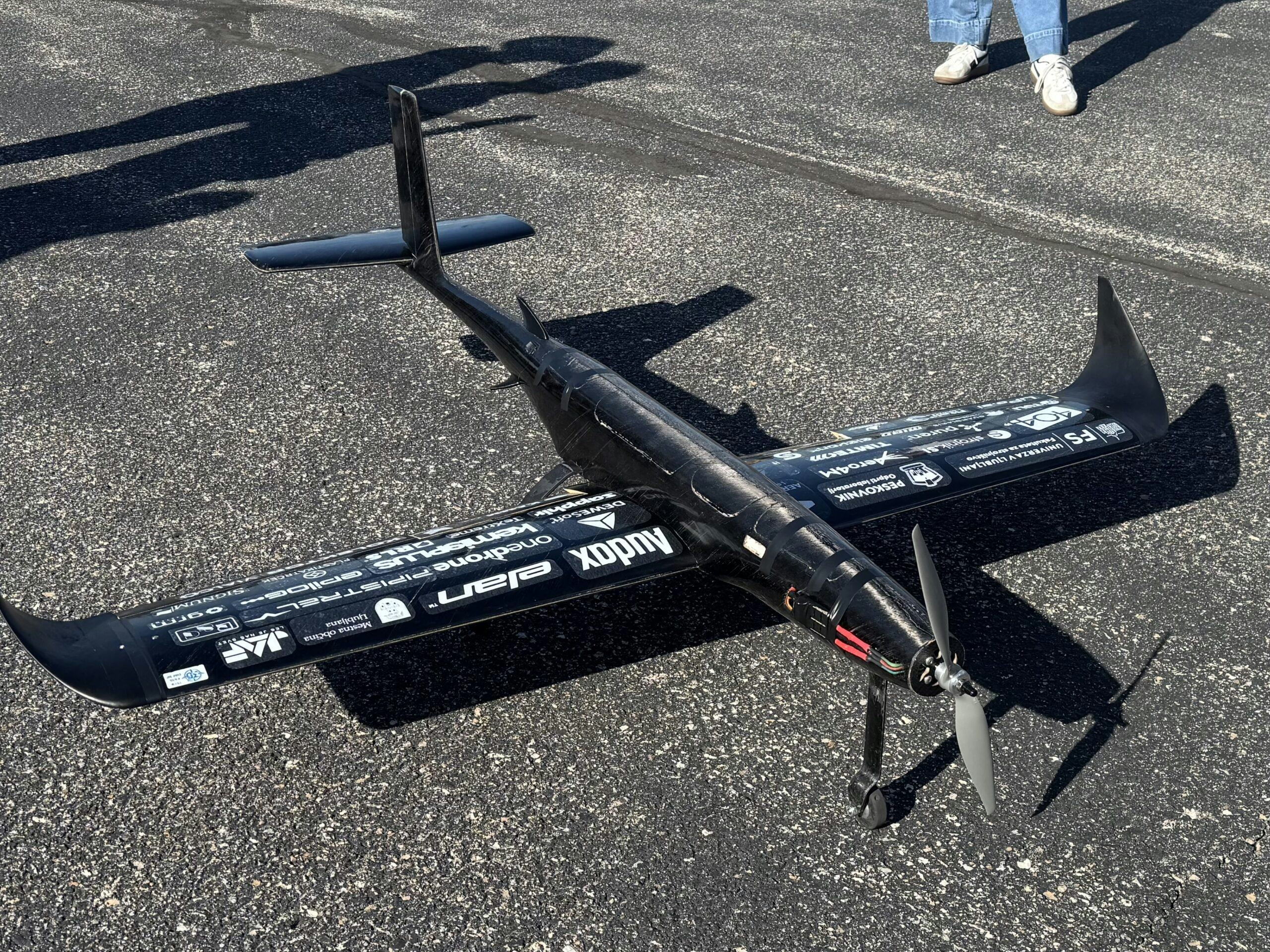
US Air Force Employs AI to Accelerate Flight Test Planning
Enhancing Agility in Military Aviation
In the evolving landscape of modern air warfare, technological superiority increasingly hinges not only on advanced aircraft but also on the speed at which new systems can be tested, validated, and deployed. Recognizing this imperative, the US Air Force has turned to artificial intelligence to streamline one of the most time-consuming stages in capability development: the extensive documentation required prior to flight testing.
At the Air Force Test Center, engineers have introduced the AI Flight Test Assistant (AFTA), a generative AI platform designed to significantly reduce the preparation time for flight tests. Traditionally, the process demands the creation of numerous documents—including test plans, hazard assessments, evaluation frameworks, and technical reports—before any aircraft can take to the skies. While these documents are essential for ensuring safety and data integrity, they have historically slowed the overall testing timeline.
Transforming Test Preparation with AI
AFTA addresses this bottleneck by producing initial drafts of necessary documents within minutes rather than days, thereby substantially shortening the “time-to-test,” a critical metric in defense planning. Maj. Gen. Scott Cain, commander of the Air Force Test Center, emphasized the importance of speed in maintaining a strategic advantage: “Our ability to test, learn, and adapt faster than potential adversaries allows us to deliver credible capability to the warfighter. Tools that help our engineers move faster while maintaining rigorous testing standards are critical to that effort.”
The system’s impact is already tangible. In one case, an operational tester reduced a task that previously required over 20 hours to less than two hours, with minimal initial human input. Another complex cost-estimation workflow was developed in under ten minutes and now generates results in less than a minute. Operating seamlessly in the background, AFTA frees engineers to concentrate on other critical tasks while automating document generation.
Jordan Conner, a lead on the program, described AFTA as a cloud-based tool that leverages generative AI to augment labor-intensive test and evaluation processes. Initially conceived as a document generator, the platform has evolved into a versatile, no-code workflow editor. This advancement allows engineers to create customized, automated processes tailored to their organizational needs by uploading reference materials and defining structured workflows—an important development in a domain where consistency and traceability are paramount.
Challenges and Broader Implications
Despite its promise, the integration of AI into flight test planning presents challenges. The Air Force must navigate the complexities of managing vast data sets, overcoming institutional resistance to change, and ensuring robust cybersecurity measures to safeguard sensitive information. Addressing these issues is essential for fully harnessing the potential of AI-driven solutions.
The success of AFTA has attracted attention across the defense sector, likely prompting increased interest from other contractors in AI-powered tools. Concurrently, competitors may accelerate their own AI initiatives to maintain technological parity. Recent advancements, such as Northrop Grumman’s B-21 Raider, highlight the expanding role of AI in enhancing long-range strike capabilities and suggest a future in which artificial intelligence is integral to military aviation.
As the US Air Force continues to refine and expand the capabilities of AFTA, this initiative represents a significant stride toward faster, more efficient, and more secure flight test planning, with the potential to reshape the pace of innovation in military aviation.

Etihad Airways Suspends Airbus A380 Flights on Key Route

Aditya Birla Group Seeks Approval for Aircraft Leasing in GIFT City

Qatar Airways Highlights Innovation and Connectivity at Arabian Travel Market 2026

Hong Kong's Five-Year Plan Includes Andrew Fan's Aircraft Parts Processing Hub Proposal

ACIA Aero Leasing Delivers ATR72-600 to Air Nostrum

RTX Appoints Jill Albertelli as Head of Pratt & Whitney

TAT Technologies Joins Beyond Aero Hydrogen Aircraft Program

AURAK Study Highlights Barriers to Air Taxi Adoption in Emerging Economies

Xiamen Air Selects Altitude for 787 Maintenance at Heathrow

Etihad and Swissport Extend Global Partnership
