
Orquestre insights de IA em ações

Tendências
Categories
US Designates Two New Drone Test Sites to Advance Aviation Research
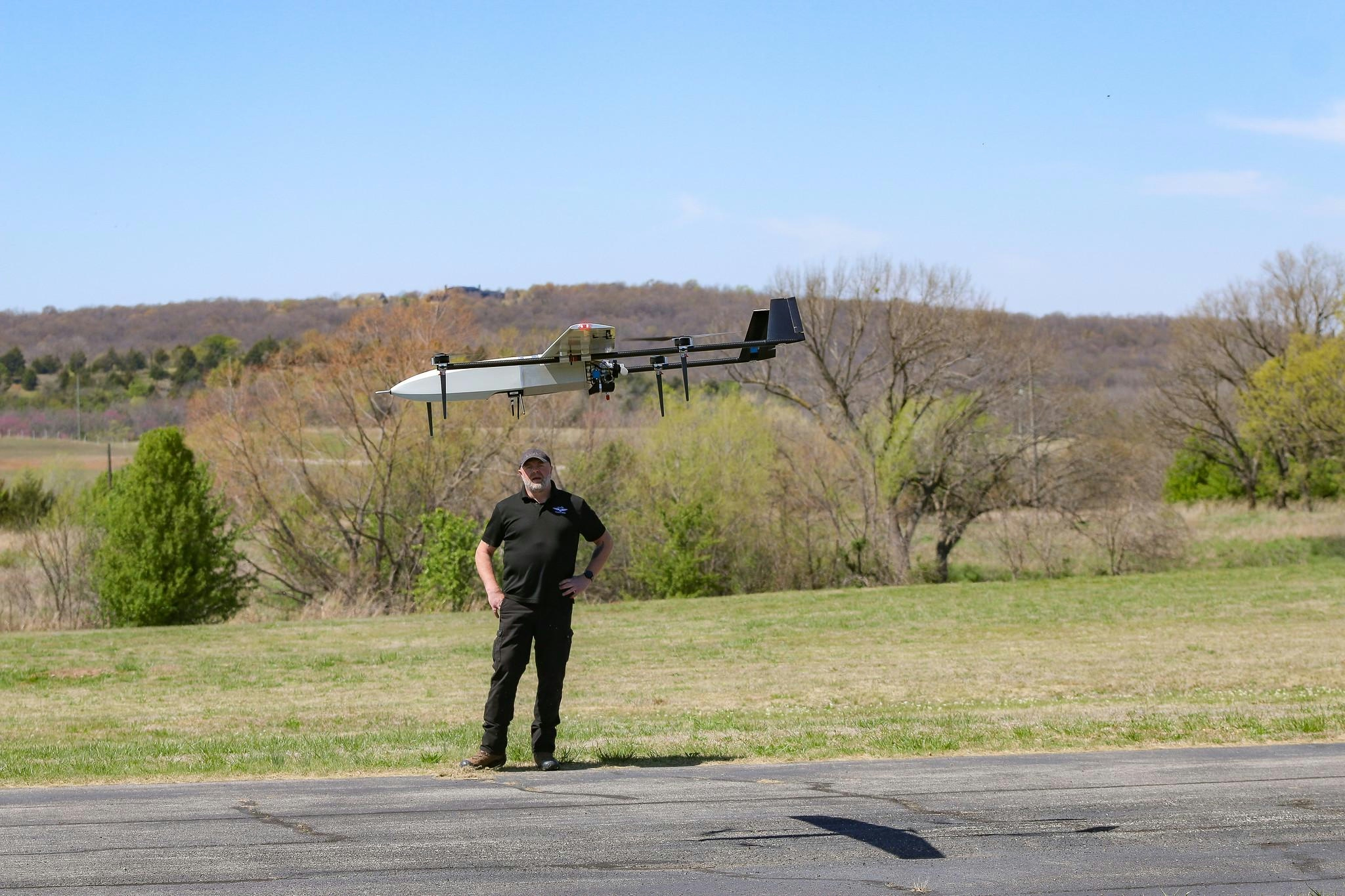
US Designates Two New Drone Test Sites to Advance Aviation Research
The US Department of Transportation and the Federal Aviation Administration (FAA) have announced the designation of two new drone test sites in Oklahoma and Indiana, marking the first expansion of the national UAS (unmanned aircraft systems) Test Site program in nearly a decade. Hosted respectively by the Choctaw Nation of Oklahoma and the Indiana Economic Development Corporation, these sites are poised to play a critical role in advancing research, development, and the integration of drones into the National Airspace System.
Enhancing Drone Capabilities and National Security
Officials emphasized the strategic importance of these new locations in supporting beyond visual line-of-sight (BVLOS) operations, autonomous flight, and multi-drone coordination. Transportation Secretary Sean P. Duffy stated that the new test sites will enable the collection of vital data and the testing of innovative systems, ensuring that the United States maintains its leadership in drone technology. FAA Administrator Bryan Bedford highlighted the potential for these facilities to modernize cargo delivery, emergency medical transport, and other advanced aviation technologies, while also informing the development of future safety and security standards.
This expansion arrives amid growing concerns over vulnerabilities in US airspace security and the imperative to mitigate supply chain risks, particularly in light of China’s dominant position in the global drone market. The recent federal ban on foreign-made drones, including those manufactured by DJI, has accelerated efforts by US companies such as Skydio to expand their market presence. The Indiana test site is expected to bolster local research, development, and manufacturing capabilities, potentially generating high-skilled employment and delivering significant economic benefits to the state.
Despite these advances, the broader drone market continues to face challenges in securing US airspace against potential threats. Experts underscore the urgent need for integrated national systems capable of detecting and mitigating unauthorized drone activity. The new test sites are anticipated to provide valuable data and insights that will support the establishment of robust safety and security frameworks.
The announcement also aligns with the objectives of President Donald Trump’s Executive Order “Unleashing American Drone Dominance,” which aims to foster high-skilled employment and position the United States as a global leader in unmanned aircraft technologies.
Expansion of the UAS Test Site Program
Since its establishment in 2013, the FAA’s UAS Test Site program has been instrumental in scaling drone technologies across the country. With the addition of the Oklahoma and Indiana sites, the program now encompasses nine designated locations, joining existing centers in Alaska, North Dakota, New Mexico, Nevada, New York, Texas, and Virginia.
These sites have already demonstrated significant contributions to the advancement of drone applications. For example, Alaska’s Center for Unmanned Aircraft Systems Integration has enabled BVLOS testing for cargo and medical delivery drones, supporting remote deliveries for the US Postal Service. New Mexico’s site has facilitated military and commercial trials for autonomous infrastructure inspection, while Texas A&M’s Corpus Christi Autonomy Research Institute has advanced urban air mobility projects, including the first FAA-approved citywide BVLOS corridors for package delivery. North Dakota’s Northern Plains UAS Test Site has been pivotal in evaluating counter-drone technologies critical to national security.
As the US drone industry continues to adapt to evolving regulatory landscapes and intensifying global competition, the new test sites in Oklahoma and Indiana are expected to accelerate innovation, strengthen domestic manufacturing, and enhance the nation’s capacity to safely integrate drones into everyday operations.

Etihad Airways Suspends Airbus A380 Flights on Key Route

Aditya Birla Group Seeks Approval for Aircraft Leasing in GIFT City

Qatar Airways Highlights Innovation and Connectivity at Arabian Travel Market 2026

Hong Kong's Five-Year Plan Includes Andrew Fan's Aircraft Parts Processing Hub Proposal

ACIA Aero Leasing Delivers ATR72-600 to Air Nostrum

RTX Appoints Jill Albertelli as Head of Pratt & Whitney

TAT Technologies Joins Beyond Aero Hydrogen Aircraft Program

AURAK Study Highlights Barriers to Air Taxi Adoption in Emerging Economies

Xiamen Air Selects Altitude for 787 Maintenance at Heathrow

Etihad and Swissport Extend Global Partnership
