
Orquestre insights de IA em ações

Tendências
Categories
Would you board an AI-piloted airliner?
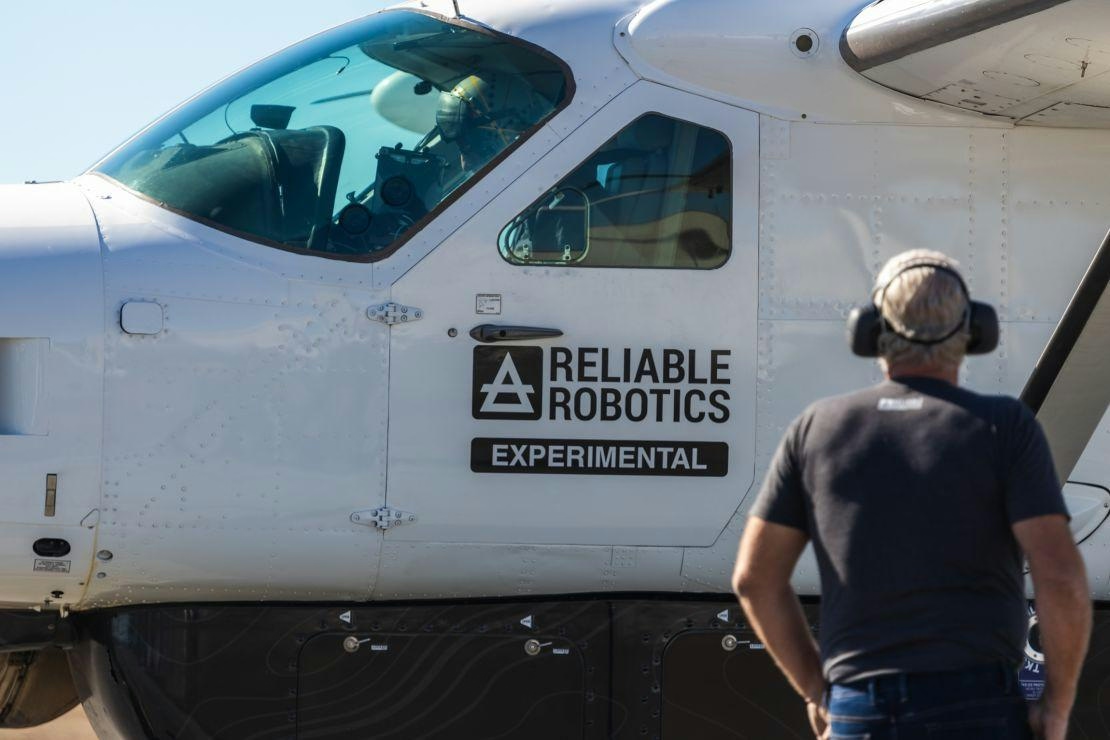
Would You Board an AI-Piloted Airliner?
As autonomous systems increasingly assume safety-critical roles in aviation, the industry faces a complex challenge: how to balance trust, safety, and innovation. Dr. Rashid Ali FRAeS, Chair of the RAeS C3 Specialist Group at Coventry University, examines the critical issues shaping the future of flight and public acceptance of AI-piloted aircraft.
Public Perception and the Fear of the Unknown
In a recent seminar, Dr. Ali sought to understand public sentiment toward autonomous flight by collecting candid responses from a diverse group of professionals—including nurses, lawyers, accountants, and managers—while concealing his identity to avoid researcher bias. The findings revealed a pervasive sense of uncertainty and mistrust.
Imagine an airport terminal where an announcement declares that a flight to New York will be operated entirely by a computer, with no human pilot on board. The initial silence that follows quickly gives way to murmurs of confusion and apprehension. Despite decades of automation advancements, the prospect of flying without a human pilot remains unsettling for many. Passengers often feel like unwitting test subjects, questioning whether AI can safely manage the complexities of flight at cruising altitudes. Comparisons to self-driving cars underscore this skepticism, as autonomous vehicles have yet to fully earn public confidence.
Regulatory, Market, and Industry Challenges
Beyond passenger perception, the introduction of AI-piloted airliners presents significant regulatory and insurance challenges. Authorities must develop frameworks to certify and insure aircraft operated by artificial intelligence, while the industry grapples with questions of liability in the event of an incident.
Market reactions to AI in aviation are mixed. Some investors view AI as a catalyst for improved efficiency and safety, while others caution against the risk of an AI bubble fueled by overhyped expectations. Traditional airlines are closely monitoring these developments, with some accelerating investments in AI technologies to enhance operational performance. However, they must also confront public concerns directly, as passenger trust remains a crucial factor in the successful adoption of autonomous flight.
Navigating the Future of Autonomous Aviation
The path forward requires a careful balance between innovation, safety, and public confidence. As the aviation sector advances toward greater autonomy, transparent communication, rigorous testing, and robust regulatory oversight will be essential. Addressing both the technical challenges and the human factors involved is critical if the industry hopes to persuade passengers to embrace AI-piloted airliners with assurance.

Etihad Airways Suspends Airbus A380 Flights on Key Route

Aditya Birla Group Seeks Approval for Aircraft Leasing in GIFT City

Qatar Airways Highlights Innovation and Connectivity at Arabian Travel Market 2026

Hong Kong's Five-Year Plan Includes Andrew Fan's Aircraft Parts Processing Hub Proposal

ACIA Aero Leasing Delivers ATR72-600 to Air Nostrum

RTX Appoints Jill Albertelli as Head of Pratt & Whitney

TAT Technologies Joins Beyond Aero Hydrogen Aircraft Program

AURAK Study Highlights Barriers to Air Taxi Adoption in Emerging Economies

Xiamen Air Selects Altitude for 787 Maintenance at Heathrow

Etihad and Swissport Extend Global Partnership
