
Превращайте аналитические выводы ИИ в реальные действия

В тренде
Categories
Adani and Embraer Partnership Aims to Transform Global Air Travel
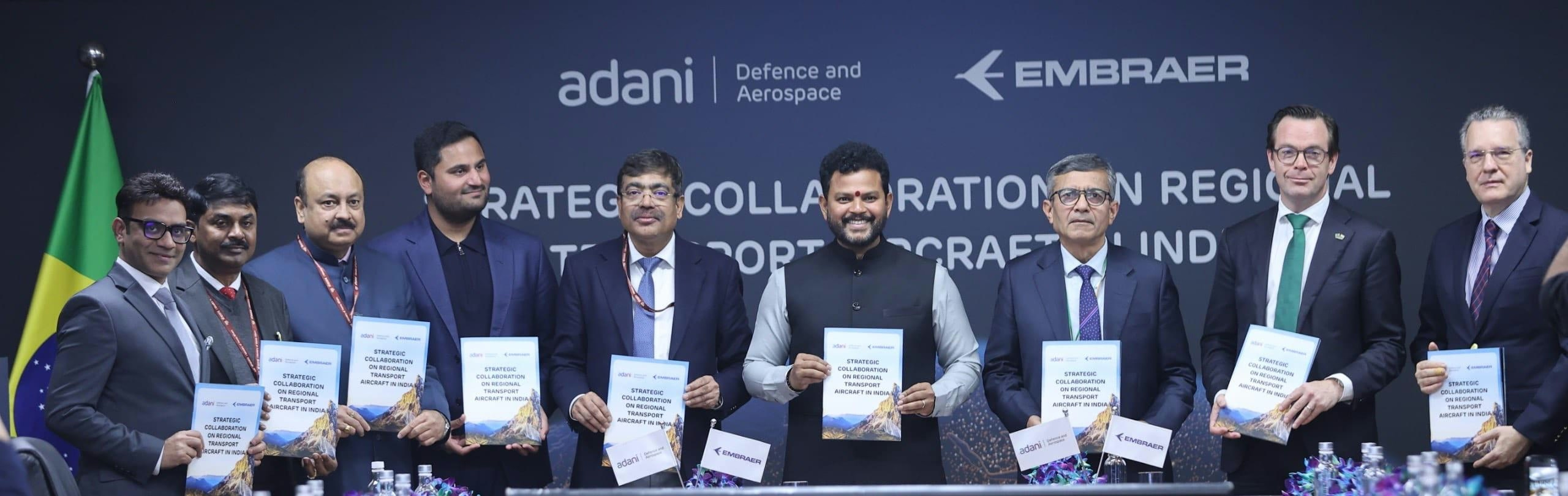
Adani and Embraer Partnership Aims to Transform Global Air Travel
For decades, the global aviation industry has been dominated by a duopoly comprising Airbus and Boeing. These two giants have largely shaped the experience of air travel, whether for long-haul international flights or major city connections. However, a new strategic alliance between India’s Adani Defence & Aerospace and Brazil’s Embraer seeks to challenge this established order. The partnership aims to revolutionize regional air travel, focusing on routes that have traditionally been underserved by the major manufacturers.
A Strategic Alliance Focused on Regional Connectivity
Formalized through a memorandum of understanding in early 2026, the collaboration unites Embraer, the world’s third-largest civil aircraft manufacturer known for its efficient E-Jet series, with the Adani Group, a dominant player in logistics and infrastructure that manages key Indian airports such as Mumbai and Ahmedabad. This marks Embraer’s first significant manufacturing venture in Asia, with plans to design, assemble, and service aircraft within India. The initiative is designed to transform India from a predominantly aviation technology consumer into a global producer, aligning with broader national ambitions.
Addressing the “Missing Middle” in Air Travel
While Airbus and Boeing have concentrated on large, long-haul aircraft, the Adani-Embraer partnership targets the 70-to-140-seat aircraft segment, which is crucial for connecting smaller cities and underserved regions. In 2025, India’s domestic air travel network carried nearly 167 million passengers, with demand surging particularly in Tier-2 and Tier-3 cities. Projections suggest that India will require approximately 500 aircraft in the 80-to-146-seat category over the next two decades. By focusing on these high-frequency, short-haul routes, the partnership aims to fill a critical gap often neglected by larger manufacturers, thereby enhancing regional connectivity.
Building a Comprehensive Aviation Ecosystem
The partnership’s ambitions extend well beyond aircraft assembly. It embraces a “Complete System” approach that includes the development of localized supply chains, which supports the “Make in India” initiative by fostering a robust network of Indian suppliers. This is expected to generate thousands of skilled jobs and reduce dependence on imported components. Additionally, the establishment of local maintenance, repair, and overhaul (MRO) hubs will reduce aircraft downtime, improving operational efficiency and turnaround times. The alliance also plans to invest heavily in human capital development, focusing on technical training and workforce expansion in engineering and aviation services. Collectively, these efforts aim to improve access to remote areas, boost employment in technical sectors, and position India as a hub for affordable air travel across Asia.
Opportunities and Challenges
Despite its promising outlook, the partnership faces considerable challenges. Brazil’s aviation market remains relatively underdeveloped, and both companies must overcome structural barriers while contending with intense competition from emerging electric vertical takeoff and landing (eVTOL) and business aviation firms. The global aviation landscape is rapidly evolving, with new technologies and players continuously reshaping market dynamics.
Nonetheless, the Adani-Embraer alliance represents a significant and bold attempt to diversify the aviation industry and address the growing demand for regional air connectivity. If successful, it could redefine the way smaller cities are linked worldwide, offering a new model for accessible, efficient, and locally driven air travel.

Etihad Airways Suspends Airbus A380 Flights on Key Route

Aditya Birla Group Seeks Approval for Aircraft Leasing in GIFT City

Qatar Airways Highlights Innovation and Connectivity at Arabian Travel Market 2026

Hong Kong's Five-Year Plan Includes Andrew Fan's Aircraft Parts Processing Hub Proposal

ACIA Aero Leasing Delivers ATR72-600 to Air Nostrum

RTX Appoints Jill Albertelli as Head of Pratt & Whitney

TAT Technologies Joins Beyond Aero Hydrogen Aircraft Program

AURAK Study Highlights Barriers to Air Taxi Adoption in Emerging Economies

Xiamen Air Selects Altitude for 787 Maintenance at Heathrow

Etihad and Swissport Extend Global Partnership
