
Превращайте аналитические выводы ИИ в реальные действия

В тренде
Categories
AI Enhances Efficiency at Asian Airports Using Existing Capacity
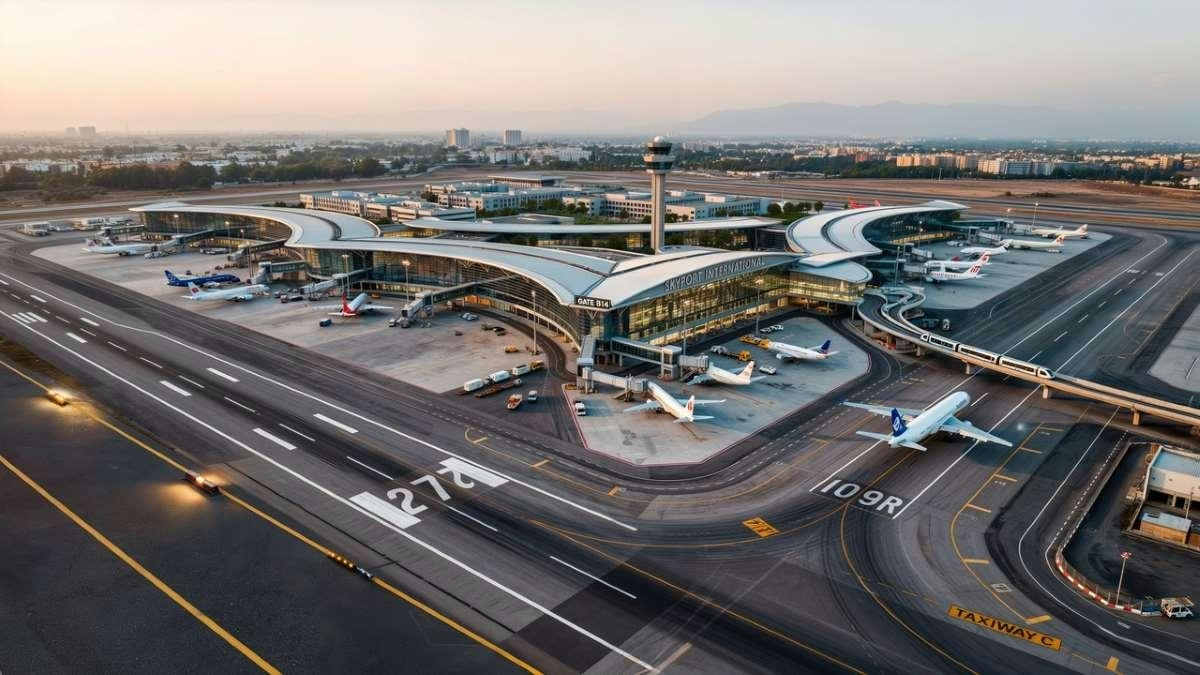
AI Enhances Efficiency at Asian Airports Using Existing Capacity
Optimizing Ground Operations to Manage Growing Demand
KUALA LUMPUR — As passenger numbers surge across Asia, airports are increasingly turning to artificial intelligence (AI) to improve operational efficiency without the lengthy delays and high costs associated with expanding physical infrastructure. By maximizing the use of existing runways, gates, and terminals, AI technologies offer a practical solution to accommodate rising demand, according to Christiaan Hen, CEO of Assaia.
Hen highlighted that many flight delays originate during ground operations, where aircraft turnaround involves a complex sequence of interdependent tasks such as baggage handling, passenger disembarkation, refueling, cleaning, catering, and boarding. “The turnaround is a highly interconnected operation, so even a small delay in one area can quickly cascade through the rest of the process,” he explained.
Assaia’s annual Turnaround Report, which analyzed over 450,000 aircraft turnarounds worldwide, revealed that flights delayed by 15 minutes or more often experienced prolonged baggage offloading times. Furthermore, departure delays exceeding six minutes tend to be unrecoverable, increasing the likelihood of subsequent disruptions throughout an airline’s schedule.
Real-Time Monitoring and Predictive Insights
To mitigate these challenges, Assaia has developed ApronAI, a platform that employs computer vision and AI to monitor turnaround activities in real time. The system automatically timestamps critical milestones—including disembarking, baggage loading and unloading, refueling, and boarding—and compares progress against planned timelines. Operations teams receive immediate alerts when tasks fall behind schedule, enabling prompt intervention to prevent delays from compounding.
Hen emphasized that AI’s capacity to identify recurring bottlenecks—whether linked to specific aircraft stands, particular processes, or certain times of day—allows airports to address systemic inefficiencies rather than merely reacting to isolated incidents. This capability is increasingly vital as Asian airports grapple with labor shortages, growing operational complexity, and the prohibitive costs and extended timelines of physical expansion.
Adoption and Challenges Across the Region
Japan’s New Chitose Airport in Hokkaido, the first in the Asia-Pacific region to implement Assaia’s technology, exemplifies the growing embrace of AI to sustain operational reliability amid rising passenger volumes. Serving as a key international gateway, New Chitose is central to Hokkaido Airports’ strategy to enhance connectivity, particularly with Southeast Asia.
For travelers, the expanded use of AI promises fewer unexpected delays, more reliable departure times, and smoother journeys, including reduced waiting times for gates and baggage delivery. “Passengers rarely think about what happens while an aircraft is on stand, but those activities have a direct impact on their journey,” Hen noted.
Despite its potential, the integration of AI into airport operations faces significant obstacles. High implementation costs, concerns over data security, and supply chain constraints present formidable challenges. The market is responding with increased investment in smart airport technologies and autonomous flight capabilities, while manufacturers are expanding production capacity for critical equipment such as grid systems and generators, particularly in Japan and Korea. Meanwhile, China’s limited access to advanced computing resources may hinder its progress relative to U.S. counterparts.
As Asian airports strive to balance efficiency, reliability, and growth, AI is positioned to play a pivotal role—contingent on the ability of stakeholders to overcome the technological and operational hurdles ahead.

Etihad Airways Suspends Airbus A380 Flights on Key Route

Aditya Birla Group Seeks Approval for Aircraft Leasing in GIFT City

Qatar Airways Highlights Innovation and Connectivity at Arabian Travel Market 2026

Hong Kong's Five-Year Plan Includes Andrew Fan's Aircraft Parts Processing Hub Proposal

ACIA Aero Leasing Delivers ATR72-600 to Air Nostrum

RTX Appoints Jill Albertelli as Head of Pratt & Whitney

TAT Technologies Joins Beyond Aero Hydrogen Aircraft Program

AURAK Study Highlights Barriers to Air Taxi Adoption in Emerging Economies

Xiamen Air Selects Altitude for 787 Maintenance at Heathrow

Etihad and Swissport Extend Global Partnership
