
Превращайте аналитические выводы ИИ в реальные действия

В тренде
Categories
AIESL CEO Urges India to Advance Beyond MRO to Become Global Aviation Manufacturing Hub
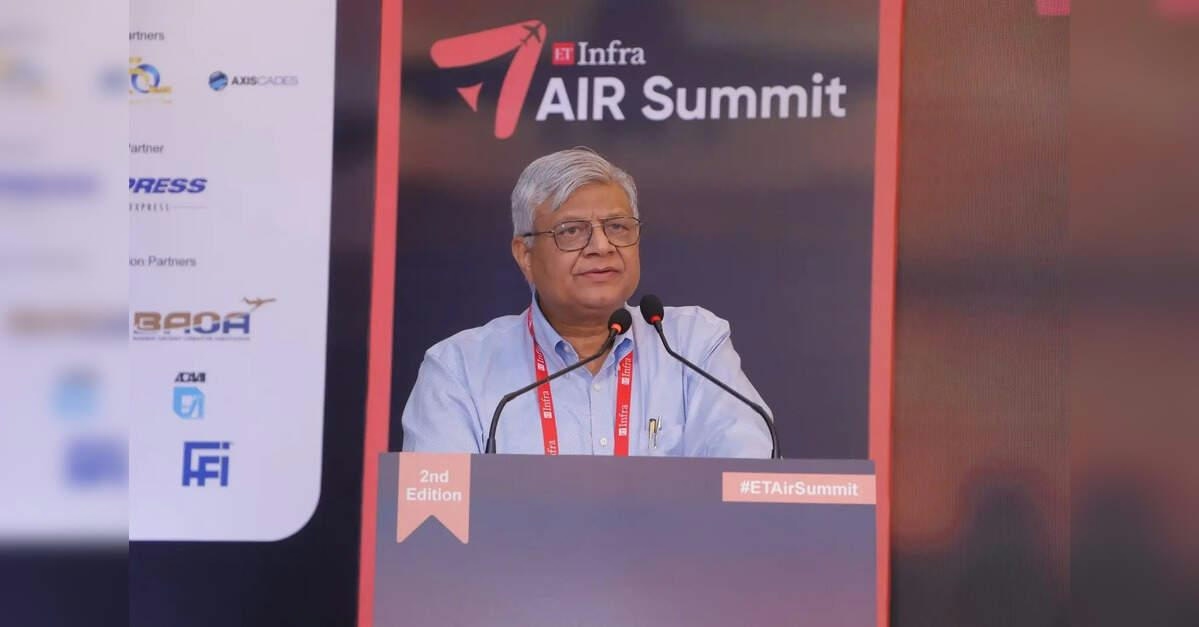
AIESL CEO Urges India to Advance Beyond MRO to Become Global Aviation Manufacturing Hub
Sharad Agarwal, CEO of AI Engineering Services Limited (AIESL), has called on India to leverage its engineering expertise to transcend its current role in maintenance, repair, and overhaul (MRO) and establish itself as a global leader in aviation manufacturing. Speaking at the ET Infra Air Summit 2026, Agarwal emphasized that India’s vast talent pool, technical experience, and industrial potential uniquely position the country to become a major player in the global aviation sector. However, he stressed that this transformation requires a concerted effort to align regulatory frameworks, infrastructure development, and human capital with long-term manufacturing ambitions.
Engineering Excellence and the Path Forward
Agarwal highlighted that Indian engineers are already deeply embedded in the global aviation ecosystem, contributing to complex technical areas such as engine and electronics overhauls, landing gear systems, flight control actuators, and thrust reversal mechanisms. “Engineering is our DNA. The country is producing millions of engineers every year,” he remarked, underscoring the need to build an aviation ecosystem that supports not only MRO but also large-scale manufacturing capabilities.
He identified three critical pillars essential for this transformation. First, regulatory harmonization is paramount. Currently, India’s MRO industry operates under a fragmented regulatory environment, encompassing standards from the Directorate General of Civil Aviation (DGCA), the US Federal Aviation Administration (FAA), European authorities, and defense agencies. Agarwal argued that aligning these regulations is vital for India’s aviation services and manufacturing sectors to gain global acceptance and competitiveness.
Second, Agarwal warned against India remaining a mere “plug-and-play” assembly hub. He called for strategic investments to develop a robust manufacturing base capable of serving both domestic and international markets over the next two decades. “India needs to invest to become a global leader, where it not just assembles but also manufactures for global needs,” he stated.
Third, the development and retention of human capital are crucial. With numerous engineering colleges and 147 approved aviation training schools producing thousands of technicians and engineers annually, India possesses the workforce necessary to support sector expansion. The challenge lies in effectively deploying and retaining this talent within the country’s aviation ecosystem.
Challenges and Strategic Imperatives
Agarwal also emphasized the importance of sustainability in the aviation sector’s future growth, advocating for the adoption of green energy, resource conservation, and a reduced environmental footprint as integral components of industry development.
Despite these opportunities, India faces significant challenges in advancing beyond MRO. The rising demand for MRO services, driven by capacity reductions among Asia-Pacific airlines, has increased operational pressures. Additionally, escalating costs for MRO operators amid the ongoing Middle East crisis and disruptions in raw material supplies due to geopolitical tensions threaten to complicate India’s ambitions. These factors may prompt shifts in the market, with increased investment in India’s manufacturing sector. Notably, global technology companies such as Google are exploring investments in AI infrastructure, server production, and drone manufacturing within the country. Meanwhile, international competitors are likely to strengthen their own manufacturing capabilities to maintain their global positions.
In response, Agarwal called for industry consolidation, stronger partnerships with global original equipment manufacturers (OEMs), and continued regulatory reforms. “India needs to become self-sustainable. India needs to be the aviation partner and aviation leader for the world,” he asserted.
Ultimately, Agarwal’s message was unequivocal: India’s aviation opportunity depends not only on rising demand but on its capacity to convert its engineering strengths into globally competitive manufacturing capabilities.

Etihad Airways Suspends Airbus A380 Flights on Key Route

Aditya Birla Group Seeks Approval for Aircraft Leasing in GIFT City

Qatar Airways Highlights Innovation and Connectivity at Arabian Travel Market 2026

Hong Kong's Five-Year Plan Includes Andrew Fan's Aircraft Parts Processing Hub Proposal

ACIA Aero Leasing Delivers ATR72-600 to Air Nostrum

RTX Appoints Jill Albertelli as Head of Pratt & Whitney

TAT Technologies Joins Beyond Aero Hydrogen Aircraft Program

AURAK Study Highlights Barriers to Air Taxi Adoption in Emerging Economies

Xiamen Air Selects Altitude for 787 Maintenance at Heathrow

Etihad and Swissport Extend Global Partnership
