Изображение

Превращайте аналитические выводы ИИ в реальные действия

Присоединяйтесь к списку ожидания AeroGenie уже сегодня!

В тренде

Categories

Bombardier to Acquire MHICA, Internalize Wing Production
September 4, 2026By ePlane AI
Bombardier to Acquire MHICA, Internalize Wing Production
0
0
Bombardier Aerospace
MHICA Acquisition
Wing Manufacturing

Bombardier to Acquire MHICA, Internalize Wing Production

Bombardier Aerospace has announced an agreement to acquire the assets of MHI Canada Aerospace (MHICA) from Mitsubishi Heavy Industries (MHI), a strategic move designed to enhance Bombardier’s manufacturing capabilities and strengthen its supply chain resilience. The acquisition, which involves MHICA’s facilities located in Mississauga, Ontario, is anticipated to be finalized by late 2026.

Expansion of Manufacturing Capabilities and Workforce

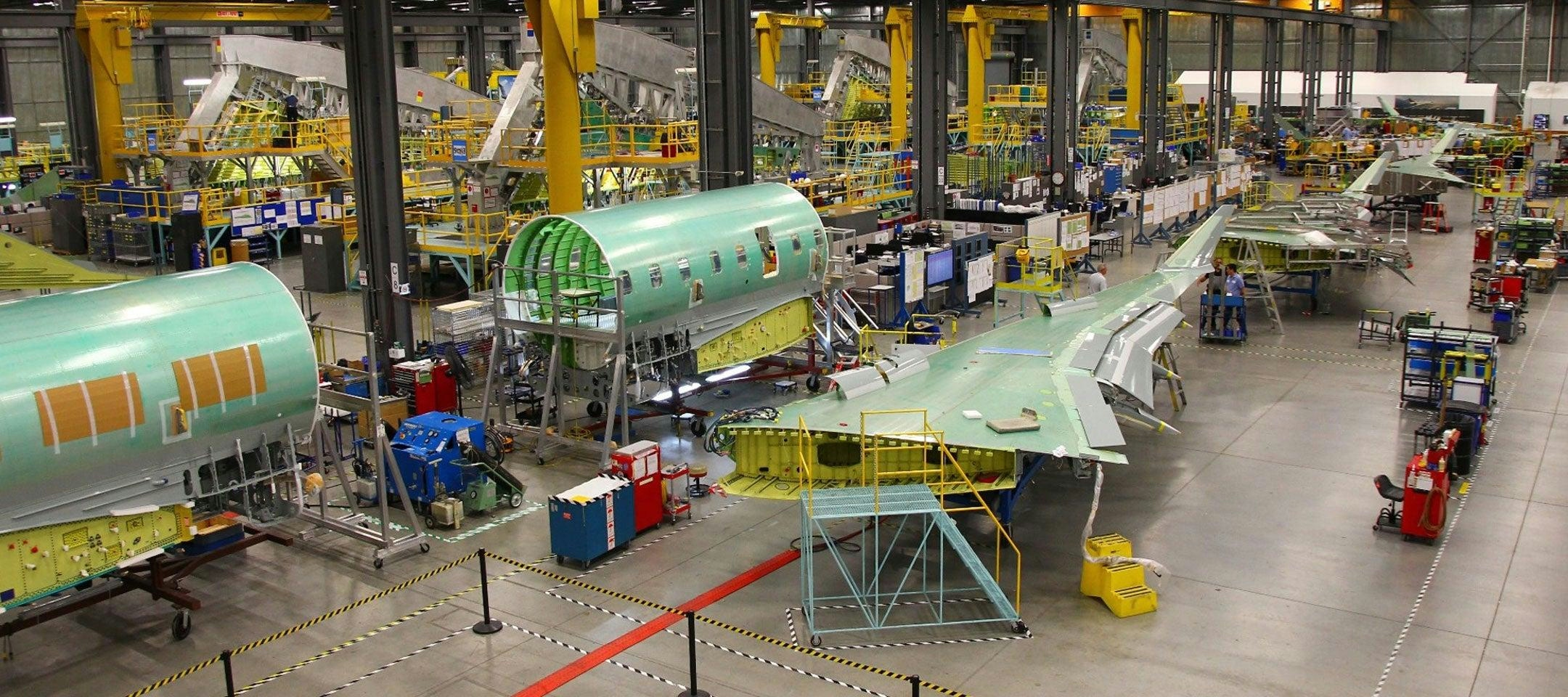
The transaction will integrate approximately 750 MHICA employees into Bombardier’s workforce, significantly bolstering the company’s in-house expertise in aerostructures and expanding its manufacturing footprint. MHICA currently produces main wings and centre fuselage structures for Bombardier’s Global 5500 and Global 6500 business jets, as well as the main wing for the Challenger 3500. The Mississauga site comprises a 270,000-square-foot manufacturing facility alongside a 70,000-square-foot logistics centre, underscoring the scale of operations being acquired.

By internalizing this component production, Bombardier aims to increase operational autonomy and exert greater control over critical elements of its business jet programmes. This strategic integration is expected to enhance supply-chain resilience amid ongoing industry challenges, enabling Bombardier to respond more effectively to market demands and potential disruptions.

Integration Challenges and Market Response

The acquisition remains subject to customary closing conditions, including regulatory approvals. Bombardier will face the complex task of integrating MHICA’s operations and ensuring a seamless transition for both existing programmes and the incoming workforce. The company’s management of these challenges will be closely observed by industry stakeholders.

Market reactions to the deal have been cautiously optimistic. Analysts highlight the potential for Bombardier to strengthen its manufacturing capacity and improve its competitive position within the aerospace sector. The consolidation is being closely monitored by competitors, who are assessing its implications for their own operations and supply chains.

Meanwhile, Mitsubishi Heavy Industries has reaffirmed its ongoing commitment to the commercial aerospace and defence sectors despite divesting its Canadian aerostructures assets. This acquisition represents a significant strategic step for Bombardier as it seeks to internalize key production capabilities and reinforce its standing in the global business jet market.

More news
JAL Acquires Hanjin KAL Stake, Strengthening Alliance with Korean Air

JAL Acquires Hanjin KAL Stake, Strengthening Alliance with Korean Air

JAL Acquires Stake in Hanjin KAL, Bolstering Alliance with Korean Air Amid Management Dispute Japan Airlines (JAL) has acquired a stake in Hanjin KAL, the holding company of Korean Air, marking a significant development in the strategic partnership between the two carriers. Although the exact size and value of JAL’s investment have not been disclosed, industry analysts emphasize the timing of the acquisition as critical, coinciding with an intensifying management control dispute involving the Hoban Group. Strategic Investment Amid Shareholder Tensions JAL announced the acquisition in Tokyo on June 3, simultaneously signing a broader strategic partnership agreement with Korean Air. Korean Air clarified that JAL’s investment was made independently, motivated by the long-term market value of Hanjin KAL. The absence of a regulatory filing for large shareholdings—mandatory for stakes of 5% or more—suggests that JAL’s stake remains below this threshold. The investment arrives at a pivotal moment. The Hoban Group has rapidly increased its stake in Hanjin KAL, reaching 20.15% as of July, closely matching the combined 20.57% held by Chairman Cho Won-tae and his allies. Should JAL’s stake be aligned with Chairman Cho, it could serve as a crucial “white knight” in defending his management control amid the ongoing contest. Currently, major shareholders of Hanjin KAL include Delta Air Lines with 14.90%, Korea Development Bank (KDB) holding 10.58%, and the National Pension Service at 5.11%. Both Delta and KDB are regarded as supporters of Chairman Cho. With JAL’s addition, the pro-Cho faction would command over 46% of shares, significantly outnumbering the Hoban Group’s holdings. Potential Challenges and Market Implications Despite the strengthened alliance, challenges remain. There is speculation that KDB, which played a stabilizing role during the 2019 management dispute between Chairman Cho and his sister, might divest its 10.58% stake to recover public funds following the planned merger of Korean Air and Asiana Airlines. Such a move could reignite a full-scale battle for control with the Hoban Group. JAL’s investment also raises questions regarding regulatory approval and the integration process with Korean Air, given the cross-border nature of the partnership. Market reactions have been largely positive, with expectations that the deepening cooperation will boost investor confidence and potentially enhance stock performance for both airlines. Competitors, including Delta Air Lines, a major stakeholder, are closely monitoring the situation and may reconsider their strategic positions in response to JAL’s involvement. Chairman Cho has a history of leveraging foreign airline partnerships to consolidate his control. During the 2019 dispute, Delta Air Lines acquired a stake in Hanjin KAL, reinforcing Cho’s position. Since then, Delta has expanded its cooperation with Korean Air, including a joint bid for Canada’s WestJet. Expanding Cooperation Beyond Equity Investment The partnership between JAL and Korean Air extends beyond equity stakes to encompass broad business collaboration. Despite their membership in different global airline alliances—Korean Air in SkyTeam and JAL in oneworld—the two carriers have agreed to pursue a cooperative relationship that transcends alliance boundaries. Enhanced codesharing on Korea-Japan routes is expected to be the initial focus, particularly as Korean Air advances its merger with Asiana Airlines.
AI Startup Offers $12.5 Million for Spirit Aviation Data

AI Startup Offers $12.5 Million for Spirit Aviation Data

AI Startup Micro1 Surpasses Google with $12.5 Million Bid for Spirit Airlines Data Micro1 Inc., an artificial intelligence startup, has submitted a $12.5 million offer to acquire Spirit Airlines’ extensive business data, outbidding Google’s $10 million proposal by 25%. This development, revealed in a court filing on Thursday, has intensified the competition for access to a vast dataset comprising approximately 100 million corporate emails, 500 million Microsoft Teams messages, over five million crew pairings, and around 16 million customer chat sessions. These records, alongside other operational and internal documents, were created prior to the low-cost carrier’s cessation of operations earlier this year. The auction, conducted in New York’s Southern District Court as part of Spirit Airlines’ Chapter 11 liquidation proceedings, has attracted significant attention due to the scale and commercial value of the data involved. AI firms like Micro1 are keen to obtain such real-world business datasets to train and enhance artificial intelligence models, as well as to gain deeper insights into airline operations. Legal Proceedings and Privacy Concerns Spirit’s advisers have provisionally agreed to sell the data to Google following a court-sanctioned auction. However, the sale has not been finalized. A bankruptcy judge is scheduled to rule on September 9 whether to approve the Google transaction or consider Micro1’s higher, albeit late, bid. Given the judiciary’s general reluctance to overturn auction results post-conclusion, Micro1 faces considerable procedural challenges despite its more lucrative offer. Privacy and data protection issues remain at the forefront of the dispute. Micro1’s legal representatives have highlighted the company’s technical capacity to “deidentify” the records, thereby safeguarding employee privacy. The startup has committed to excluding sensitive personnel files, including disciplinary and investigatory documents, as well as materials related to collective bargaining with unions representing Spirit employees. Furthermore, Micro1 has pledged to store the data exclusively within the United States and to permit oversight by an independent ombudsman appointed by Spirit’s advisers. Unions representing former Spirit workers have voiced opposition to the Google sale, citing concerns over privacy risks. In response, Google has asserted that it “will not receive any personal information from this dataset” and plans to engage an external firm to remove sensitive customer information. The forthcoming hearing on September 9 may establish significant precedents regarding how courts weigh higher bids against the finality of bankruptcy auctions and the privacy protections required when large corporate datasets are transferred. This case highlights the increasing value of business data in the artificial intelligence era and the heightened scrutiny surrounding the handling of such information during corporate liquidations.
FAI Technik Authorized as Starlink Dealer

FAI Technik Authorized as Starlink Dealer

FAI Technik Authorized as Starlink Dealer FAI Technik, a prominent German business jet maintenance, repair, and overhaul (MRO) provider, has been officially appointed as an authorized dealer and installer of SpaceX’s Starlink satellite internet system for aviation. This authorization is effective immediately, with installations to be carried out at the company’s maintenance facility located at Albrecht Dürer Airport in Nuremberg, Germany. Expanding Connectivity Services for Business Aviation In June, FAI Technik completed its inaugural Starlink installation on a Bombardier Global Express XRS and has planned further installations across its own fleet. The company is also extending Starlink installation services to external aircraft owners and operators. Starlink’s satellite internet system is designed to provide high-speed, reliable in-flight connectivity, enabling video conferencing, streaming, cloud-based applications, and uninterrupted online communication. Michael Axtmann, managing director of FAI Technik, emphasized the significance of this development, stating that the company’s new role as an authorized SpaceX Starlink dealer and installer represents a key milestone in expanding its modification and connectivity capabilities. He noted the increasing demand for high-speed, dependable connectivity within the business aviation sector and expressed confidence that Starlink will become a valuable addition to the suite of services offered to aircraft owners and operators. Positioning Amid Market Challenges FAI Technik operates under EASA Part-145 maintenance organisation approval and offers a comprehensive range of aircraft maintenance, modification, and installation services from its Nuremberg base. The integration of Starlink complements its existing connectivity upgrade portfolio, which includes systems such as Gogo’s Galileo, Honeywell’s Ka-Band, and Collins’ Ku-Band. Nonetheless, FAI Technik’s new role unfolds within a competitive and rapidly evolving market environment. The company may encounter challenges related to market competition, regulatory compliance, and the technical complexities of integrating new satellite systems. Competitors are likely to respond with aggressive pricing strategies or enhanced service offerings to maintain their market positions. Investor sentiment remains divided, with some expressing concerns over Starlink’s declining average revenue per user, while others remain optimistic about its swift market share expansion. Furthermore, regulatory scrutiny concerning orbital congestion and the associated costs could impact the broader satellite connectivity industry. Despite these challenges, FAI Technik’s partnership with SpaceX strategically positions the company to address the growing demand for advanced in-flight connectivity solutions in the business aviation sector.
AI Flight Between Madurai and Chennai to End After 68 Years on Oct. 25

AI Flight Between Madurai and Chennai to End After 68 Years on Oct. 25

Air India Express to Cease Chennai-Madurai Service After 68 Years Air India Express will discontinue its Chennai-Madurai-Chennai flight from October 25, bringing to an end a 68-year legacy of continuous service on this route. The flight, historically operated by Indian Airlines and later Air India, has long been a vital connection for travelers due to its affordability and convenience. Industry sources confirm that the airline has deemed the route commercially unviable, prompting the decision to withdraw the service. Impact on Passengers and Market Dynamics Despite Air India’s claims, travel agents and tour operators contest the rationale, citing robust passenger traffic. On a recent Friday, 159 passengers arrived in Madurai from Chennai, with approximately 70 returning the same day. The daily schedule currently departs Chennai at 10:15 a.m., arriving in Madurai at 11:30 a.m., and returns at noon, reaching Chennai by 1:10 p.m. With Air India Express’s exit, IndiGo will become the sole carrier on this route, operating more than five flights daily. This development raises concerns about a potential monopoly, which could lead to fare increases and reduced travel options for passengers. The termination of this service is expected to have significant repercussions for both tourism and business travel in southern Tamil Nadu. Madurai, a prominent cultural and commercial hub, depends heavily on air connectivity, especially during the peak tourist season from October to March. Travel industry representatives warn that the loss of the Air India Express flight may discourage domestic and international visitors, particularly during major festivals such as Dasara, Deepavali, Christmas, and Pongal. Increased travel costs or limited flight availability could prompt tourists to bypass Madurai or seek alternative destinations. Local Response and Future Prospects The decision has drawn criticism from travel agents and business communities in Madurai, Sivakasi, and Karaikudi, who question the apparent neglect of Madurai amid Air India’s expansion in other cities like Tiruchi, which has seen new flights to Hyderabad, Singapore, and the UAE. These stakeholders have appealed to Members of Parliament from southern districts to petition the Union Aviation Minister for reconsideration, underscoring the strategic importance of maintaining the Chennai-Madurai air link. As the October 25 deadline approaches, uncertainty persists for passengers and the regional travel ecosystem. Many hope for either a reversal of the decision or the entry of new carriers to fill the void left by Air India Express, ensuring continued connectivity for southern Tamil Nadu.
Airbus Reaches 1,000 Orders Amid Delivery Concerns

Airbus Reaches 1,000 Orders Amid Delivery Concerns

Airbus Reaches 1,000 Orders Amid Delivery Challenges European aerospace giant Airbus has achieved a notable milestone this year, securing over 1,000 aircraft orders. This accomplishment underscores the robust demand for commercial airliners, yet the company continues to face significant hurdles in scaling up production to meet these commitments. Production and Supply Chain Constraints Despite strong order intake, Airbus’s production output has consistently lagged behind initial targets, generating concern among investors and customers. The company is contending with persistent supply chain disruptions, which have impeded its ability to deliver aircraft on schedule. Key issues include the limited availability of Pratt & Whitney engines and delays in obtaining necessary regulatory approvals. These challenges have contributed to a growing backlog of deliveries and have recently impacted Airbus’s share price, particularly amid quality concerns surrounding the A330 model. Competitive Pressures and Strategic Investments The commercial aviation sector remains intensely competitive, with Boeing, Airbus’s primary rival, expected to respond to Airbus’s order success through aggressive marketing and pricing strategies. This competitive environment adds complexity to Airbus’s efforts to fulfill its delivery obligations. In response, Airbus is investing heavily in local infrastructure, especially in emerging markets such as India. These investments aim to strengthen the company’s position as a key player in the future of regional air travel. However, ongoing production delays and supply chain issues highlight the challenges Airbus faces in sustaining its leadership role in the industry. Industry analysts emphasize that Airbus’s ability to resolve supply chain bottlenecks and address quality concerns will be crucial to maintaining its growth trajectory. While the aerospace sector’s outlook remains positive, Airbus’s future performance will depend on its capacity to meet ambitious production targets amid the complexities of a global supply network.
The Cost of De-Icing a Boeing 777 for Airlines

The Cost of De-Icing a Boeing 777 for Airlines

The Cost of De-Icing a Boeing 777 for Airlines As winter takes hold across airports in the northern United States, Canada, and Europe, commercial airlines confront a critical safety challenge: the complete removal of ice, snow, and frost from aircraft surfaces before departure. The Federal Aviation Administration’s (FAA) “clean aircraft” mandate enforces this requirement through stringent federal regulations. For airlines operating large widebody jets such as the Boeing 777-300ER—with its wingspan exceeding 212 feet and wing area surpassing 4,600 square feet—de-icing is a complex and costly necessity. Specialized vehicles equipped with heated glycol-based fluids spray aircraft surfaces at high pressure to eliminate contaminants. This process is followed by the application of a thicker anti-icing coating designed to protect the aircraft as it taxis to the runway. Each de-icing event for a Boeing 777 can consume hundreds of gallons of fluid and incur costs running into several thousand dollars. At major winter hubs including Chicago O’Hare (ORD), Minneapolis-St. Paul (MSP), Denver (DEN), and Toronto Pearson (YYZ), airlines may de-ice hundreds of aircraft daily during severe weather. Over the course of a season, a single carrier’s expenditure on de-icing can reach between $30 million and $50 million, involving millions of gallons of fluid. The Safety Imperative of De-Icing Ice accumulation on an aircraft’s wings poses a serious threat to flight safety by disrupting the smooth airflow necessary for lift. Research conducted by NASA indicates that even a thin layer of frost or ice on the leading edge can reduce lift by up to 30% while increasing drag by 40%. This hazard extends beyond the wings to the horizontal stabilizer and control surfaces, potentially impairing pitch control and restricting the movement of ailerons, elevators, and rudders. Additionally, ice can obstruct critical sensors such as pitot tubes, which provide essential data to flight instruments. Erroneous readings from these sensors have been linked to catastrophic incidents, including the crash of Air France Flight 447 in 2009. In recognition of these dangers, FAA regulations strictly prohibit takeoff with any ice, snow, or frost adhering to critical aircraft surfaces, underscoring the indispensable nature of thorough de-icing procedures. Financial and Operational Challenges The financial burden of de-icing widebody aircraft like the Boeing 777 extends beyond the direct costs of fluids and labor. Airlines also incur increased fuel consumption and maintenance expenses due to the additional ground time required for de-icing. These operational delays can cascade through flight schedules, compelling airlines to adjust departure and arrival times, and in some cases, leading to cancellations or missed connections. Market dynamics often compel airlines to transfer a portion of these costs to passengers through higher ticket prices, particularly during peak winter months. In response, carriers are actively exploring more efficient de-icing technologies and investing in aircraft equipped with advanced de-icing systems to reduce turnaround times and operational expenditures. The pursuit of cost-effective solutions remains a priority as airlines strive to balance safety imperatives with efficiency and profitability amid challenging winter conditions. While essential for ensuring flight safety, de-icing represents a significant operational and financial challenge for airlines, influencing winter operations, competitive strategies, and the overall passenger experience.
AVAKS-GeoService Patents UAV with Four Lift Propellers and One for Acceleration

AVAKS-GeoService Patents UAV with Four Lift Propellers and One for Acceleration

AVAKS-GeoService Patents UAV Featuring Four Lift Propellers and Dedicated Cruise Propeller OOO NPP "Autonomous Aerospace Systems – GeoService" has secured a patent for a novel unmanned aerial vehicle (UAV) design that integrates vertical take-off and landing (VTOL) capabilities with efficient horizontal flight. This innovative aircraft employs four electric lift propellers—arranged as two on each side boom—to facilitate vertical ascent and descent. Distinctively, it incorporates a separate cruise engine equipped with a tail-mounted propeller, which provides thrust during forward flight. Design Innovations and Flight Control Unlike previous VTOL UAVs that depended on mechanically tilting engines or modulating thrust across multiple propeller-motor units for directional control, AVAKS-GeoService’s design eliminates the need for complex engine rotation mechanisms. The patent documentation notes that earlier methods often compromised control accuracy. To overcome these limitations, the new UAV features full aerodynamic control surfaces, including ailerons on the trailing edges of the wings for roll control and elevators on the tail stabilizers for pitch adjustments. These control surfaces are actuated by servos connected to an automatic control system, thereby enhancing flight precision throughout all operational phases. The aircraft is equipped with a combined pitot-static tube located in the nose, which provides avionics with critical data on static, dynamic, and total air pressure. Additional onboard instrumentation includes a digital magnetic compass and a radio altimeter mounted beneath the fuselage, the latter primarily used to determine altitude during vertical take-off and landing. For communication, the UAV employs a radio modem operating on a two-way half-duplex channel, offering a communication range of up to 100 kilometers. Market Context and Future Challenges This patent emerges amid a period of significant transformation within the tactical UAV market. The sector is rapidly evolving from hardware-centric platforms toward software-defined systems that emphasize data integration, autonomy, and interoperability. Established defense technology providers and emerging competitors such as Anduril, Helsing, Quantum Systems, and Stark Defence are intensifying efforts to advance software capabilities and autonomous functionalities. Consequently, AVAKS-GeoService faces the dual challenge of introducing innovative hardware while simultaneously adapting to a market increasingly driven by rapid software development and system integration. To maintain competitiveness, the company will need to continuously refine its UAV designs, not only through aerodynamic and mechanical improvements but also by investing in advanced software, data processing, and autonomous technologies. The latest patent underscores AVAKS-GeoService’s commitment to technical innovation, yet ongoing adaptation will be essential as the tactical UAV landscape continues to prioritize flexibility, connectivity, and rapid innovation.
Could AI Agents Turn the Time Between Trips Into a Revenue Channel?

Could AI Agents Turn the Time Between Trips Into a Revenue Channel?

Could AI Agents Turn the Time Between Trips Into a Revenue Channel? A recent survey conducted by Skift Research, involving nearly 7,000 travelers, underscores the growing complexity of the travel path to purchase. Travelers now discover options through a diverse array of platforms, including search engines, social media, and increasingly, AI tools. More than 60% of travelers aware of AI technologies already incorporate them into their trip planning. Despite this diversification in discovery, bookings remain heavily concentrated within a limited number of channels where factors such as price, trust, and payment flexibility dominate decision-making. This fragmentation presents a significant challenge for airlines striving to maintain a cohesive customer relationship across multiple, often disconnected, touchpoints. Extending Customer Engagement Through AI Agents Customer-facing AI agents have begun to enhance discrete service interactions by answering queries, modifying reservations, and resolving issues. The emerging opportunity lies in extending this value over time by preserving context from one interaction to the next. As AI agents increasingly manage disruption recovery, rebooking, upgrades, and loyalty support, airlines face the imperative of developing a unified approach to customer context. Without such integration, disparate systems risk becoming even more difficult to coordinate effectively. Erik Zahnlecker, agent product manager at Sierra, explains that “long-running AI agents are designed to stay with both the customer and the task over time.” These agents can retain context for days or even months, linking phases of travel planning, booking, service, loyalty, and the often-overlooked intervals between trips into a continuous, persistent relationship. Zahnlecker characterizes current travel discovery as a sequence of one-way touchpoints—travelers read a webpage, scroll through social media feeds, compare offers on online travel agencies, and then move on. AI agents, by contrast, have the potential to transform these fragmented interactions into ongoing conversations, resuming where the traveler left off or proactively engaging when relevant. Central to this transformation is the agent’s capacity for memory and context. Zahnlecker emphasizes, “What do you know about the customer? What do you remember from prior interactions? That’s what allows you to move from a conversation to a lasting relationship.” Travel planning rarely occurs in a single session; it often unfolds over days, with weeks or months between booking and departure, and frequently another extended period between trips. An AI agent capable of retaining context can recall traveler preferences, resume prior conversations, and continue advancing the traveler’s objectives—thereby reducing repetitive interactions and anticipating needs. Moreover, this experience can seamlessly traverse multiple communication channels. Zahnlecker notes, “The most advanced version has agents working across chat, email, SMS, and voice. A traveler could say, ‘I’m on the phone, but I need to go. Can you text me?’ and pick up the conversation there.” Challenges and Competitive Dynamics Deploying such sophisticated AI agents introduces new challenges. Ensuring the security of AI systems with access to enterprise platforms and sensitive customer data is paramount. Equally important is establishing clear accountability for autonomous decisions and maintaining robust human oversight. As travel agencies and airlines increasingly adopt AI to personalize services and capture greater margins, competition is expected to intensify. Rapid deployment of AI agents may lead to improved customer retention and scalability, as industry players vie to offer more personalized and responsive service. The market for agentic AI is projected to expand significantly, with enterprises prioritizing measurable productivity gains and cost efficiencies. Vendors are competing to deliver autonomous resolution capabilities and seamless integration with enterprise systems. For airlines, the ability to monetize the months between trips and cultivate deeper customer relationships through AI agents may soon emerge as a critical competitive advantage.
AL-51F1 Engine Extends Su-57's Range Beyond Air-to-Air Missiles

AL-51F1 Engine Extends Su-57's Range Beyond Air-to-Air Missiles

AL-51F1 Engine Enhances Su-57’s Operational Range and Stealth Capabilities The integration of the AL-51F1 engine marks a significant advancement in the performance of Russia’s Su-57 fighter jet, substantially extending its operational range and survivability against both air-to-air and surface-to-air missile threats. According to military analyst Yuri Knutov, the Su-57 is equipped with an advanced “sensor suit” that grants pilots comprehensive 360-degree situational awareness. This capability, Knutov asserts, currently surpasses the maneuverability and detection systems of any other combat aircraft globally. Knutov further characterizes the Su-57 not merely as a multi-role fighter but as a dedicated air superiority platform. Its design enables it to engage adversaries effectively while maintaining a near-invisible presence on the battlefield. “Such aircraft allow you to destroy the enemy while practically remaining invisible,” he remarked, underscoring the jet’s stealth and combat advantages. Technical data available from open sources reveal that the AL-51F1 engine produces a maximum thrust of approximately 11,000 kgf in dry mode and can reach up to 18,000 kgf with afterburner engaged. The engine features a redesigned nozzle that reduces both infrared and radar signatures, thereby enhancing the aircraft’s stealth profile and reducing its detectability by enemy sensors. Production Challenges and Strategic Implications Despite these technological strides, the Su-57 program faces considerable obstacles. The ongoing conflict in Ukraine has disrupted production schedules, delaying the mass manufacture of the AL-51F1 engine and complicating the integration of advanced sixth-generation technologies into the fighter jet. These setbacks have prompted skepticism among international defense observers regarding Russia’s capacity to compete with the sophisticated fighter programs of the United States and China. Market analysts have expressed doubts about the Su-57’s ability to achieve operational readiness and technological parity with rivals such as the U.S. F-35 and China’s fifth-generation stealth fighters. In response, both the United States and China are accelerating their own stealth aircraft development programs to maintain a competitive edge in aerial warfare technology. The future influence of the Su-57 on the global air power balance will hinge not only on its technical capabilities but also on Russia’s success in overcoming production and integration challenges amid a complex and evolving geopolitical environment.
Competition for Defunct Spirit Airlines’ Employee Data Continues

Competition for Defunct Spirit Airlines’ Employee Data Continues

Competition for Defunct Spirit Airlines’ Employee Data Continues Rising Bids Amid Bankruptcy Proceedings The future of Spirit Airlines’ extensive employee and operational data remains uncertain months after the airline filed for bankruptcy protection. Interest in the dataset has intensified, with several artificial intelligence companies vying to acquire the valuable information. Initially, Google emerged as the leading bidder, offering $10 million to secure the data at auction. However, AI data firm Micro1 has since surpassed this offer, submitting a bid of $12.5 million, according to aviation news outlet Simply Flying. The dataset in question is vast and multifaceted, encompassing approximately 600 million email and chat records from 17,000 employees, 17 million OneDrive files, 20.5 million SharePoint items, and over 30 million recorded customer service calls. Spanning several decades, the collection includes sensitive employee and workplace records, making it a highly coveted resource for companies developing advanced AI models. Such data could significantly enhance AI systems’ ability to interpret workplace communications, operational workflows, and customer service interactions. Privacy Concerns and Labor Objections Despite the commercial appeal, the proposed sale has sparked criticism from labor representatives. The Association of Flight Attendants-CWA has formally objected to the transaction, expressing concerns over the use of sensitive employee data and highlighting issues related to unpaid compensation for former Spirit Airlines employees. The union has called for increased transparency and stronger protections for workers whose information is included in the sale. In response to these privacy concerns, Spirit Airlines has assured that a third party will anonymize the data by removing personally identifiable information prior to any transfer. The company has also reiterated its commitment to addressing data privacy issues and ensuring compliance with applicable regulations. As the bankruptcy process unfolds, the final determination regarding the sale and management of Spirit Airlines’ data remains pending. Both industry stakeholders and labor groups continue to monitor the situation closely.
line









