
Превращайте аналитические выводы ИИ в реальные действия

В тренде
Categories
Brussels Summit Addresses Challenges of Aviation’s Net-Zero Goals
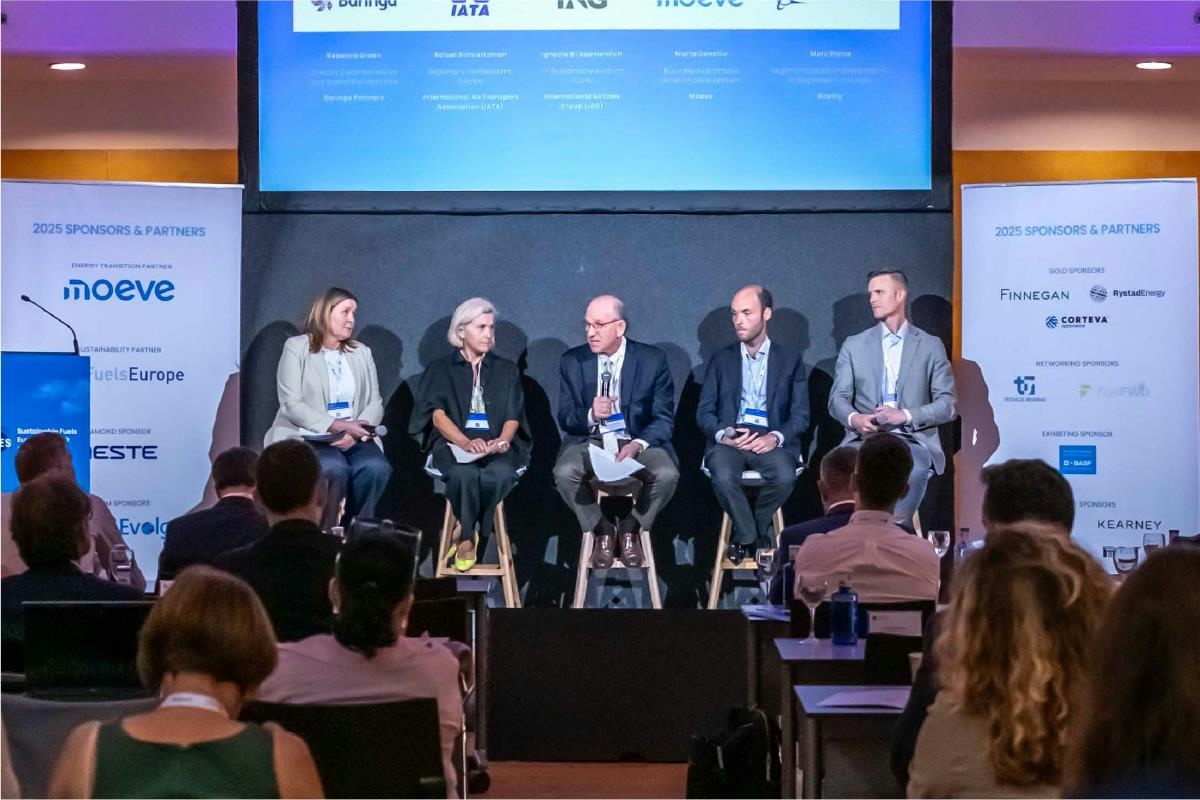
Brussels Summit Addresses Challenges of Aviation’s Net-Zero Goals
The International Air Transport Association (IATA) is set to host the fourth World Sustainability Symposium in Brussels on 13–14 October 2026. This gathering will bring together a diverse group of stakeholders, including aviation executives, policymakers, energy producers, investors, and technology experts, to confront the sector’s most urgent sustainability challenges. The selection of Brussels as the venue is particularly significant, given the city’s influential role in shaping Europe’s regulatory framework on aviation fuels, carbon markets, infrastructure, and industry competitiveness.
Airlines worldwide have committed to achieving net-zero carbon emissions by 2050. However, realizing this ambition depends on decisions that extend well beyond airport operations. Success will require a substantial increase in renewable energy production, the establishment of resilient supply chains for sustainable aviation fuel (SAF), and the implementation of policies that encourage innovation while maintaining the accessibility of air travel. The symposium aims to address these interconnected issues, emphasizing how climate action, energy security, connectivity, and economic growth can progress in tandem.
Scaling Sustainable Aviation Fuel
A primary focus of the symposium will be the rapid expansion of sustainable aviation fuel, particularly hydroprocessed esters and fatty acids (HEFA), low-carbon aviation fuels, and co-processing techniques that incorporate renewable materials into existing refinery operations. SAF is widely regarded as the most immediate and effective means of reducing emissions from current aircraft, as transformative new technologies remain years away from large-scale deployment. At high blending ratios, SAF can reduce lifecycle carbon emissions by more than 80%, positioning it as a cornerstone of the aviation industry’s net-zero strategies.
Despite its promise, the industry faces considerable challenges related to feedstock availability, production capacity, competitive pricing, and the development of reliable infrastructure. Demand for SAF is increasing rapidly, driven by environmental imperatives and corporate sustainability commitments. Airlines and policymakers are increasingly focused on higher SAF blends, expected to dominate the market at levels between 30% and 50% by 2026, as essential to meeting climate targets. In response, carriers such as Ryanair are expanding partnerships with suppliers like Neste to secure future SAF supplies.
Marie Owens Thomsen, IATA’s Senior Vice President for Sustainability and Chief Economist, highlighted that ambition is no longer the limiting factor. She stated, “The challenge now is the speed at which we can develop and scale interdependent solutions,” underscoring that airlines cannot achieve the energy transition in isolation. Coordinated efforts across transport, energy, finance, technology, and government sectors are critical to progress.
Aligning Global Markets and Policy
The symposium will also examine how governments can develop harmonized policies to support transparent and competitive international markets for SAF, carbon credits, and other decarbonization mechanisms. Given the global nature of airline operations, fragmented regulations and inconsistent sustainability standards impose significant costs and complexities. While Europe has established ambitious climate objectives for aviation, IATA cautions that some policies fail to fully consider the complex interdependencies between fuel availability, infrastructure, investment risk, energy security, and airline competitiveness.
Brussels will serve as a platform for regulators and industry leaders to explore opportunities for greater policy alignment, with the goal of accelerating emissions reductions while safeguarding passengers from unnecessary costs and preserving the economic and social benefits of air connectivity.
The event will feature prominent speakers including LATAM Airlines Group CEO Roberto Alvo, European Parliament member Cynthia Ní Mhurchú, International Energy Agency renewable energy chief Paolo Frankl, Green Climate Fund Board Co-chair Leif Holmberg, and MIGA climate business head Margarita Cabrera Botero. Sustainability leaders from IAG, Airbus, and Schiphol will also participate, contributing to the development of practical solutions for the aviation sector’s net-zero transition.

Etihad Airways Suspends Airbus A380 Flights on Key Route

Aditya Birla Group Seeks Approval for Aircraft Leasing in GIFT City

Qatar Airways Highlights Innovation and Connectivity at Arabian Travel Market 2026

Hong Kong's Five-Year Plan Includes Andrew Fan's Aircraft Parts Processing Hub Proposal

ACIA Aero Leasing Delivers ATR72-600 to Air Nostrum

RTX Appoints Jill Albertelli as Head of Pratt & Whitney

TAT Technologies Joins Beyond Aero Hydrogen Aircraft Program

AURAK Study Highlights Barriers to Air Taxi Adoption in Emerging Economies

Xiamen Air Selects Altitude for 787 Maintenance at Heathrow

Etihad and Swissport Extend Global Partnership
