
Превращайте аналитические выводы ИИ в реальные действия

В тренде
Categories
Cathay Pacific Restarts Hong Kong–Seattle Route Using A350-900 Aircraft
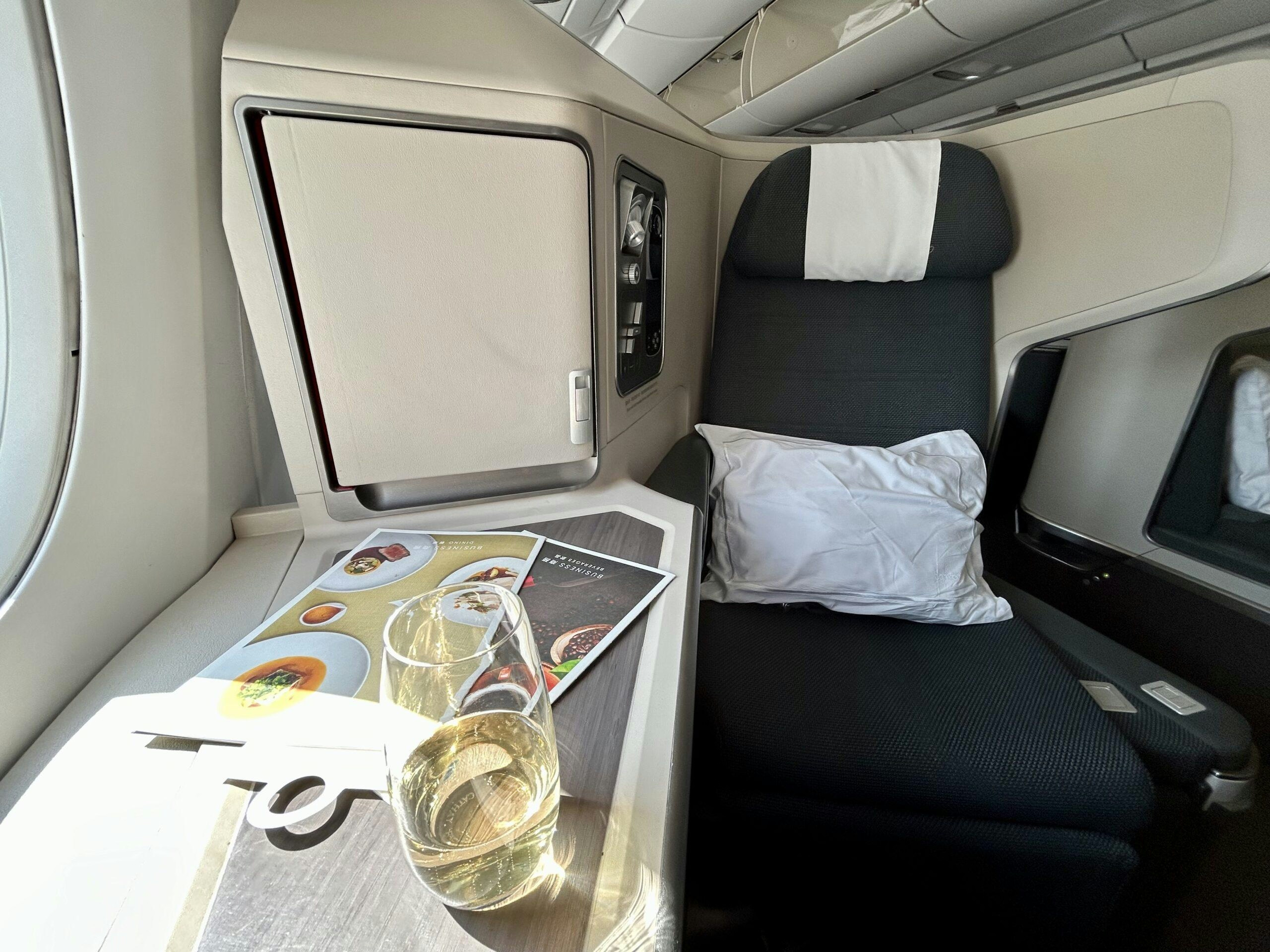
Cathay Pacific Resumes Hong Kong–Seattle Service with Airbus A350-900
Cathay Pacific will recommence its nonstop flights between Hong Kong International Airport (HKG) and Seattle-Tacoma International Airport (SEA) in March 2026, utilizing its advanced Airbus A350-900 aircraft. This decision reflects renewed confidence in transpacific travel demand and underscores the airline’s strategic commitment to expanding its presence in the North American market amid a recovering Asia-Pacific aviation sector.
Route Operations and Scheduling
The reinstated service will feature a three-class cabin layout—business, premium economy, and economy—offering seating for 280 passengers per flight. Westbound journeys from Seattle to Hong Kong are expected to take approximately 15 hours, while eastbound flights will average around 16 hours, accounting for prevailing wind conditions. Departures from Hong Kong are scheduled for late afternoon, arriving in Seattle early morning local time, thereby facilitating convenient connections to destinations across North America.
Seattle’s prominence as a hub for technology, aerospace, and biotechnology industries aligns with Cathay Pacific’s focus on premium business travelers. The direct route eliminates the need for connecting flights, appealing to both corporate and leisure passengers, including the substantial Asian diaspora in the Pacific Northwest.
The Airbus A350-900: Enhancing Efficiency and Passenger Experience
Central to Cathay Pacific’s fleet modernization is the Airbus A350-900, which offers significant improvements over older Boeing 777 models. The aircraft delivers a 25% reduction in fuel consumption and operates with a noise footprint 50% smaller than legacy widebodies, contributing to a more environmentally sustainable operation. Its wider fuselage, measuring 18.5 inches more than previous models, enhances passenger comfort, while advanced features such as LED lighting and humidity controls help mitigate jet lag on long-haul flights.
Currently, Cathay Pacific operates a fleet of 35 A350-900s, with additional deliveries planned through 2028. The aircraft’s range exceeds 8,000 nautical miles, enabling nonstop transpacific flights without technical stops and supporting the airline’s long-haul ambitions.
Strategic Market Position and Competitive Context
The Hong Kong–Seattle route represents a critical link between two major global aviation hubs. Hong Kong remains Asia’s third-largest airport, handling over 70 million passengers annually, while Seattle-Tacoma International Airport processed 50 million passengers in 2025, with transpacific flights accounting for 35% of its international traffic. The flight schedule is designed to facilitate same-day onward connections to key cities such as San Francisco, Los Angeles, and Vancouver.
Despite challenges posed by rising fuel costs, Cathay Pacific plans to increase overall capacity by 10% in 2026. The airline’s investment in fuel-efficient aircraft like the A350-900 helps mitigate these pressures, enabling competitive pricing and maintaining route profitability. Recent financial reports indicate that increased demand and expanded capacity have contributed to Cathay Pacific’s annual profit growth, signaling a positive market response.
Competitors are expected to closely observe Cathay Pacific’s fleet enhancements and capacity expansion, as the transpacific market remains intensely competitive. The airline’s emphasis on operational efficiency and passenger comfort positions it favorably as travel demand rebounds to pre-pandemic levels.
Outlook for Transpacific Travel
Transpacific capacity among Asian carriers has increased by 18% year-over-year entering March 2026, with business travel between Hong Kong and Seattle returning to levels last seen in 2019. Cathay Pacific’s resumption of this route not only strengthens its North American network but also highlights the airline’s adaptability and resilience within a dynamic global aviation environment.

Etihad Airways Suspends Airbus A380 Flights on Key Route

Aditya Birla Group Seeks Approval for Aircraft Leasing in GIFT City

Qatar Airways Highlights Innovation and Connectivity at Arabian Travel Market 2026

Hong Kong's Five-Year Plan Includes Andrew Fan's Aircraft Parts Processing Hub Proposal

ACIA Aero Leasing Delivers ATR72-600 to Air Nostrum

RTX Appoints Jill Albertelli as Head of Pratt & Whitney

TAT Technologies Joins Beyond Aero Hydrogen Aircraft Program

AURAK Study Highlights Barriers to Air Taxi Adoption in Emerging Economies

Xiamen Air Selects Altitude for 787 Maintenance at Heathrow

Etihad and Swissport Extend Global Partnership
