Изображение

Превращайте аналитические выводы ИИ в реальные действия

Присоединяйтесь к списку ожидания AeroGenie уже сегодня!

В тренде

Categories

China Eastern Airlines Cargo Unveils New Aircraft at Shanghai Pudong, Expands Freighter Fleet to 20
June 13, 2026By ePlane AI
China Eastern Airlines Cargo Unveils New Aircraft at Shanghai Pudong, Expands Freighter Fleet to 20
0
0
China Eastern Airlines
Freighter Fleet Expansion
Shanghai Pudong Airport

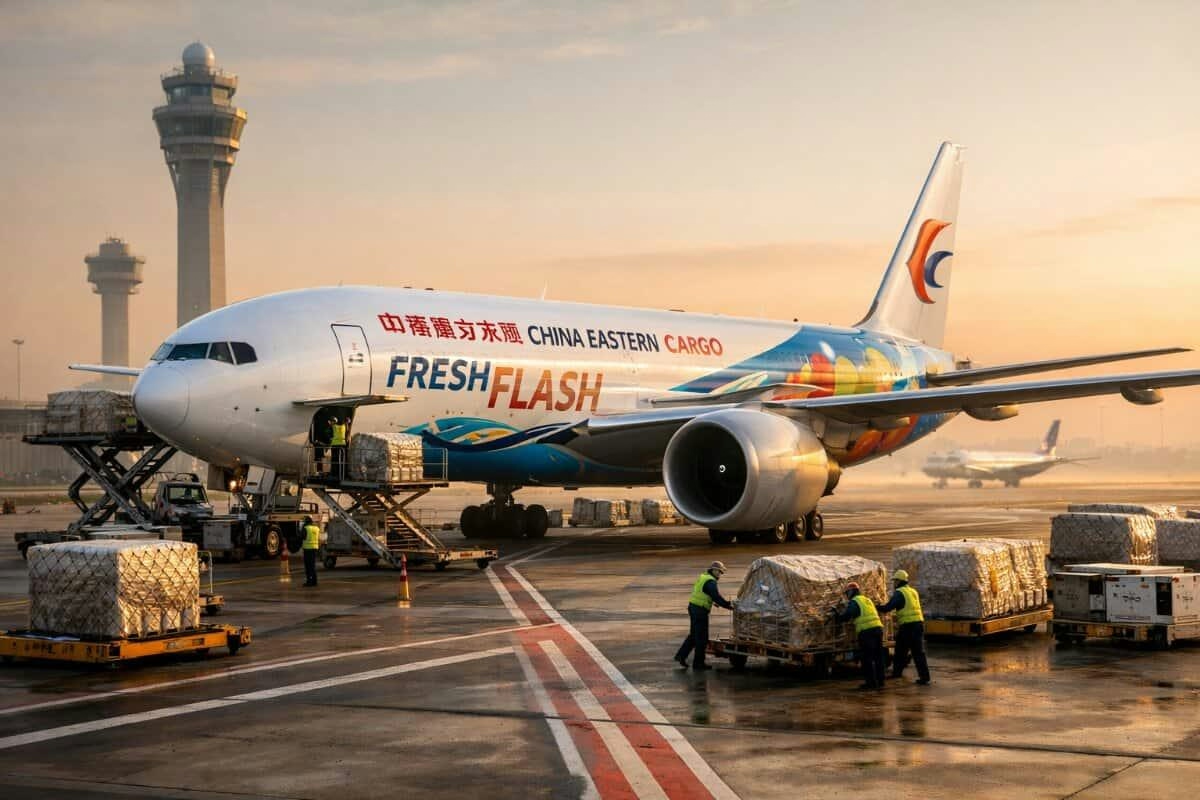
China Eastern Airlines Cargo Expands Freighter Fleet with New “Fresh Flash” Aircraft at Shanghai Pudong

China Eastern Airlines Cargo has unveiled its newly branded “Fresh Flash” special-livery aircraft at Shanghai Pudong International Airport, marking a significant expansion of its all-cargo fleet to 20 aircraft. This development underscores the airline’s strategic commitment to strengthening its position in the global air freight market and highlights the increasing importance of cargo operations in supporting international travel supply chains and connectivity.

The introduction of the Fresh Flash aircraft at one of Asia’s busiest aviation hubs emphasizes the vital role that air cargo plays in sustaining modern travel ecosystems. Air freight facilitates the transport of a wide range of goods, from tourism-related products and hospitality supplies to medical shipments and time-sensitive retail items, ensuring the smooth functioning of global travel and tourism infrastructure.

Enhancing Global Supply Chains and Navigating Market Competition

The addition of the Fresh Flash aircraft represents more than a mere fleet upgrade; it reinforces the essential supply chains that support airlines, airports, hotels, and tourism operators worldwide. As global travel demand continues to recover and diversify, maintaining uninterrupted cargo flows is critical to ensuring the availability of aircraft cabin supplies, inflight catering, hotel essentials, and retail merchandise. Expanding to 20 dedicated cargo aircraft enhances China Eastern’s operational resilience, providing greater scheduling flexibility and improved capacity to manage seasonal surges in tourism-related logistics. However, this growth also introduces challenges, particularly in meeting the rising demand for maintenance, repair, and overhaul (MRO) services as the fleet expands.

China Eastern’s fleet expansion occurs amid intensifying competition within the air cargo sector. The airline’s launch of a thrice-weekly Airbus A350-900 freighter service between Shanghai Pudong and Zurich positions it in direct competition with Swiss International Air Lines on a key international route. Concurrently, competitors are bolstering their capabilities: Cathay Pacific has extended its order commitment to eight Airbus A350 freighters, while China Airlines is acquiring two additional Boeing 777 freighters to replace aging aircraft and enhance operational efficiency. These developments reflect a dynamic market environment where airlines are investing in fleet modernization and route expansion to capture growing demand and maintain competitive advantage.

Shanghai Pudong’s Role in Global Aviation and the Symbolism of Fresh Flash

Shanghai Pudong International Airport functions as both a major passenger hub and a high-volume cargo gateway. The arrival of the Fresh Flash aircraft further solidifies its status as a central node in global aviation, facilitating seamless integration between passenger and freight operations. Efficient cargo throughput at Pudong supports a broad spectrum of supply chains, including duty-free retail and hotel procurement networks, thereby ensuring uninterrupted travel experiences.

The Fresh Flash special livery, designed to evoke speed, freshness, and precision, symbolizes the evolving identity of air cargo carriers within the global travel economy. As airlines increasingly leverage branding to engage international markets, the Fresh Flash aircraft serves as a visual representation of China Eastern’s dedication to innovation and global connectivity. With its expanded fleet and renewed focus on operational excellence, China Eastern Airlines Cargo is positioned to play a pivotal role in shaping the future of international air logistics and travel supply chains.

More news
EgyptAir Extends Boeing Health Management Agreement

EgyptAir Extends Boeing Health Management Agreement

EgyptAir Extends Boeing Health Management Agreement Amid Regional Challenges EgyptAir Maintenance & Engineering has announced an expansion of its partnership with Boeing through the implementation of Boeing’s Airplane Health Management (AHM) system across its growing Boeing 737 MAX fleet. The agreement was formalized at the 2026 El-Alamein International Airshow, where Mohamed Samy, Chairman and CEO of EgyptAir Maintenance & Engineering, and Dave McKenna, Boeing Global Services’ Regional Managing Director of Sales for the Middle East and Africa, signed the deal in the presence of Ahmed Adel, Chairman and CEO of EgyptAir Holding. Enhancing Fleet Monitoring and Maintenance The AHM system provides continuous, real-time monitoring of aircraft conditions, utilizing predictive analytics to reduce unscheduled delays, improve parts planning, and optimize maintenance, repair, and overhaul (MRO) operations. EgyptAir has already integrated AHM technology for its Boeing 787 and 777 fleets, and this latest agreement extends the system’s application to its expanding 737-8 fleet, which is set to reach 18 aircraft. Navigating Industry and Regional Uncertainties This extension comes amid a period of significant uncertainty for the Middle Eastern aviation sector. Regional conflicts have contributed to rising fuel costs and potential disruptions to flight routes, creating operational and financial pressures for carriers such as EgyptAir. Furthermore, the airline’s continued reliance on Boeing technology faces scrutiny due to ongoing labor disputes at Boeing’s manufacturing facilities, which threaten to affect aircraft deliveries and after-sales support. Market analysts suggest that EgyptAir’s deepening collaboration with Boeing may attract critical attention, especially as some competing Middle Eastern airlines explore alternative maintenance providers or adopt different technologies to reduce their dependence on Boeing and mitigate supply chain risks. Despite these challenges, EgyptAir’s leadership underscores the importance of advanced health management systems in maintaining operational efficiency and fleet reliability. The airline asserts that leveraging Boeing’s AHM solution is vital to minimizing disruptions and upholding high standards of safety and service within a complex and evolving regional environment.
Scaling Agentic AI in Asia-Pacific Airlines

Scaling Agentic AI in Asia-Pacific Airlines

Scaling Agentic AI in Asia-Pacific Airlines Across the Asia-Pacific airline industry, senior executives are confronting the rapid advancement of artificial intelligence and its profound transformative potential. While enthusiasm for AI remains high, there is considerable variation in expectations, attitudes, and concerns among leadership. The swift pace of technological change is outstripping many organizations’ capacity to adapt, compelling airlines to reconsider their operating models and organizational structures to remain competitive. Investment and Confidence in AI Recent research by KPMG underscores the magnitude of investment in AI within the region. Large companies anticipate spending an average of US$245 million on AI initiatives over the coming year, significantly surpassing the global average of US$186 million. Confidence in AI’s capabilities is also notably strong, with 40% of Asia-Pacific companies expecting AI agents to autonomously manage specific projects within two to three years, compared to just 30% globally. For airlines, agentic AI—defined as AI systems capable of autonomous decision-making—holds the promise of revolutionizing processes ranging from end-to-end trip planning to customer service. However, the aviation sector’s inherent complexity, stringent regulatory environment, and dependence on trust present substantial challenges to large-scale AI adoption. Despite mounting pressure to innovate, many airlines find it difficult to scale AI effectively, often impeded by legacy systems and the rapid pace of technological evolution. Challenges and Industry Responses Cybersecurity has emerged as a critical concern amid the rise of AI-driven threats. The sophisticated hacking capabilities of AI agents have prompted a surge in security expenditures, highlighting the urgent need for robust safeguards as airlines expand their AI applications. In this context, industry leaders such as Cathay Pacific are advancing AI trials in collaboration with partners like Google. These initiatives explore a range of applications, from enhancing operational efficiency to mitigating environmental impacts, including efforts to reduce contrail formation. Practical Recommendations for Scaling Agentic AI To scale agentic AI safely and responsibly, five key recommendations have been identified. First, airlines should prioritize high-impact workflows that yield quick, measurable returns. For example, automating call center operations with AI voice agents to handle routine tasks—such as modifying return flights—can reduce wait times and allow staff to focus on more complex issues, thereby building internal confidence and establishing a foundation for broader AI integration. Second, strengthening data foundations is essential. The effectiveness of agentic AI depends on access to high-quality, well-structured data. Airlines must ensure that operational data is comprehensively captured and accessible, often through data lakes, and that application programming interfaces (APIs) are re-engineered to be AI-compatible. Additionally, fine-tuning generic AI models to comprehend aviation-specific language is critical. Third, assessing integration readiness and scaling gradually is vital. Airlines should map out the applications, data sources, and dependencies that AI agents will utilize, evaluating whether data is complete, available in real time, and securely accessible. Initial deployments should focus on lower-risk, human-assisted workflows, expanding as performance and governance controls mature. Fourth, modernizing organizational structures is necessary to support accelerated AI adoption. This involves evolving organizational models and processes to accommodate new ways of working, fostering cross-functional collaboration, and ensuring governance frameworks keep pace with technological advancements. Finally, prioritizing cybersecurity remains non-negotiable. With AI-driven threats increasing, airlines must invest in advanced security protocols and continuous monitoring to protect sensitive data and maintain stakeholder trust. As Asia-Pacific airlines navigate the complexities of agentic AI, their success will hinge on balancing innovation with responsibility, ensuring that technology, people, and processes evolve in concert to unlock AI’s full potential.
Japan Airlines Begins Autonomous Drone Inspections

Japan Airlines Begins Autonomous Drone Inspections

Japan Airlines Introduces Autonomous Drone Inspections for Aircraft Maintenance Japan Airlines (JAL) has embarked on a pioneering initiative by integrating fully autonomous drones into its aircraft maintenance procedures, marking a first in Japan’s aviation industry. In collaboration with French drone manufacturer Donecle, JAL has deployed the Iris GVI drones, which are officially approved in aircraft manufacturers’ maintenance manuals, to conduct exterior inspections within its maintenance hangars. This technological advancement aims to enhance both the safety and efficiency of routine aircraft inspections. Enhancing Maintenance Efficiency and Safety The Iris GVI drones operate autonomously to capture high-resolution images of aircraft exteriors, enabling maintenance personnel to conduct thorough visual assessments without the need for manual inspections at elevated heights. This innovation is expected to significantly reduce the time required for inspections, allowing maintenance teams to allocate more resources toward predictive maintenance activities. By facilitating detailed and precise defect mapping through integrated image-analysis tools, the drones assist in identifying and measuring potential issues with greater accuracy, thereby contributing to improved aircraft quality and operational reliability. Since late June 2026, JAL has been rigorously evaluating the performance of drone-assisted inspections by comparing their results with those obtained through traditional visual checks. The drones are equipped with advanced obstacle-detection technology, ensuring safe and contactless navigation around aircraft regardless of the operator’s skill level. This capability underscores the potential for autonomous systems to maintain high safety standards while streamlining maintenance workflows. Challenges and Industry Implications Despite the promising benefits, the adoption of autonomous drone inspections introduces several challenges. Regulatory compliance remains a critical concern as aviation authorities deliberate on integrating autonomous technologies within existing safety frameworks. Furthermore, public perception and acceptance of drone use in aircraft maintenance could influence the rate at which such innovations are embraced across the industry. JAL’s initiative is likely to stimulate interest among competitors, prompting other airlines and maintenance providers to accelerate their own drone inspection programs or consider counter-drone strategies. With the global drone-services market projected to expand rapidly, the balance between innovation and safety will become a defining factor in the sector’s evolution. By adopting autonomous drone technology, Japan Airlines not only positions itself at the forefront of maintenance innovation within Japan but also exemplifies the broader transformation of aircraft servicing. Automation and data-driven processes are increasingly central to the future of aviation maintenance, signaling a shift toward more efficient and technologically advanced operations.
Alliance Air flight makes emergency landing at Delhi airport after engine failure

Alliance Air flight makes emergency landing at Delhi airport after engine failure

Alliance Air Flight Makes Emergency Landing at Delhi Airport Following Engine Failure An Alliance Air flight was forced to make an emergency landing at Delhi airport on Friday afternoon after experiencing an engine malfunction mid-flight. The ATR 72-600 aircraft, operating as flight 9I 698, was carrying approximately 40 passengers and crew members when one of its engines became inoperative, according to sources cited by news agency PTI. Safe Landing and Immediate Aftermath The aircraft touched down safely at around 2:15 pm, as confirmed by the flight tracking website Flightradar24. Authorities reported no injuries among those onboard. At the time of reporting, Alliance Air had not released an official statement regarding the incident. Regulatory and Industry Implications This emergency landing is likely to attract scrutiny from aviation safety authorities, who may initiate regulatory investigations to determine the cause of the engine failure. Such incidents typically prompt a thorough review of airline maintenance and operational procedures, with regulators assessing whether existing safety standards were adequately followed. In recent years, similar engine failures have led to regulatory reassessments and, in some cases, revisions to maintenance protocols for the affected aircraft models. The incident may also have repercussions for Alliance Air’s market reputation. High-profile safety events often result in temporary declines in passenger confidence, and the airline could face increased insurance premiums. Competitors may seize the opportunity to highlight their own safety records and operational reliability amid heightened public concern. As investigations continue, the primary focus remains on ensuring passenger safety and upholding stringent oversight of airline operations.
Alliance Air plane makes emergency landing at Delhi airport after engine failure

Alliance Air plane makes emergency landing at Delhi airport after engine failure

Alliance Air Flight Executes Emergency Landing at Delhi Airport Following Engine Failure An Alliance Air flight carrying approximately 40 passengers was forced to make an emergency landing at Indira Gandhi International Airport in Delhi on Friday afternoon after experiencing an engine failure mid-flight. The aircraft, operating as flight 9I 698, was traveling from Prayagraj to Delhi aboard an ATR 72-600, a twin-engine turboprop. Incident Overview and Response The emergency was triggered when one of the aircraft’s engines became inoperative during the journey. Despite this technical malfunction, the flight crew managed to safely land the plane at approximately 2:15 pm, according to data from the flight tracking service Flightradar24.com. There were no reported injuries among the passengers or crew members, underscoring the effectiveness of the pilots’ response to the situation. Alliance Air has yet to release an official statement regarding the incident. However, the successful handling of the emergency highlights the importance of rigorous pilot training and adherence to established aviation safety protocols. Similar recent events, such as the emergency landing of a Coast Guard plane carrying Homeland Security Secretary Markwayne Mullin, have demonstrated how prompt communication between pilots and air traffic controllers is vital in managing in-flight emergencies and ensuring passenger safety. Aviation Safety and Technical Considerations Aviation experts emphasize that while engine failures in commercial flights are uncommon, pilots undergo extensive training to manage such scenarios. The ATR 72-600 is engineered to operate safely on a single engine if necessary, enabling pilots to perform controlled landings even under adverse conditions. This design feature plays a crucial role in mitigating risks during engine-related emergencies. Incidents of this nature typically lead to thorough reviews of airline maintenance practices and operational procedures. However, immediate reactions from the market or competitors tend to be restrained unless the event reveals broader safety issues. At present, attention remains focused on the proficient response of the flight crew and the wellbeing of those onboard. Further information is anticipated as Alliance Air and relevant aviation authorities continue their investigation into the circumstances surrounding the engine failure and emergency landing.
GE Aerospace and WZL-2 to Collaborate on F404-GE-102 Engine Support

GE Aerospace and WZL-2 to Collaborate on F404-GE-102 Engine Support

GE Aerospace and WZL-2 Collaborate on F404-GE-102 Engine Support for Poland’s FA-50 Fleet Partnership to Enhance Maintenance Capabilities GE Aerospace and Poland’s Military Aviation Works No. 2 (WZL-2) have formalized a memorandum of understanding aimed at developing maintenance, repair, and overhaul (MRO) as well as depot-level maintenance capabilities for the F404-GE-102 engine. This engine powers Poland’s fleet of KAI FA-50 fighter jets. The agreement was announced at the MSPO international defence industry exhibition held in Kielce, Poland. The memorandum outlines a joint effort to evaluate the requirements necessary to establish comprehensive F404-GE-102 engine maintenance operations at WZL-2’s facilities. This initiative supports Poland’s recent procurement of 48 FA-50 light combat aircraft from South Korea’s Korea Aerospace Industries (KAI). The initial delivery of 12 aircraft in 2023, configured as FA-50GF “Gap Filler” variants, will be followed by 36 additional units in the FA-50PL configuration. Scope and Industry Context The proposed support framework will encompass all 48 F404-GE-102 engines associated with the aircraft order, including spare engines. GE Aerospace notes that over 4,000 F404 engines have been delivered worldwide, collectively logging more than 13 million flight hours. Approximately 300 of these engines currently power the T-50, TA-50, and FA-50 Golden Eagle aircraft produced by KAI. This collaboration emerges amid broader challenges and evolving dynamics within the military aerospace sector. The U.S. Navy’s repeated delays in awarding new military trainer contracts could affect demand and scheduling for F404 engine support services. Additionally, the ongoing competition for military trainer contracts—where both the T-50 and Boeing-Saab T-7, each equipped with GE’s F404 engine, are contenders—may influence strategic planning and market responses for both GE Aerospace and WZL-2. Competitive Landscape and Strategic Implications Competitors are actively responding to these market developments. Rolls-Royce, for instance, has invested heavily in upgrading its Indianapolis engine facility to bolster its military program capabilities, signaling heightened competition in the military engine support sector. Meanwhile, GE Aerospace continues to advance the qualification of its T901 turboshaft engine and maintains a robust position within the broader aerospace engine market. As GE Aerospace and WZL-2 proceed with their assessment, the results could significantly impact Poland’s long-term fighter jet support infrastructure. Furthermore, this partnership may influence the competitive environment for military engine maintenance across Europe.
PD-35 Trails GE9X in Fuel Efficiency but Holds Symbolic Significance

PD-35 Trails GE9X in Fuel Efficiency but Holds Symbolic Significance

PD-35 Trails GE9X in Fuel Efficiency but Holds Symbolic Significance The Russian PD-35 engine, currently in development for heavy wide-body aircraft, marks a notable advancement for Russia’s aviation sector. Engineered to deliver up to 35 tons of take-off thrust, the PD-35’s design concept aligns closely with that of leading Western engines. However, when measured by specific fuel consumption—a critical economic metric in civil aviation—the PD-35 remains behind its American counterpart, the General Electric GE9X. Performance and Efficiency Comparison In cruise conditions, the PD-35’s specific fuel consumption is estimated between 0.51 and 0.53 kilograms per kilogram-force per hour (kg/kgf·h), whereas the GE9X achieves a more efficient range of 0.49 to 0.52 kg/kgf·h. This measurement reflects the amount of fuel burned per hour to generate one kilogram-force of thrust. Despite the GE9X’s larger physical dimensions, including a 3.4-meter fan and thrust capacity up to 49 tons, it demonstrates superior efficiency per unit of thrust. Even marginal differences in fuel consumption can lead to substantial operational cost variations over time, particularly in the ultra-long-range business jet segment where competition is intense. Engineering Priorities: Balancing Reliability and Efficiency The GE9X attains its fuel efficiency through advanced engineering features such as a high compression ratio of 60:1 and the incorporation of ceramic matrix composites in its hot section. These innovations enable the engine to operate at elevated temperatures, maximizing thermodynamic efficiency. In contrast, Russian engineers have emphasized reliability in the PD-35’s design by maintaining a cooler gas generator. This approach reduces thermal stress, potentially extending engine lifespan and simplifying maintenance. The PD-35 employs a simpler two-shaft configuration and a high bypass ratio of 11:1, optimizing thrust generated from external airflow. This design philosophy results in a modest fuel consumption penalty, with the PD-35 consuming up to 8% more fuel at its upper range compared to the GE9X’s minimum. Market Implications and Symbolic Importance The engineering choices embedded in the PD-35 carry significant market implications. As airlines and aircraft manufacturers increasingly prioritize fuel efficiency, the PD-35 faces challenges competing against the GE9X, especially in markets where operational costs are a decisive factor. This dynamic may shift demand toward more fuel-efficient engines, potentially affecting PD-35 sales. Meanwhile, GE Aerospace is positioned to strengthen the GE9X’s market dominance by continuing to introduce technological enhancements that improve efficiency. Beyond performance metrics, the PD-35 holds considerable symbolic value for Russia. Its development represents a statement of technological independence and national pride. For certain buyers who prioritize brand heritage and maintainability over marginal improvements in fuel efficiency, the PD-35’s robust and balanced design may offer distinct appeal. A Practical Alternative in a Competitive Landscape While the PD-35 may not establish new benchmarks in fuel efficiency, its pragmatic engineering approach provides a maintainable and reliable alternative to the technologically advanced and costly GE9X. As the global aviation market continues to evolve, the PD-35’s symbolic significance and operational dependability could prove as influential as its technical specifications.
Balancing Innovation and Safety in HEMS Interior Design

Balancing Innovation and Safety in HEMS Interior Design

Balancing Innovation and Safety in HEMS Interior Design The design of Helicopter Emergency Medical Service (HEMS) interiors is undergoing significant transformation, driven by the dual imperatives of innovation and safety. These airborne medical environments must cater to the complex needs of both patients and medical crews, accommodating a spectrum of equipment ranging from basic medical supplies to highly specialized devices used by doctors and paramedics. At their most advanced, HEMS interiors operate as flying Intensive Care Units (ICUs), yet their configurations are shaped by a multifaceted set of factors including patient requirements, operational concepts, climate, geography, population distribution, and the inherent constraints of aircraft space and weight. Navigating the Challenges of Innovation and Safety Striking the right balance between cutting-edge technology and uncompromising safety standards presents a multifaceted challenge for designers and manufacturers. The integration of new medical technologies often increases system complexity, necessitating user-friendly interfaces that enable medical crews to perform efficiently under pressure. Moreover, regulatory frameworks continue to evolve in response to technological advancements, compelling manufacturers to remain agile and proactive in ensuring compliance. While innovation promises enhanced capabilities, it must not come at the expense of established safety protocols. Market responses to these innovations remain mixed. Some operators and end-users embrace advanced features enthusiastically, recognizing their potential to improve patient outcomes. However, skepticism persists regarding the safety and reliability of unproven technologies, influencing purchasing decisions and heightening demand for robust safety assurances. Within this competitive landscape, HEMS providers may either adopt similar safety measures to meet market expectations or accelerate their innovation cycles to secure a competitive advantage. Industry Perspectives on Balancing Innovation and Safety Leading industry practitioners offer diverse approaches to managing the tension between innovation and safety in HEMS interiors. Aerolite focuses on lightweight, ergonomic designs that support advanced critical care equipment, working closely with operators to tailor solutions that enhance safety and usability across a variety of medical missions. Gama Aviation provides a comprehensive service model encompassing the identification of commercial off-the-shelf (COTS) equipment, design, production, and turnkey HEMS programs. Their integrated approach extends beyond outfitting aircraft to managing flight operations, facilitating the seamless incorporation of new technologies within established safety frameworks. Bucher, with its experience spanning automotive, railway, and aviation sectors, delivers versatile EMS systems including quick-change helicopter interiors. This cross-industry expertise informs a design philosophy that emphasizes adaptability alongside rigorous safety standards. United Rotorcraft operates as a mission system designer and integrator across multiple airborne operations such as law enforcement, search and rescue, aerial firefighting, corporate aviation, and HEMS. Their mission-specific customization ensures that safety remains paramount even as they integrate the latest technological advancements. As HEMS interiors continue to evolve, the industry’s capacity to harmonize innovation with safety will remain a critical determinant of success. Achieving this balance requires close collaboration among aviation, medical, and engineering experts, alongside vigilant attention to regulatory developments and market demands. In this high-stakes environment, the overarching objective is unequivocal: to deliver life-saving care in the air without compromising safety.
South Korea Begins Independent Aircraft Engine Development, Experts Urge Joint Collaboration First

South Korea Begins Independent Aircraft Engine Development, Experts Urge Joint Collaboration First

South Korea Pursues Independent Aircraft Engine Development Amid Calls for Joint Collaboration South Korea is intensifying efforts to develop indigenous aircraft engine technology, a move that reflects the country’s growing ambitions within the global defense industry. However, industry experts caution that pursuing full independence in this highly complex field without initial collaboration may pose significant risks. They advocate for a phased approach that begins with joint development alongside established international partners to mitigate costs, technical challenges, and development timelines. Challenges and Expert Perspectives on Engine Self-Reliance Kim Young-je, president of GE Aerospace Korea, expressed strong support for South Korea’s goal of achieving “engine self-reliance” but emphasized the necessity of a collaborative foundation. In a recent interview, Kim highlighted the immense technical and financial demands of developing advanced aircraft engines capable of operating under extreme conditions exceeding 1,800 to 1,900 degrees Celsius. He noted that such projects typically require over a decade of intensive research and development, underscoring the value of partnering with experienced global firms. “Collaborating initially with a proven global partner like GE Aerospace allows South Korea to acquire critical expertise, lowering risks and increasing the likelihood of success,” Kim stated. He pointed to the example of Japan, which despite early investments in engine development, continues to face significant challenges in producing high-performance engines. Similarly, South Korea’s success with the Nuri (KSLV-II) space launch vehicle was achieved through initial cooperation with Russia, illustrating the benefits of strategic partnerships in complex aerospace projects. The hurdles confronting South Korea’s independent engine program are substantial. High development costs, technological complexities, and the extensive testing and certification processes required have generated skepticism among investors and analysts regarding the project’s feasibility and timeline. Additionally, the competitive landscape is evolving, with other nations potentially accelerating their own collaborative or independent development efforts to maintain technological superiority. GE Aerospace’s Role and the Case for Joint Development GE Aerospace has a well-established record of successful joint ventures, including its 50-50 partnership with France’s Safran to produce the LEAP engine, one of the world’s best-selling aircraft engines. The company regards South Korea as a strategic market, with over 1,600 GE Aerospace military engines currently deployed across the Republic of Korea Air Force and Navy. Key defense platforms such as the KAI KF-21 Boramae fighter jet, KAI T-50 Golden Eagle trainer, KUH-1 Surion helicopter, and Sejong the Great-class destroyers rely on GE Aerospace engines. Kim revealed that GE Aerospace has proposed joint development initiatives with South Korean partners to create high-performance engines. He described this collaborative model as optimal for both countries, enabling them to jointly explore global export markets while minimizing the burdens associated with redesign and development. Addressing concerns related to U.S. International Traffic in Arms Regulations (ITAR), Kim clarified that such partnerships can be structured to facilitate international sales without undue restrictions. The relationship between GE Aerospace and South Korea’s defense industry has evolved beyond a traditional supplier-customer framework to encompass production and export collaboration. Kim highlighted the company’s longstanding partnership with Hanwha Aerospace and its integration with a robust South Korean supply chain involving approximately 70 local firms. In addition to military applications, GE Aerospace is expanding its presence in South Korea’s civil aviation sector by providing digital fuel-saving solutions to domestic airlines and planning further cooperation with major carriers such as Korean Air and Asiana Airlines. As South Korea deliberates its strategic direction, experts continue to emphasize the importance of leveraging global expertise through joint development before embarking on the costly and technically demanding path toward fully independent aircraft engine production.
GTA Holdings Secures Safran Helicopter Engines Distributorship in Brunei

GTA Holdings Secures Safran Helicopter Engines Distributorship in Brunei

GTA Holdings Secures Safran Helicopter Engines Distributorship in Brunei Strategic Expansion into Brunei KUALA LUMPUR — GTA Holdings Bhd has officially expanded its regional presence by securing a distributorship for selected Safran Helicopter Engines products and services in Brunei. This development follows the initial announcement in July when GTA’s subsidiary signed a memorandum of understanding with Safran Helicopter Engines Asia to extend their partnership beyond Malaysia. The formal distributor agreement, signed by GTA’s wholly-owned unit Global Turbine Asia Sdn Bhd, authorizes the company to market and support Safran helicopter engine products and services within Brunei, thereby reinforcing GTA’s footprint in Southeast Asia. Strengthening Partnerships and Regional Presence Datuk Nonee Ashirin Mohd Radzi, managing director and chief executive officer of GTA, emphasized that the appointment reflects Safran’s confidence in GTA’s technical expertise and operational standards, cultivated through years of collaboration. She described the agreement as a significant milestone that not only deepens GTA’s relationship with Safran but also enhances its commitment to delivering reliable aerospace support solutions and advancing aviation capabilities in the region. According to Nonee, the partnership underscores a shared dedication to supporting customers and strengthening the aviation sector across Southeast Asia. Challenges and Market Outlook Despite the promising prospects, GTA’s entry into Brunei presents several challenges. The company must navigate the regulatory framework governing Brunei’s aviation sector, ensuring full compliance with both local and international standards. Additionally, servicing a relatively small market introduces logistical complexities that will require careful management. Market reactions to GTA’s expansion have been mixed; while some investors view the move as a strategic diversification and growth opportunity, others remain cautious due to the competitive environment and potential market saturation in Brunei. Industry competitors may respond by intensifying their presence or enhancing their offerings to protect market share. Company Profile and Regional Context GTA Holdings specialises in maintenance, repair, and overhaul (MRO) services for helicopter and fixed-wing aircraft engines, parts, and components. Its operations are based at the Helicopter Centre at Sultan Abdul Aziz Shah Airport in Subang, serving a diverse clientele that includes aviation operators, MRO customers, and defence-related markets. Safran Helicopter Engines Asia, headquartered in Singapore, supports over 200 operators and more than 1,100 helicopter engines across 19 countries in Asia, positioning it as a key player in the regional aerospace industry.
line









