
AeroGenie — Ваш интеллектуальный второй пилот.

В тренде
Categories
Chinese Rival Challenges Joby and Archer Aviation's Market Prospects
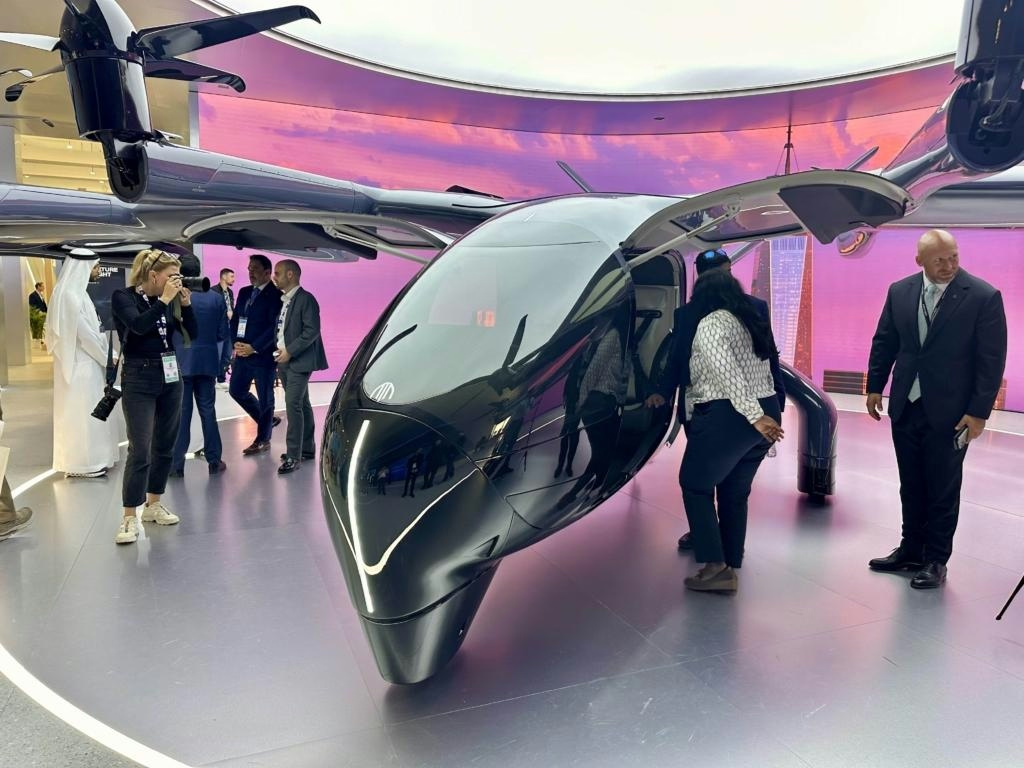
Chinese Rival Challenges Joby and Archer Aviation's Market Prospects
The emerging market for electric vertical takeoff and landing vehicles (eVTOLs) is witnessing a significant shift as a Chinese competitor challenges the established focus of U.S.-based startups Joby Aviation and Archer Aviation. While these American companies have concentrated primarily on developing passenger air taxi services, a new freight-oriented approach from China is reshaping the competitive landscape and raising questions about the future direction of the industry.
The Passenger Air Taxi Model Under Scrutiny
Joby and Archer have championed eVTOLs as urban air taxis designed to transport passengers swiftly between city centers and airports, promising reduced travel times and quieter, more environmentally friendly alternatives to helicopters. Despite these advantages, the model faces considerable obstacles. The high initial costs and uncertain maintenance expenses pose financial challenges, while the service competes directly with existing helicopter operations, which remain a niche luxury market. Moreover, for many travelers in the United States, driving to the airport remains a practical, if inconvenient, option, limiting the immediate appeal of air taxis.
In more remote or geographically challenging regions such as parts of Kazakhstan and Serbia—where Joby and Archer have secured early customers—the lack of infrastructure for both ground and air travel presents a potential opportunity for eVTOLs. However, the demand for small, short-range passenger aircraft in these areas remains uncertain, leaving the long-term viability of the air taxi concept open to question.
Autoflight’s Freight-Centric Disruption
Contrasting with the passenger-focused strategies of Joby and Archer, Chinese company Autoflight is pioneering a freight-first approach to eVTOL technology. Its Matrix V5000, recently demonstrated in a test flight, is promoted as the world’s first 5-ton eVTOL capable of carrying heavy cargo loads beyond the capacity of traditional helicopters. Autoflight aims to streamline logistics by transporting freight directly from origin to destination, thereby reducing the need for multiple handling stages and lowering associated costs.
This freight-centric model may prove more sustainable and commercially viable, particularly in regions where infrastructure is underdeveloped. By addressing a tangible logistical challenge rather than a luxury transport niche, Autoflight’s strategy introduces a new dimension to the eVTOL market that could disrupt the passenger air taxi narrative.
Legal and Regulatory Challenges Complicate the Market
Amid intensifying competition, Joby and Archer are also entangled in legal and regulatory disputes that threaten to undermine their market positions. Archer has accused Joby of misrepresenting its business operations and relationships in China, including allegations of customs violations related to import documentation. These claims have prompted an investigation by the U.S. International Trade Commission into Joby’s import practices following Archer’s formal complaint.
Further complicating matters, Archer alleges that Joby has mischaracterized itself as a domestically based U.S. company while relying heavily on a Chinese subsidiary for critical components. These legal battles introduce significant uncertainty regarding both companies’ ability to secure government contracts and maintain competitive advantages, especially as U.S. authorities increase scrutiny of foreign supply chains and corporate affiliations within the aerospace sector.
Navigating a Shifting Competitive Landscape
As Autoflight’s freight eVTOLs gain momentum and legal disputes escalate, Joby and Archer confront a rapidly evolving market environment. The future trajectory of eVTOL technology may hinge not only on advances in passenger and freight transport but also on regulatory decisions and international competitive dynamics. The coming years will be critical in determining whether the industry’s growth is driven by technological innovation, strategic market positioning, or the resolution of complex legal and geopolitical challenges.
The Most Fuel-Efficient Widebody Aircraft in Commercial Service in 2026

Corrosion Caused Engine Failure in Naples Jet Crash, Final Report Finds
Marina Council and Airport Commission Approve Joby Ground Lease
The Design Rationale Behind Airbus’s A321XLR Cabin Architecture
Boeing Sticks to 787 Delivery Goal Despite Seat and Engine Delays
JetBlue’s New York Slots, Mint Fleet, and A321XLR Orders Position It as an Acquisition Target
Black Forest Ventures Acquires MAC Air Group

Rep. Laura Gillen Questions NASA Administrator on Aviation Noise and Space Innovation

Two Small Planes in Pennsylvania Crashes Shared Engine Manufacturer, Records Show
The Resurgence of the Airbus A380
