
Превращайте аналитические выводы ИИ в реальные действия

В тренде
Categories
Comparing the A321XLR and Tu-214: Strengths and Suitable Uses
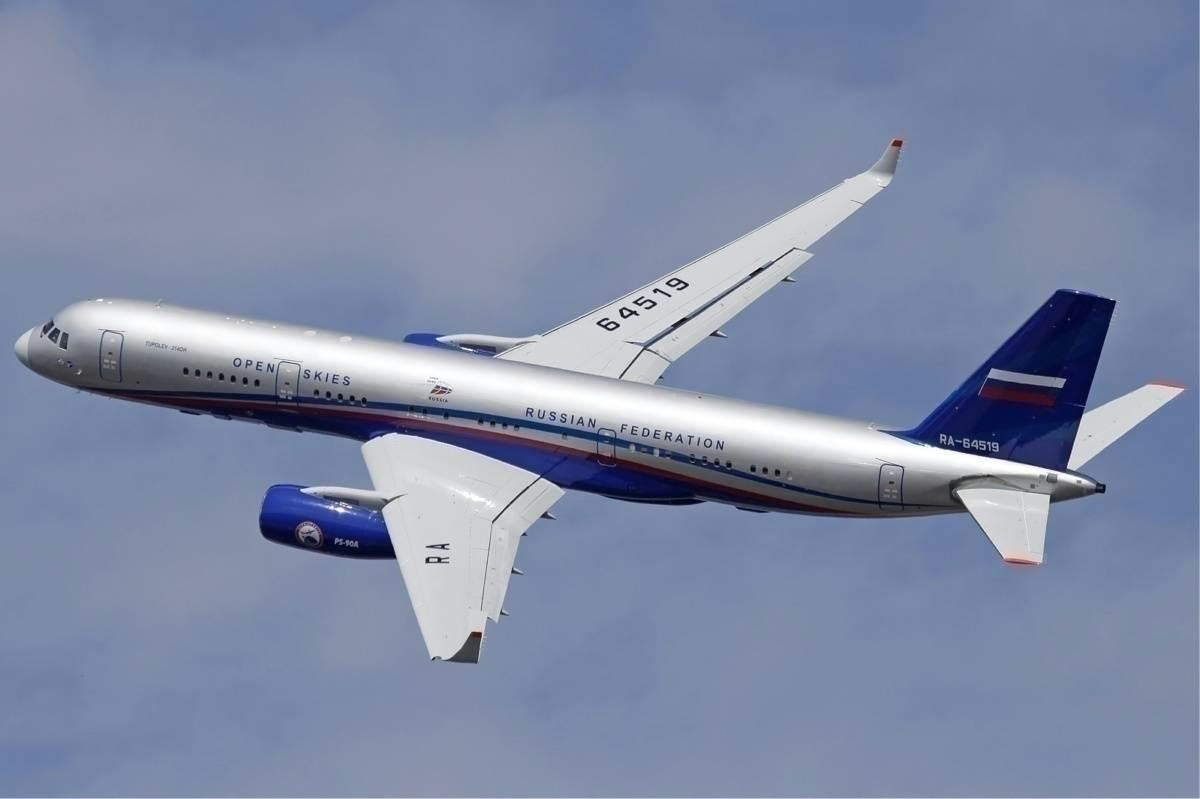
Comparing the A321XLR and Tu-214: Strengths and Suitable Uses
The Airbus A321XLR and Russia’s Tu-214 are frequently compared due to their positioning between traditional narrowbody jets and larger long-haul aircraft. However, a detailed examination of their specifications and operational deployment reveals significant differences that influence their suitability for various airline needs.
Range and Operational Realities
The Tu-214 is generally reported to have a range of approximately 6,500 kilometers, whereas the A321XLR boasts a published range of 8,700 kilometers. These headline figures, however, do not fully capture the operational realities faced by airlines. Actual range is influenced by multiple factors including passenger load, baggage, cargo, and fuel requirements. The A321XLR was specifically designed to open long-distance routes that do not justify the use of widebody aircraft. Airbus markets it as a “route opener,” capable of connecting both primary and secondary cities, particularly in markets where operating larger jets would be economically impractical. Its modern engines, advanced fuel system, and a maximum takeoff weight (MTOW) of 101.5 tonnes extend the capabilities of the single-aisle aircraft into the long-haul domain.
Capacity: More Than Just Seats
While Airbus lists the A321XLR’s maximum seating capacity at 244 passengers, this figure corresponds to a high-density, single-class layout that is rarely employed on long-haul flights. Most airlines prefer two-class configurations, typically accommodating between 206 and 220 passengers. This distinction is critical because long-range flights require additional space for catering, water, crew equipment, reserve fuel, and sometimes cargo, all of which reduce the available payload for passengers.
Real-world airline configurations demonstrate this variability. For instance, Wizz Air’s A321XLRs are outfitted with 239 seats in a high-density arrangement, whereas Air Canada’s version features only 182 seats, including 14 full-flat business-class seats. Consequently, the effective passenger capacity of the A321XLR ranges widely, from around 206 to 220 seats in a standard two-class layout, up to 239 in high-density configurations, or fewer in premium-focused setups.
Range Versus Payload: The Real-World Tradeoff
The A321XLR’s official specifications include a maximum range of 8,700 kilometers and an MTOW of 101.5 tonnes, supported by a permanent rear center fuel tank holding 12,900 liters, with an optional forward tank available. However, maximum range, payload, and fuel capacity are interdependent variables. Increasing fuel load reduces the weight available for passengers and cargo. Industry analyses indicate that high-density seating configurations (230–240 seats) cannot achieve the aircraft’s full theoretical range when operating near maximum payload, underscoring the tradeoff between range and capacity.
Market Impact and Competitive Edge
The A321XLR has empowered airlines to inaugurate new long-haul routes that were previously unfeasible with narrowbody aircraft. United Airlines and American Airlines, for example, have introduced nine new international routes utilizing the XLR. United plans to deploy the aircraft on five additional international routes in 2027, including destinations such as Ibiza, Valencia, Marseille, Toulouse, and Luxembourg City. The A321XLR’s integration within the A320 family also facilitates streamlined pilot and crew training, enhancing its appeal to airlines already operating Airbus narrowbodies.
In contrast, the Tu-214, a Russian twinjet, has not played a significant role in recent international market developments. Its shorter range and limited adoption suggest it is less competitive in the long-haul segment compared to the A321XLR.
Conclusion
Although both the A321XLR and Tu-214 occupy the intermediate space between narrowbody and widebody aircraft, the A321XLR’s extended range, operational flexibility, and seamless integration into existing fleets have established it as the preferred option for airlines seeking to open new long-haul routes. The Tu-214 remains less prominent and less competitive within this evolving market segment.

Etihad Airways Suspends Airbus A380 Flights on Key Route

Aditya Birla Group Seeks Approval for Aircraft Leasing in GIFT City

Qatar Airways Highlights Innovation and Connectivity at Arabian Travel Market 2026

Hong Kong's Five-Year Plan Includes Andrew Fan's Aircraft Parts Processing Hub Proposal

ACIA Aero Leasing Delivers ATR72-600 to Air Nostrum

RTX Appoints Jill Albertelli as Head of Pratt & Whitney

TAT Technologies Joins Beyond Aero Hydrogen Aircraft Program

AURAK Study Highlights Barriers to Air Taxi Adoption in Emerging Economies

Xiamen Air Selects Altitude for 787 Maintenance at Heathrow

Etihad and Swissport Extend Global Partnership
