
Превращайте аналитические выводы ИИ в реальные действия

В тренде
Categories
Debate Continues Over Responsibility for Air India Crash
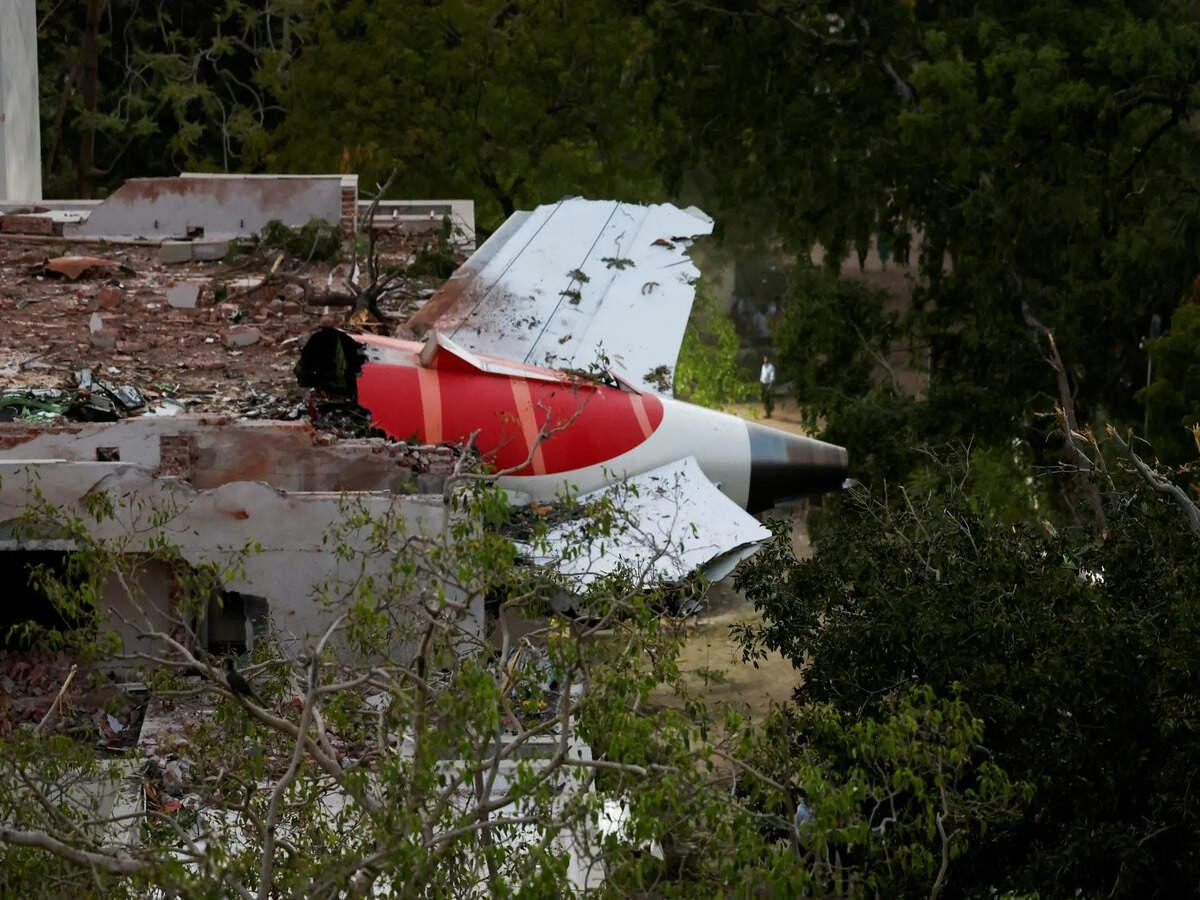
Debate Over Responsibility for Air India Flight 171 Crash Persists
Nearly five months after the tragic crash of Air India Flight 171, which claimed 260 lives, the investigation into the disaster remains fraught with controversy. The question of whether pilot error or mechanical failure caused the crash continues to provoke intense debate, with the Supreme Court of India recently entering the discourse to address the issue of accountability.
Conflicting Perspectives on Cause
Flight 171, traveling from Ahmedabad to London on 12 June, crashed into a building just 32 seconds after takeoff. An interim report released in July has faced criticism for its heavy emphasis on the actions of the flight crew—Captain Sumeet Sabharwal and First Officer Clive Kunder—while some experts and observers argue that potential mechanical faults have not been sufficiently explored. The report’s focus on the pilots’ conduct has sparked concerns that technical factors may have been overlooked.
On Friday, a Supreme Court judge publicly stated that the aircraft’s captain should not be held responsible for the crash. This statement followed remarks by Air India CEO Campbell Wilson at the Aviation India 2025 summit, where he asserted that there was “nothing wrong with the aircraft, the engines or the operation of the airline.” Wilson described the crash as “absolutely devastating” for the victims’ families and airline staff but emphasized that Air India was cooperating fully with investigators, while maintaining a distance from the direct inquiry.
Investigation and Controversy
The investigation is being led by India’s Air Accident Investigation Bureau (AAIB), with assistance from U.S. officials due to the American origin of the aircraft and its engines. The AAIB’s preliminary report, issued one month after the accident, follows standard protocol by summarizing known facts without reaching definitive conclusions. However, the 15-page document has become a focal point of controversy, particularly regarding two paragraphs that highlight the movement of the fuel cutoff switches from “run” to “cutoff” seconds after takeoff. This action effectively deprived the engines of fuel. Although the switches were subsequently returned to “run,” the delay proved fatal. Cockpit voice recordings captured one pilot questioning the other about the fuel cutoff, with the response: “I did not do so.”
This exchange has intensified speculation about the pilots’ involvement, yet critics caution that an exclusive focus on human error risks obscuring possible technical malfunctions. The Supreme Court’s intervention has further complicated the debate, underscoring the challenges inherent in assigning responsibility in such complex aviation disasters.
Human Impact and Industry Developments
Amid the ongoing investigation, the crash’s sole survivor, Viswashkumar Ramesh, has spoken publicly about his profound feelings of guilt and trauma. Ramesh, who suffers from severe post-traumatic stress disorder and has been unable to communicate with his family, highlights the deep psychological scars left by the tragedy.
Meanwhile, India’s aviation sector is undergoing significant transformation. Hindustan Aeronautics Ltd (HAL) recently announced a partnership with Russia to manufacture the Sukhoi Superjet-100 domestically. This collaboration could alter the competitive dynamics for global aircraft manufacturers such as Boeing and Airbus. The market has responded positively to the HAL-Russia alliance, with investors closely monitoring its potential impact.
As the investigation proceeds and the aviation industry evolves, the question of responsibility for the Air India Flight 171 crash remains unresolved, with families, survivors, and officials alike continuing to seek clarity and answers.

Etihad Airways Suspends Airbus A380 Flights on Key Route

Aditya Birla Group Seeks Approval for Aircraft Leasing in GIFT City

Qatar Airways Highlights Innovation and Connectivity at Arabian Travel Market 2026

Hong Kong's Five-Year Plan Includes Andrew Fan's Aircraft Parts Processing Hub Proposal

ACIA Aero Leasing Delivers ATR72-600 to Air Nostrum

RTX Appoints Jill Albertelli as Head of Pratt & Whitney

TAT Technologies Joins Beyond Aero Hydrogen Aircraft Program

AURAK Study Highlights Barriers to Air Taxi Adoption in Emerging Economies

Xiamen Air Selects Altitude for 787 Maintenance at Heathrow

Etihad and Swissport Extend Global Partnership
