
Превращайте аналитические выводы ИИ в реальные действия

В тренде
Categories
How Airports Can Use AI to Improve Decision-Making
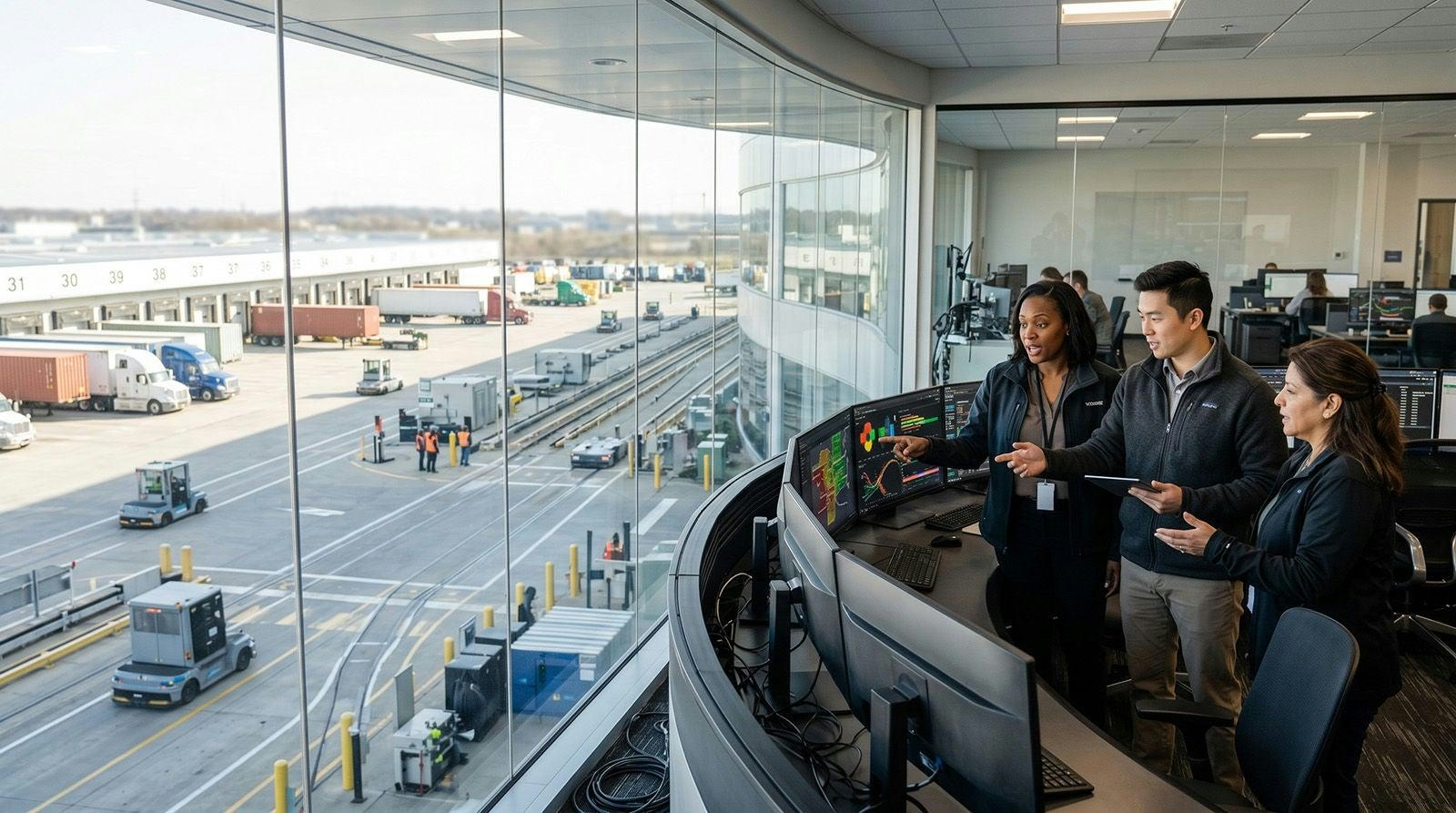
How Airports Can Use AI to Improve Decision-Making
Fares Djenandji, chief growth officer at Ipsotek (an Eviden Business), explores how the next phase of artificial intelligence (AI) is poised to revolutionize airport operations by delivering contextual operational intelligence. Over the past decade, airports have made substantial investments in advanced camera networks, video management systems, and sophisticated analytics. Virtually every area within terminals, airside operations, and security zones is now under constant surveillance. Despite this extensive data collection and visibility, many airport operations teams continue to grapple with challenges such as delayed responses, fragmented workflows, alert fatigue, and missed opportunities to prevent disruptions before they escalate.
From Detection to Understanding
The fundamental issue lies not in the quantity of data but in the lack of meaningful understanding. Traditional Vision AI technologies excel at detecting events—identifying queues forming, vehicles entering restricted zones, or passengers lingering excessively. While these detections provide valuable information, they primarily answer the question, "What is happening?" For airport operations, however, the more pressing questions are, "What does this mean operationally?" and "What should happen next?"
Emerging AI capabilities are beginning to address this gap. Innovations such as Natural Language Detection (NLD), Vision Language Models (VLMs), and generative AI are advancing beyond mere event detection. These technologies interpret scenes within their operational context, explain their significance, and link them to real-world airport processes. For instance, a queue at security is no longer just a queue; it becomes an indicator of potential flight delays, a signal of staffing pressures, and an early warning for congestion further downstream.
The Limits of More Data
In response to increasing operational complexity, many airports have deployed additional AI models, generating more alerts and data streams. However, this approach often results in information overload. Without contextual understanding, scaling detection capabilities merely increases the volume of alerts that operations teams must manually assess, leading to overwhelmed control rooms and slower decision-making.
The critical transformation, therefore, is not solely about enhancing detection accuracy but about embedding intelligence that can interpret, prioritize, and synthesize information. While Vision AI remains a foundational technology, it must evolve to provide actionable insights rather than simply more data.
Connecting Siloed Systems
Airports function within a complex ecosystem comprising video platforms, Airport Operational Databases (AODB), flight schedules, passenger flow analytics, and gate management tools. Although each system contains valuable data, they often operate in isolation, hindering operational agility. True contextual AI arises when these disparate data sources are integrated. By fusing video insights with flight timings, passenger volumes, and operational milestones, airports can develop a richer, interconnected understanding of their operations. Vision Language Models are particularly effective in this integration, combining visual recognition with language-based reasoning to deliver deeper, more actionable insights.
Challenges and Industry Response
Despite AI’s transformative potential, significant challenges remain. Governance frameworks must evolve rapidly to keep pace with AI adoption, a concern underscored in Forrester’s State of Agentic AI in 2026 report. Market reactions to AI-driven improvements in air traffic management are mixed. For example, the Federal Aviation Administration (FAA) has pledged substantial reductions in flight delays by 2028 through AI deployment, yet analysts remain skeptical about the feasibility of this timeline. Meanwhile, some airlines and airports are aggressively adopting AI to streamline operations and enhance decision-making, while others lag behind due to governance and integration obstacles.
As AI technologies continue to advance, airports must shift their focus from merely accumulating data to achieving genuine operational intelligence—where context, understanding, and timely action combine to improve outcomes for both passengers and operators.

Hong Kong's Five-Year Plan Includes Andrew Fan's Aircraft Parts Processing Hub Proposal

ACIA Aero Leasing Delivers ATR72-600 to Air Nostrum

RTX Appoints Jill Albertelli as Head of Pratt & Whitney

TAT Technologies Joins Beyond Aero Hydrogen Aircraft Program

AURAK Study Highlights Barriers to Air Taxi Adoption in Emerging Economies

Xiamen Air Selects Altitude for 787 Maintenance at Heathrow

Etihad and Swissport Extend Global Partnership
Sepehran Airlines B737 Returns to Mashhad After Tyre and Engine Issues

Etihad Deploys Widebody Fleet to Meet Strong Demand
Korean Air Finalizes $36.2 Billion Deal with Boeing
