
Превращайте аналитические выводы ИИ в реальные действия

В тренде
Categories
How AS9110 Strengthens Aviation Safety in MRO
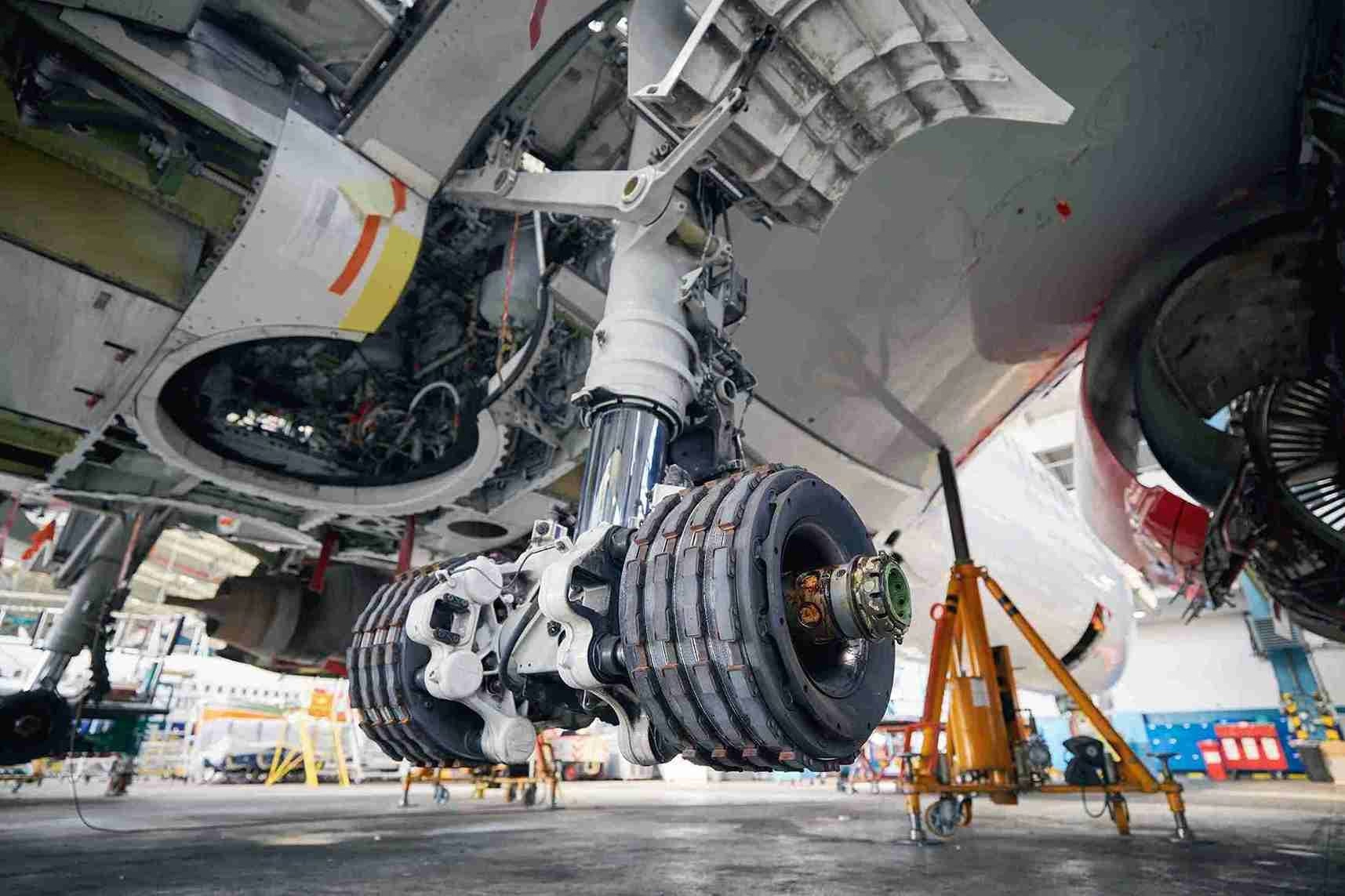
How AS9110 Strengthens Aviation Safety in MRO
AS9110 stands as the internationally recognized quality management standard specifically designed for aviation Maintenance, Repair, and Overhaul (MRO) organizations. Beyond serving as a mere compliance credential, AS9110 integrates disciplined process control, traceability, risk-based thinking, and continual improvement into everyday maintenance operations. This comprehensive approach transforms routine hangar-floor activities into quantifiable safety outcomes, reinforcing the integrity of aircraft maintenance.
The Critical Role of AS9110 in Aviation Safety
Commercial aviation has witnessed significant safety advancements in recent years. According to the International Air Transport Association’s (IATA) 2025 Annual Safety Report, the fatal accident rate has improved markedly, declining from one per 3.5 million flights during the 2012–2016 period to one per 5.6 million flights in the 2021–2025 timeframe. This progress reflects a concerted global effort characterized by relentless standardization, stringent oversight, and a commitment to learning from every near-miss and nonconformance. Central to this achievement is the maintenance sector, where the margin for error is effectively nonexistent.
Research consistently highlights maintenance environments as high-risk settings, with human factors contributing to an estimated 70 to 80 percent of all aviation accidents and incidents, according to the National Academies of Sciences, Engineering, and Medicine. The precision and reliability of MRO activities are therefore indispensable to ensuring flight safety.
Developed by the International Aerospace Quality Group (IAQG) and grounded in the ISO 9001:2015 framework, AS9110 establishes rigorous quality management system (QMS) requirements tailored to organizations performing MRO on both civil and military aircraft. The current iteration, AS9110 Revision C, extends beyond generic quality principles by embedding aerospace-specific provisions that directly address the conditions under which maintenance errors are most likely to occur.
Core Requirements and Their Safety Implications
AS9110 is not a simplistic checklist but a structured management framework demanding that organizations provide documented evidence and undergo independent audits to verify that their processes are controlled, personnel are competent, and systems are designed to intercept errors before they affect airworthiness. The standard mandates robust organizational leadership and risk planning, stringent maintenance process control, meticulous technical data management, comprehensive supplier oversight, rigorous configuration management, and a commitment to continual improvement. Collectively, these elements enhance the reliability and safety of MRO operations, thereby supporting broader aviation safety objectives.
Configuration Management: A Pillar of Error Prevention
Among AS9110’s operational mandates, configuration management is particularly critical. This requirement ensures precise traceability of aircraft, components, and documentation throughout every maintenance phase. Each installed part must be traceable in terms of origin, service history, and conformity status, with all information thoroughly documented and verifiable. Failures in configuration management can lead to severe consequences, including the use of incorrect parts, unauthorized modifications, or undocumented changes that jeopardize airworthiness. By making traceability a non-negotiable process requirement, AS9110 effectively closes vital safety gaps.
Mitigating Human Factors in Maintenance
Human error in aviation maintenance frequently stems from unclear procedures, inadequate task handovers, time pressures, and fatigue—challenges that cannot be fully addressed by individual skill alone. AS9110 confronts these risks by enforcing clear procedural guidelines, fostering robust communication, and instituting systematic controls. These measures collectively reduce the likelihood of errors and contribute to enhanced overall safety within maintenance operations.
Industry Adoption and Market Impact
The adoption of AS9110 has bolstered confidence among airlines and regulatory authorities regarding the quality and safety of MRO activities. This increased trust has been reflected in a positive market response, with certified organizations gaining competitive advantage. In turn, industry competitors are increasingly embracing similar standards to maintain compliance with evolving safety regulations and to safeguard their market positions.
AS9110 thus remains a foundational element in advancing aviation safety within MRO, driving measurable improvements through rigorous quality management and widespread industry implementation.

Hong Kong's Five-Year Plan Includes Andrew Fan's Aircraft Parts Processing Hub Proposal

ACIA Aero Leasing Delivers ATR72-600 to Air Nostrum

RTX Appoints Jill Albertelli as Head of Pratt & Whitney

TAT Technologies Joins Beyond Aero Hydrogen Aircraft Program

AURAK Study Highlights Barriers to Air Taxi Adoption in Emerging Economies

Xiamen Air Selects Altitude for 787 Maintenance at Heathrow

Etihad and Swissport Extend Global Partnership

Sepehran Airlines B737 Returns to Mashhad After Tyre and Engine Issues

Etihad Deploys Widebody Fleet to Meet Strong Demand

Korean Air Finalizes $36.2 Billion Deal with Boeing
