Изображение

Превращайте аналитические выводы ИИ в реальные действия

Присоединяйтесь к списку ожидания AeroGenie уже сегодня!

В тренде

Categories

How Flawed Models and Overlooked Technology Contributed to an Airline’s Bankruptcy
July 7, 2026By ePlane AI
How Flawed Models and Overlooked Technology Contributed to an Airline’s Bankruptcy
0
0
Spirit Airlines
Delta Air Lines
Technology Failure

How Flawed Models and Overlooked Technology Contributed to an Airline’s Bankruptcy

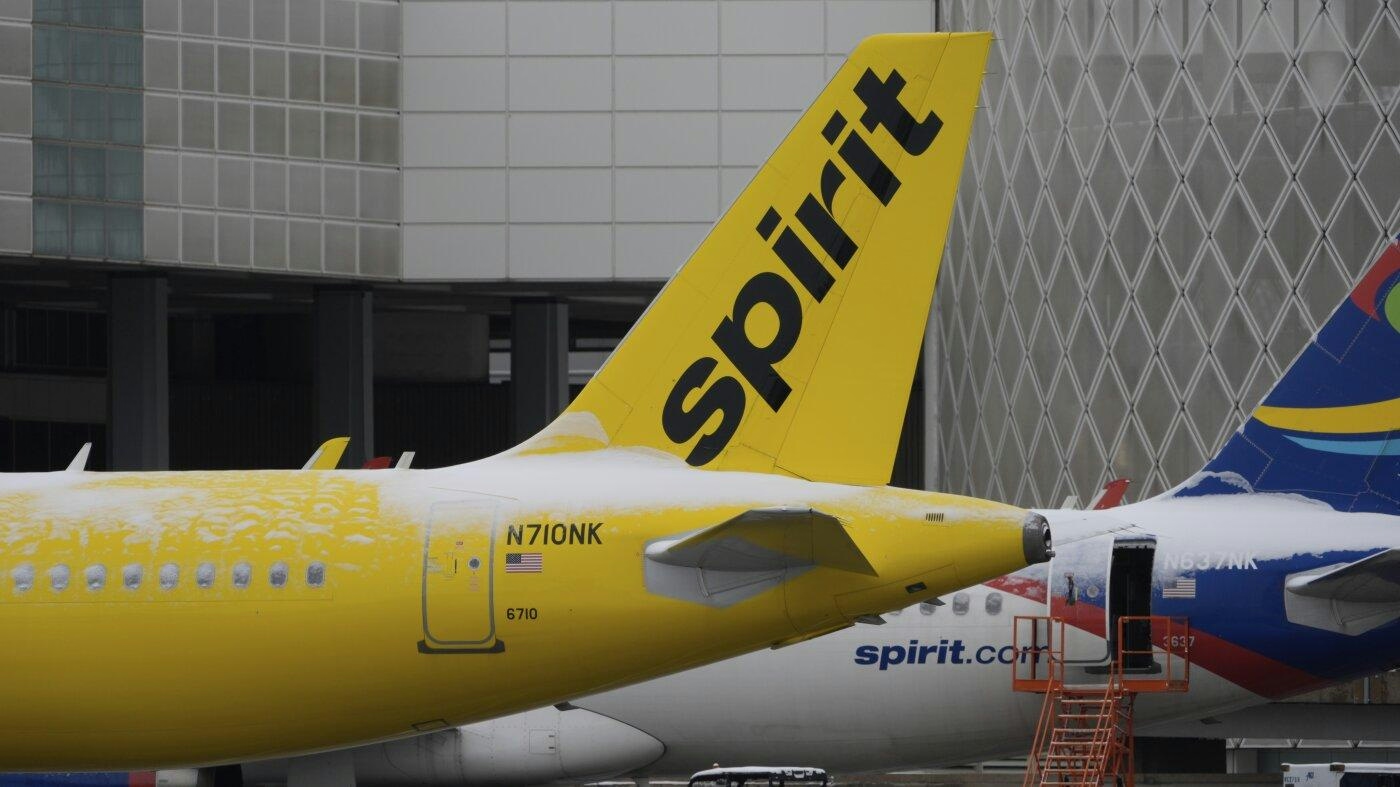
The aviation industry currently finds itself in a paradoxical state. Despite soaring demand for air travel, rapid technological advancements, and readily available capital, airlines are collapsing at an unprecedented rate. The recent bankruptcy of Spirit Airlines is emblematic of a broader crisis, serving as a cautionary signal for the entire sector.

Governance Failures and Operational Risks

Industry experts emphasize that airline bankruptcies are rarely the result of isolated financial setbacks. Rather, they stem from deeper governance failures, where leadership fails to identify and address emerging risks. These risks often remain concealed within outdated data models and neglected technological systems. The inability to adapt to evolving operational demands and technological landscapes leaves carriers vulnerable to cascading failures.

This vulnerability was starkly illustrated by Delta Air Lines’ operational meltdown in 2024. The disruption affected 1.3 million passengers and inflicted a financial loss estimated at $500 million. Although a federal investigation into the incident concluded without penalties, the episode exposed the fragility of even the largest airlines’ technological infrastructure. It underscored the immense operational and financial consequences that can arise from system breakdowns.

Industry Response Amid Technological and Financial Challenges

In the wake of such incidents, many airlines have begun reassessing their technological frameworks. There is a growing emphasis on scrutinizing data models and investing in system upgrades to mitigate the risk of similar disruptions. However, this technological pivot occurs amid broader challenges within the tech sector, particularly concerning artificial intelligence. The high costs associated with implementing advanced technologies, coupled with uncertain returns on investment, have prompted a reevaluation of large-scale tech expenditures.

Rising financing costs and difficulties in justifying expansion have become recurring themes across the industry. For airlines, the imperative is clear: robust technology and accurate data models are no longer optional but essential for operational resilience and investor confidence. The Spirit Airlines bankruptcy serves as a stark reminder that the most significant risks in aviation often originate not from external factors in the skies, but from internal systems and strategic decisions on the ground.

More news
Blueberry Aviation Completes Recovery of Garuda’s ATR72-600 Fleet

Blueberry Aviation Completes Recovery of Garuda’s ATR72-600 Fleet

Blueberry Aviation Completes Recovery of Garuda’s ATR72-600 Fleet Blueberry Aviation has announced the successful conclusion of the recovery of Garuda Indonesia’s ATR72-600 fleet, marked by the return of the tenth and final aircraft to Toulouse on July 5, 2026. This project, undertaken on behalf of the French and Italian Export Credit Agencies (ECAs), represents a significant achievement for the Monaco-based aircraft trading and asset management firm. Complex Recovery and Asset Management The recovery process involved numerous challenges, including ensuring the airworthiness and safety of the aircraft after prolonged grounding periods, coordinating extensive maintenance and repair operations across the fleet, and adhering to stringent regulatory compliance standards. Blueberry Aviation oversaw the entire repossession operation, which encompassed on-site physical and records inspections, fleet valuation, aircraft recovery, ferrying, storage in France, insurance management, and the remarketing and redelivery of the aircraft to new owners. This accomplishment follows Blueberry Aviation’s earlier success in 2022, when it completed a comparable repossession and remarketing project involving 11 ATR72-600 aircraft recovered from Avianca following the airline’s Chapter 11 bankruptcy filing. In both instances, the company was entrusted by the ECAs to manage the full scope of the process, underscoring its expertise in handling distressed assets and supporting airlines through restructuring or insolvency. Market Impact and Company Profile The recovery has elicited positive responses from Garuda’s customers, who have noted improvements in fleet reliability and service quality. Meanwhile, competitors are reportedly enhancing their maintenance programs and closely examining Blueberry Aviation’s methodologies to sustain their competitive positions. The successful recovery and remarketing of these fleets further consolidate Blueberry Aviation’s reputation as a leader in commercial aircraft remarketing, sourcing, and asset management, particularly in complex and distressed scenarios. Operating globally with offices in Monaco, New York, Singapore, and Mumbai, Blueberry Aviation is led by founder and CEO François Gautier. The company has completed over 190 commercial aircraft transactions and more than 565 helicopter deals to date. Its advisory team offers clients comprehensive support, including equipment selection, transaction execution, sourcing and sales of new and pre-owned aircraft, technical assistance, and portfolio management. Beyond its commercial aircraft activities, Blueberry Aviation is recognized as one of the largest helicopter traders in the secondary market. The completion of the Garuda ATR72-600 recovery project highlights Blueberry Aviation’s capacity to manage intricate asset recoveries and reinforces its position as a trusted partner for export credit agencies and airlines worldwide.
CubCrafters Introduces Turbine-Powered Carbon Cub ULT

CubCrafters Introduces Turbine-Powered Carbon Cub ULT

CubCrafters Introduces Turbine-Powered Carbon Cub ULT CubCrafters has unveiled the Carbon Cub ULT, a turbine-powered advancement of its Carbon Cub UL model, marking a notable progression in backcountry aviation technology. This new iteration replaces the conventional Rotax piston engine with a French-manufactured TurboTech TP-R90 regenerative turboprop engine, establishing the ULT as one of the lightest high-performance backcountry aircraft currently available. Drawing inspiration from the iconic Piper Super Cub, the Carbon Cub ULT is engineered to comply with the Federal Aviation Administration’s (FAA) recently introduced MOSAIC regulations. These rules broaden the scope of light-sport aircraft certification and permit alternative propulsion systems, including turbine engines. CubCrafters stresses that the ULT is not merely a faster or more powerful variant of the UL but a distinct model that integrates the smooth operation of a turbine, compatibility with Jet-A and diesel fuels, push-button engine start, and single-lever FADEC (Full Authority Digital Engine Control) management, all while maintaining performance metrics comparable to the Rotax-powered UL. The company announced the Carbon Cub ULT on July 7, 2026, ahead of its scheduled public debut at the EAA AirVenture Oshkosh event later in the month. Customer deposits are currently being accepted, with initial deliveries expected to commence in 2027. Designed for the MOSAIC Era CubCrafters positions the Carbon Cub ULT as the first turboprop aircraft manufactured in the United States eligible for operation by sport pilots under the FAA’s MOSAIC framework. Central to this innovation is the TurboTech engine’s FADEC system, which automates critical functions such as fuel flow, ignition timing, engine temperature regulation, and propeller control, thereby reducing pilot workload. Engine start-up is simplified to activating the master switch and pressing a single button, with the FADEC system managing the entire sequence. The prototype cockpit is equipped with Garmin G3X Touch avionics alongside a dedicated turbine engine display. The TurboTech engine employs a regenerative cycle design that recovers exhaust heat to preheat intake air prior to combustion. This approach enhances fuel efficiency, aiming to achieve consumption rates comparable to modern piston engines while retaining the operational advantages of turbine power and the ability to run on Jet-A or diesel fuel. TurboTech, founded by former Safran engineers, has developed its engines over several years, with applications in European ultralight aircraft and helicopters. The TP-R90 and TP-R150 models are rated at 160 horsepower with a combined turbine and electric boost. Current specifications for the TP-R150 indicate a maximum output of 141 horsepower, an eco-cruise fuel burn of approximately five gallons per hour at 50 percent power, a weight near 190 pounds, and a time between overhauls of 3,000 hours. Market and Industry Outlook The introduction of the Carbon Cub ULT represents a significant technological advancement, yet CubCrafters faces several challenges in bringing the aircraft to market. Regulatory approval processes, competition from established manufacturers, and market acceptance of this novel design will be critical factors influencing its success. While traditional ultralight aviation enthusiasts may initially approach the turbine-powered ULT with caution, the aircraft’s innovative features are expected to appeal to backcountry pilots seeking enhanced technology and operational versatility. Competitors within the industry may respond by intensifying marketing efforts for their existing models or accelerating the development of turbine-powered ultralight aircraft to maintain their market positions. Despite these challenges, the Carbon Cub ULT positions CubCrafters at the forefront of a new chapter in light-sport and backcountry aviation, combining contemporary engineering advancements with a legacy of proven performance.
US-Bangla Airlines Wet Leases Airbus A320-200

US-Bangla Airlines Wet Leases Airbus A320-200

US-Bangla Airlines Expands Fleet Through Wet Lease of Airbus A320-200 US-Bangla Airlines (BS, Dhaka) has initiated a wet lease agreement for an Airbus A320-200 from BBN Airlines Thailand (TZ, Bangkok Don Mueang), a strategic move aimed at enhancing fleet flexibility amid intensifying competition in the aviation sector. The arrangement was publicly confirmed by BBN Airlines Thailand, a start-up ACMI specialist, through a recent social media announcement. Operational Deployment and Aircraft History The aircraft, registered HS-SXA (msn 5089), began operating under US-Bangla’s "UBG" callsign on June 24, 2026, following its repositioning from Bangkok Suvarnabhumi to Dhaka the day before. Since entering service with US-Bangla, the A320-200 has been deployed on routes connecting Dhaka with Bangkok Suvarnabhumi, Malé, Singapore Changi, and Sharjah. This particular Airbus narrowbody, now 14.3 years old, was previously operated by Thai VietJetAir from December 2025—coinciding with the launch of BBN Airlines Thailand’s commercial operations—until April 2026. The decision to incorporate this wet-leased aircraft reflects a broader industry trend where carriers increasingly rely on wet leasing and flexible fleet management solutions to address fluctuating market demands and capacity challenges. Market Context and Fleet Strategy US-Bangla’s move comes amid a period of aggressive fleet expansion and modernization by major airlines worldwide. For instance, American Airlines is actively pursuing additional widebody aircraft orders to strengthen its competitive position against Delta and United, intensifying demand for available aircraft. Similarly, Finnair is exploring wet lease options for used A320s to support its network growth, while Starlux Airlines has recently leased eight additional A321neos from BOC Aviation, underscoring the sustained appetite for modern, fuel-efficient aircraft. These developments underscore the operational challenges US-Bangla faces in integrating leased aircraft into its network. The airline must effectively manage a crowded leasing market, ensure smooth operational assimilation, and adapt to evolving passenger preferences to sustain its competitive advantage. Current Fleet Composition and Leasing Portfolio Beyond the newly acquired A320-200, US-Bangla continues to wet lease a Boeing 737-800 from BBN Airlines Indonesia (0B, Jakarta Soekarno-Hatta), a sister company of BBN Airlines Thailand under the Avia Solutions Group umbrella. The airline also leases an ATR72-500 from NovoAir and a Boeing 737-200(F) from SkyAir, while simultaneously wet leasing one of its ATR72-600 aircraft to Air Astra, according to ch-aviation data. US-Bangla’s owned fleet currently consists of 17 aircraft, including three Airbus A330-300s, ten ATR72-600s, and four Boeing 737-800s. The addition of the wet-leased A320-200 is anticipated to improve operational flexibility, though its ultimate success will depend on the airline’s ability to integrate the aircraft efficiently within a rapidly evolving and competitive market environment.
Airbus, MTU to develop emissions-free fuel cell engines for aircraft

Airbus, MTU to develop emissions-free fuel cell engines for aircraft

Airbus and MTU Collaborate on Emissions-Free Fuel Cell Engines for Aviation Airbus and German engine manufacturer MTU have announced a strategic partnership to develop emissions-free fuel cell engines for aircraft, marking a pivotal advancement in the pursuit of sustainable aviation. The two companies plan to establish a joint venture dedicated to the development and commercialization of hydrogen-powered engines, with operations anticipated to commence in 2027. Partnership Framework and Technological Ambitions The collaboration is set to formalize following the signing of a memorandum of understanding in 2025, after which the joint venture will be officially launched. Both Airbus and MTU have highlighted that the initiative remains subject to regulatory approvals and consultations with employee representative bodies. This partnership builds on the independent efforts both companies have made in fuel cell technology, aiming to accelerate the maturation of fuel cell propulsion systems and assert European leadership in advanced aviation technologies. Fuel cell engines operate by generating electricity onboard through a chemical reaction between hydrogen and oxygen, offering a promising alternative to conventional jet engines that emit significant greenhouse gases, particularly at high altitudes. While electric battery propulsion has been explored, it remains impractical for larger aircraft due to the weight constraints of current battery technologies. Hydrogen fuel cells, therefore, present a viable pathway toward zero-emission flight. Challenges and Industry Implications Despite its potential, the development of commercially viable hydrogen fuel cell powertrains faces considerable challenges. Significant technological innovation and substantial upfront investment will be required to bring these systems to market. Furthermore, aviation regulators must certify the new technology to ensure safety in commercial operations. The limited state of hydrogen infrastructure and questions surrounding the economic feasibility of such systems contribute to skepticism within parts of the aviation industry. Market responses to the announcement have been varied. Some airlines have expressed optimism about the potential for emissions reduction and alignment with tightening environmental regulations. Conversely, others remain cautious, citing concerns over the financial costs and the need to develop new fueling infrastructure at airports. The announcement by Airbus and MTU is likely to prompt competitors in the aerospace sector to intensify their research and development efforts in alternative propulsion technologies, including sustainable aviation fuels and hybrid-electric systems. This move occurs amid ongoing consolidation within the European aviation market and increasing pressure to adopt environmentally sustainable technologies. If successful, the joint venture could position Airbus and MTU at the forefront of the aviation industry's transition toward sustainability, contributing significantly to efforts aimed at reducing the sector’s environmental footprint.
Qantas Prepares to Launch New 22-Hour Flight Route

Qantas Prepares to Launch New 22-Hour Flight Route

Qantas to Launch Record-Breaking 22-Hour Nonstop Flight Between Sydney and London Next year, Qantas Airways is set to make aviation history by inaugurating the world’s longest nonstop commercial flight, linking Sydney and London in a journey that may extend up to 22 hours. Passengers aboard the specially modified Airbus A350-1000ULR will cover over 10,000 miles and cross nearly a dozen time zones, offering an unprecedented travel experience that could include witnessing the sunrise twice before arrival. Project Sunrise: A Decade in the Making This ambitious route, known as “Project Sunrise,” represents nearly ten years of development and underscores Qantas’ enduring commitment to bridging vast distances, particularly along the iconic Kangaroo Route. Aviation expert Jason Chun Yu Wong, Associate Professor at Babson College, highlights the strategic significance of this endeavor. He notes that Qantas has long sought to master ultra-long-haul travel, with the London–Sydney corridor forming a central part of the airline’s mission since its inception. Qantas is already a leader in long-haul innovation, operating three of the world’s ten longest flights by distance. However, the Sydney–London service pushes the limits of commercial aviation further than ever before. The airline’s A350-1000ULR aircraft incorporates advanced features designed to enhance passenger well-being, including a dedicated wellness zone, improved cabin pressurization, increased humidity levels, and scientifically developed amenities. These innovations aim to reduce jet lag and improve comfort during the marathon flight. Balancing Operational Challenges and Passenger Experience According to Wong, the success of this ultra-long-haul route hinges on balancing operational feasibility and profitability with passenger willingness to pay for the premium nonstop service. He emphasizes that the passenger experience is critical for a journey of this length, stating that Qantas must reach a “point of indifference” where travelers are sufficiently motivated to pay extra for the convenience of nonstop travel. The comfort features integrated into the new service are therefore essential to achieving this balance. The launch of such an extended nonstop flight presents considerable challenges. Ensuring passenger safety and comfort over nearly a full day in the air requires careful management of sleep patterns, physical movement, nutrition, and mental engagement. Additionally, the operational complexities of ultra-long-haul flights—including crew scheduling, fuel logistics, and the specialized maintenance demands of the modified A350-1000ULR—add further layers of difficulty. Market Implications and Future Prospects Qantas’ entry into this ultra-long-haul market is expected to intensify competition among global carriers. Other airlines may accelerate their own ultra-long-haul initiatives or enhance existing services to attract premium travelers, potentially sparking price competition in the lucrative long-haul segment. The emergence of new, smaller aircraft with extended range capabilities, such as the A321XLR and 737 MAX, could also enable additional nonstop routes catering to markets with lower demand. Looking ahead, Wong views this period as an exciting phase of innovation in aviation. He points to the growing experimentation with “long and skinny” routes—long-distance flights with relatively lower passenger volumes—and the potential for narrow-body aircraft to open new nonstop markets across transatlantic and transpacific corridors. This evolution will likely drive further advancements in passenger experience, seating configurations, and onboard service. As Qantas prepares to launch this historic flight, the global aviation industry will closely observe how the airline and its competitors navigate the challenges and opportunities of ultra-long-haul travel’s next frontier.
Geopolitical Tensions and Supply Chain Disruptions Affecting Aviation Management in 2026

Geopolitical Tensions and Supply Chain Disruptions Affecting Aviation Management in 2026

Geopolitical Tensions and Supply Chain Disruptions Affecting Aviation Management in 2026 The aviation industry is confronting significant challenges as it navigates persistent supply chain disruptions alongside escalating geopolitical tensions heading into 2026. Recovery within the sector’s supply chain remains sluggish, with global aircraft backlogs surpassing 17,000 units. This backlog has hindered fleet renewal initiatives, compelling airlines to continue operating older, less fuel-efficient aircraft for extended periods. Engine manufacturers are facing multi-year maintenance queues, which have contributed to rising costs for leasing and spare engines. Critical parts shortages persist across key components such as avionics, aircraft interiors, landing gear, and composite structures. These constraints have led to increased operational expenses and have forced airlines to implement new strategies aimed at mitigating risk in an increasingly volatile environment. Rising Operational Costs and Strategic Responses Industry projections for 2025 and 2026 estimate an additional $11 billion in operating costs. This increase is driven by several factors, including higher fuel consumption due to the prolonged use of aging aircraft, escalating maintenance expenses characterized by longer repair durations and increased material costs, and engine leasing premiums that have surged by 20 to 30 percent since 2019. Furthermore, inventory stockpiling has become a normalized risk management practice, adding to the financial burden. In this context, airlines face the complex task of balancing capital discipline with the urgent need to secure essential parts, engines, and maintenance capacity amid intensifying competition and uncertainty. The operational landscape demands a shift from reactive risk management toward building long-term resilience. Building Resilience Amid Volatility The 2026 State of Logistics report highlights that volatility has become a permanent feature of the aviation supply chain, necessitating continuous adaptation by logisticians and management teams. Companies are increasingly encouraged to proactively identify and manage supply chain dependencies to anticipate and mitigate the effects of ongoing disruptions and geopolitical instability. In response, industry players are adopting a range of strategic measures, including increased investment in workforce development, diversification of business operations, and fostering closer collaboration with key stakeholders. These initiatives are designed to reduce vulnerability to supply chain fluctuations and ensure operational continuity. As geopolitical tensions persist and supply chain challenges remain unresolved, the aviation sector’s capacity to adapt and enhance resilience will be pivotal in sustaining performance and meeting future demand.
U.S. Customs and Border Protection Orders 10 Airbus H125 Helicopters for Border Security

U.S. Customs and Border Protection Orders 10 Airbus H125 Helicopters for Border Security

U.S. Customs and Border Protection Expands Fleet with Airbus H125 Helicopters U.S. Customs and Border Protection (CBP) Air and Marine Operations has finalized a contract with Airbus to acquire ten H125 helicopters, a move aimed at enhancing the agency’s capabilities in law enforcement, border security, and public safety missions across the United States. This acquisition forms part of CBP’s broader strategy to modernize its operational fleet and improve mission readiness in increasingly complex environments. Enhancing Operational Capabilities with the H125 The H125 helicopter, produced at Airbus’ Columbus, Mississippi facility, is recognized for its versatility and reliability in multi-role homeland security operations. Equipped with advanced safety features such as dual-channel full authority digital engine control, an engine data recorder, and a dual hydraulic flight control system, the aircraft is designed to reduce pilot workload and improve safety during demanding tactical flights. Its superior visibility, multi-mission flexibility, and cost-effective operation have made it a preferred choice for airborne law enforcement agencies throughout North America. Bart Reijnen, Head of the North America Region for Airbus Helicopters, emphasized the significance of the contract, noting that the expansion of the H125 fleet reflects the enduring partnership between Airbus and CBP. He highlighted the trust placed in the H125 to perform critical public safety missions under challenging conditions and reaffirmed Airbus’ commitment to providing reliable aircraft and comprehensive support services to ensure continuous mission readiness. Industry Challenges and Market Implications Despite the strategic benefits of the acquisition, the integration of the new helicopters into CBP’s existing fleet may encounter challenges related to supply chain logistics, ongoing maintenance, and system compatibility. As law enforcement agencies across the country pursue fleet modernization, this high-profile purchase is expected to influence demand for similar helicopter models. Competing manufacturers are likely to intensify efforts to promote alternative aircraft, emphasizing distinctive features and capabilities to capture a share of the evolving market. The contract also underscores the increasing importance of private sector partnerships in national security and border enforcement. As technological advancements continue to shape the future of border security operations, the collaboration between government agencies and industry players remains critical to the successful deployment and sustainment of advanced aviation assets. According to Airbus, the H125 is the world’s leading light single-engine helicopter, and this latest order is anticipated to significantly enhance CBP Air and Marine Operations’ ability to conduct patrol, surveillance, and tactical missions under demanding conditions.
Entries Open for the 2026 RedCabin Trinity Award

Entries Open for the 2026 RedCabin Trinity Award

Entries Open for the 2026 RedCabin Trinity Award The 2026 RedCabin Trinity Award, a distinguished accolade recognizing innovation in aircraft cabin interiors, has officially opened for submissions. This esteemed program offers winners not only a prestigious trophy but also the exceptional opportunity to collaborate directly with an airline, facilitating the transformation of their concepts from initial ideas into operational realities. The award welcomes entries from both industry professionals and students, with no submission fees required. Navigating a Competitive Awards Landscape As the aviation and design industries continue to advance at a rapid pace, the RedCabin Trinity Award faces the challenge of attracting a broad and diverse array of entries that exemplify the sector’s most innovative and forward-thinking work. The competition for recognition is intensifying, with other prominent awards such as the 2027 AACTA Awards, Hospitality Design Awards 2026, and RG Retail Excellence Awards 2026 also inviting submissions. This increasingly crowded field places greater emphasis on the RedCabin Trinity Award’s selection criteria and judging process, as organizers endeavor to uphold the award’s relevance and prestige within the industry. Expert Judging Panel and Award Categories The judging panel for the 2026 edition is composed exclusively of senior representatives from leading airlines and aircraft leasing companies, ensuring that winning concepts are evaluated by experts deeply embedded in the sector. The panel includes Henry Buckley of Virgin Atlantic Airways, Peter Cooke from Riyadh Air, Joy Kelly representing Avolon, Guillaume Vivet of Cathay Pacific Airways, Katsunori Maki from ANA (All Nippon Airways), Jay Mapston of American Airlines, Mauricio Parise from Delta Air Lines, and Eerika Enne of Finnair. Entries will be considered across six distinct categories. The Passenger Experience Concept category focuses on innovations in hardware, software, or digital services designed to enhance the commercial passenger journey. The Cabin MRO Concept category highlights advancements in maintenance, repair, and overhaul through new service models or technological solutions. The Cabin Service Concept category recognizes novel service models or products that push the boundaries of commercial aviation. The Sustainability Concept category seeks ideas that contribute to achieving net zero emissions by 2050, including sustainable materials and processes that reduce weight, energy consumption, water use, or waste. The Collaboration Excellence category rewards projects involving at least three entities working together to create value for commercial aviation, emphasizing both the collaborative process and its outcomes. Lastly, the Newcomer / Startup category acknowledges startups, individuals, or student-led initiatives less than two years old that have developed impactful cabin innovation concepts. Submission Details and Award Ceremony Applicants are invited to submit their entries through the RedCabin website until 7 September 2026. Winners will be announced and celebrated on 9 December during the Aircraft Cabin Innovation Summit USA 2026, hosted by Boom Supersonic in Denver, Colorado. As the awards environment becomes increasingly competitive, the RedCabin Trinity Award remains committed to setting the standard for excellence and innovation in aircraft cabin design, even as rival programs evolve their categories and timelines to keep pace.
Former Black Hawk Pilot Lands Civilian Plane on Redstone Arsenal After Engine Failure

Former Black Hawk Pilot Lands Civilian Plane on Redstone Arsenal After Engine Failure

Former Black Hawk Pilot Executes Emergency Landing on Redstone Arsenal After Engine Failure A civilian aircraft was safely brought down on Redstone Arsenal last week following an engine failure, owing to the expert handling by Dennis Dunaway, a former Black Hawk pilot with over four decades of flight experience. The emergency unfolded at approximately 7:56 a.m. when Redstone Arsenal officials received a distress call from a single-engine plane reporting engine trouble shortly after takeoff. Onboard the aircraft were Dunaway, his friend, and his son. Emergency Response and Landing Upon recognizing the severity of the situation, Dunaway promptly declared an emergency, communicating with air traffic control that he intended to return to Huntsville International Airport while maintaining altitude due to the failing engine. However, as conditions evolved, he redirected the aircraft toward Redstone Arsenal, executing a precise emergency landing on the outbound lanes of Martin Road near the Gate 7 entrance. Emergency personnel from Redstone Arsenal’s Directorate of Emergency Services, alongside law enforcement and NASA security officials, arrived swiftly at the scene. Fortunately, no injuries were reported. The aircraft was subsequently towed for repairs, and the roadway closure lasted approximately 90 minutes before Gate 7 was reopened. Implications for Aviation Safety This incident highlights the indispensable value of pilot expertise and decisive action in managing in-flight emergencies. Dunaway’s adept handling of the crisis underscores the critical importance of rigorous training and extensive experience in aviation safety. As the industry faces heightened scrutiny over safety protocols, such events often trigger comprehensive reviews of existing procedures and can influence regulatory measures aimed at preventing similar occurrences. In response to high-profile emergencies, aviation companies frequently reaffirm their commitment to safety and undertake internal evaluations of their practices. Recent controversies, including the lawsuit against Boeing-owned Wisk Aero for allegedly circumventing safety testing, have intensified the focus on maintaining stringent safety standards amid rapid technological advancements. These developments emphasize the ongoing necessity for vigilance and continuous improvement in aviation safety across the sector.
Mike Winston Explains Jet.AI’s Shift from Aviation to AI Infrastructure

Mike Winston Explains Jet.AI’s Shift from Aviation to AI Infrastructure

Mike Winston Explains Jet.AI’s Shift from Aviation to AI Infrastructure From Aviation Optimization to AI Infrastructure Challenges Private aviation is an industry characterized by narrow profit margins and stringent scheduling demands. Under the leadership of founder and investor Mike Winston, Jet.AI initially developed artificial intelligence tools aimed at optimizing these operational constraints. This unique vantage point allowed the company to gain early insight into the real-world demands of production AI workloads, well before concerns about data center power shortages entered mainstream discourse. Winston’s hands-on experience deploying AI tools within an active aviation business led to a critical realization: the primary bottleneck for AI infrastructure is not technological capability but power availability. The widening gap between electricity supply and the surging demand from AI workloads is projected to persist for years. This insight now drives Jet.AI’s strategic pivot, exemplified by its February 2025 agreement to transfer aviation operations to flyExclusive, the establishment of a data center pipeline through the Convergence Compute joint venture, and the $138 million capital raise via the SPAC AI Infrastructure Acquisition Corp. (NYSE: AIIA). Evolution Rooted in Operational Experience Jet.AI’s transformation from an aviation-focused enterprise to an AI infrastructure player is a coherent progression rather than a series of disconnected shifts. The company’s origins trace back to Jet Token, a blockchain-based private aviation startup shaped by Winston’s background in finance and investment. Regulatory challenges necessitated a move away from blockchain, prompting a focus on AI-driven solutions such as agentic booking software, route optimization for fuel and carbon efficiency, and dynamic pricing models for charter services. Each iteration responded to external pressures and yielded insights that informed subsequent developments. Developing AI software for aviation operations exposed the immense scale of computational requirements. Agentic booking systems must manage aircraft availability, pricing, and scheduling for customers with unpredictable, last-minute demands. Route optimization requires real-time modeling that incorporates weather, airspace, and fuel data. Dynamic pricing algorithms consume substantial compute power as transaction volumes and predictive complexity increase. Operating these workloads in a live business environment, rather than a research setting, underscored the significant power demands of AI at scale. “Through building AI tools for aviation, we saw firsthand the scale of transformation AI would bring,” Winston remarked in an April 2026 interview. “That led us to data centers, where the infrastructure opportunity is significant. Given my background in real estate finance and telecom, it was a natural transition. Today, we’re extending that into power generation using aero-derivative engines, another area with strong underlying demand.” Navigating Market Challenges and Industry Dynamics Jet.AI’s strategic shift unfolds amid a volatile market environment. The recent downturn in the technology sector, as reported by the BBC, has heightened skepticism regarding the sustainability of AI investment, contributing to a sharp decline in Jet.AI’s share price. Competition for electricity resources is intensifying, with AI data centers now rivaling Bitcoin mining operations in power consumption, according to CoinMarketCap. Concurrently, the rapid expansion and soaring valuations within the AI sector have sparked warnings of a potential bubble, as highlighted at the StrictlyVC event. These factors illustrate the multifaceted challenges Jet.AI confronts: managing market skepticism, competing for limited resources, and addressing the urgent need for global regulatory frameworks to ensure safe and sustainable AI deployment. Winston’s central thesis—that power availability is the defining constraint for AI infrastructure—has shifted from a niche operational insight to a focal point in broader industry discussions. As the market contends with these realities, Jet.AI’s evolution serves as a compelling case study in how operational experience can inform strategic direction within a rapidly evolving technological landscape.
line