
Превращайте аналитические выводы ИИ в реальные действия

В тренде
Categories
IAG Cargo Revenue Drops 9.4% in First Half Amid Middle East Disruptions
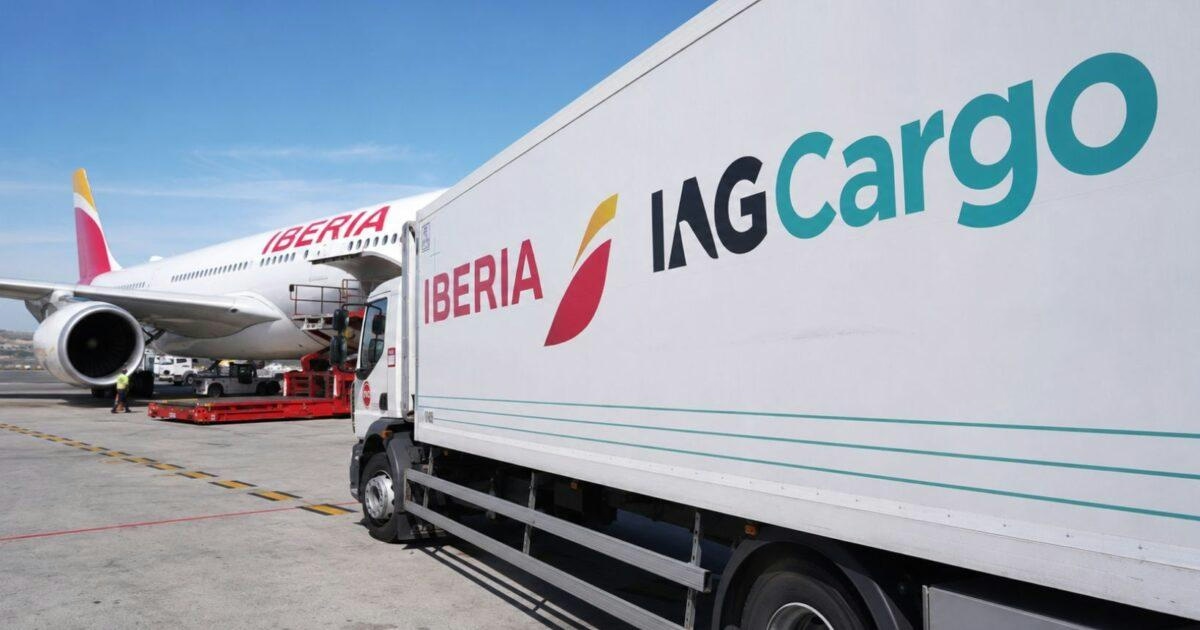
IAG Cargo Revenue Declines 9.4% in First Half Amid Middle East Market Disruptions
IAG Cargo reported a 9.4% year-on-year decline in revenue for the first half of 2026, with earnings falling to €570 million from €629 million in the same period last year. The downturn was primarily driven by ongoing disruptions in the Middle East, which constrained capacity and weakened demand across the carrier’s network. Cargo tonne kilometres (CTKs) decreased by 12.3%, reflecting the broader challenges faced by the air freight sector. Despite the volume decline, IAG Cargo managed to partially mitigate the impact through a 9.8% increase in yield per CTK at constant currency, supported by disciplined pricing strategies and favourable market conditions.
Market Challenges and Industry Context
The air cargo industry encountered significant headwinds throughout 2026. Although Middle Eastern carriers began showing signs of recovery in June, international demand remained subdued, contributing to a wider slowdown in the region. Notably, African airlines were the only global carriers to register a decline in air cargo capacity during June 2026. These difficulties coincided with a near halving of the global airline industry’s profit forecast last month, highlighting the challenging environment and intensifying scrutiny of competitor strategies and market adjustments.
Strategic Initiatives and Operational Developments
In response to these pressures, IAG Cargo advanced several strategic initiatives, including preparations for the full launch of its Global Cargo Joint Business with Qatar Airways Cargo and MASkargo. The partnership has commenced operations across 59 markets and is expected to eventually provide access to over 400 destinations worldwide.
David Shepherd, chief executive of IAG Cargo, emphasized the company’s commitment to customer responsiveness, commercial discipline, and long-term investment. He noted that these efforts helped offset the impact of lower volumes through pricing actions and a focus on demand across key trade lanes, while maintaining operational efficiency.
Further expanding its capabilities, IAG Cargo assumed ground handling responsibilities for Qatar Airways Cargo in Madrid and Dublin, in addition to extending its existing role for MASkargo at London Heathrow. Demand remained strong in the Asia Pacific and Indian markets, with continued growth in specialist product lines. Volumes for the Critical service more than tripled year-on-year, Prioritise shipments increased by 4.1%, and Secure volumes rose by 8.1%.
The airline also introduced a dedicated aircraft on ground (AOG) service for urgent aviation components and launched new cargo routes to Monterrey and St. Louis, enhancing access to manufacturing, aerospace, and automotive sectors in North America.
As the air cargo industry continues to navigate economic uncertainty and operational disruptions, IAG Cargo’s focus on efficiency, strategic partnerships, and product innovation will remain under close observation by competitors and market analysts.

Hong Kong's Five-Year Plan Includes Andrew Fan's Aircraft Parts Processing Hub Proposal

ACIA Aero Leasing Delivers ATR72-600 to Air Nostrum

RTX Appoints Jill Albertelli as Head of Pratt & Whitney

TAT Technologies Joins Beyond Aero Hydrogen Aircraft Program

AURAK Study Highlights Barriers to Air Taxi Adoption in Emerging Economies

Xiamen Air Selects Altitude for 787 Maintenance at Heathrow

Etihad and Swissport Extend Global Partnership

Sepehran Airlines B737 Returns to Mashhad After Tyre and Engine Issues

Etihad Deploys Widebody Fleet to Meet Strong Demand

Korean Air Finalizes $36.2 Billion Deal with Boeing
