
Превращайте аналитические выводы ИИ в реальные действия

В тренде
Categories
Japan Tests Mach 5 Engine Aiming to Cut Tokyo-Los Angeles Flight to Two Hours
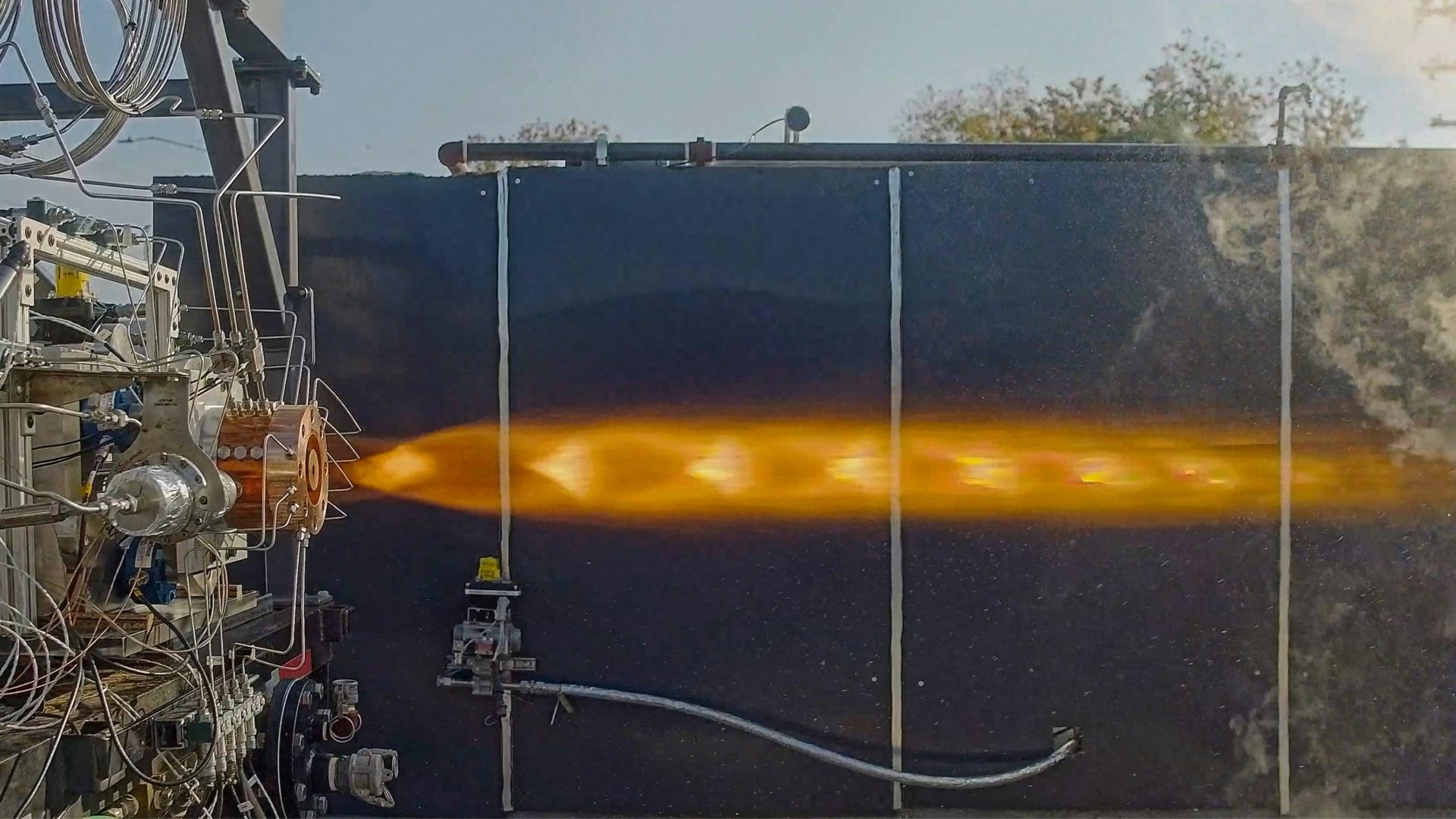
Japan Advances Hypersonic Propulsion with Mach 5 Engine Test
Japan’s space agency JAXA, in collaboration with Waseda University, has achieved a significant milestone in hypersonic technology by successfully testing the country’s first Mach 5 ramjet engine. This breakthrough could dramatically reduce flight times between Tokyo and Los Angeles from the current 12 hours to just two, heralding a new era in ultra-fast air travel.
Hypersonic Engine Test and Its Significance
In April, engineers at JAXA’s Kakuda Space Center conducted a test that demonstrated stable combustion within a ramjet engine operating at simulated speeds of Mach 5—approximately 5,400 kilometers per hour. This velocity is six times faster than conventional commercial jets and more than twice the speed of the Concorde. The test was performed at an altitude equivalent to 25 kilometers, which is double the cruising altitude of standard airliners. The experimental two-meter engine endured surface temperatures reaching 1,000°C, confirming its operational viability and thermal resilience under extreme conditions.
Professor Tetsuya Sato of Waseda University described the achievement as “only a first step,” emphasizing that the tested engine is merely one-fiftieth the size of a potential passenger aircraft. This underscores the substantial engineering challenges that remain before such technology can be scaled for commercial use.
Challenges in Commercializing Hypersonic Travel
Transforming this experimental technology into a viable commercial aircraft presents formidable obstacles. Designing a passenger jet capable of withstanding repeated exposure to intense thermal cycles—comparable to those experienced by reusable spacecraft—remains a critical engineering hurdle. The Japanese team envisions future iterations that might integrate rocket engines to enable suborbital flights, potentially bridging the gap between aviation and space tourism.
Professor Hideyuki Taguchi projects that it will take at least two decades to transition from experimental prototypes to commercial service, with a target deployment timeframe in the 2040s. This timeline depends heavily on continuous funding and technological advancements, both of which have historically impeded ambitious aerospace projects.
Market reception to hypersonic passenger travel is expected to be mixed. While some investors are enthusiastic about the prospect of drastically reduced travel times, others express caution due to the high costs and safety concerns associated with such advanced technology. The successful development and adoption of hypersonic aircraft will require not only substantial financial investment but also public trust and regulatory approval.
Competitive Landscape and Regulatory Considerations
Japan’s hypersonic ambitions enter a competitive and complex field. The ramjet engine approach competes with other emerging technologies, including SpaceX’s proposed point-to-point Starship service and efforts to revive supersonic commercial flight by companies such as Boom. Each approach faces unique challenges, including the management of sonic booms over populated areas, environmental impacts at stratospheric altitudes, and the absence of established safety certification frameworks for hypersonic passenger travel.
Regulatory approval remains a significant uncertainty, particularly for overland routes. Current regulations restrict supersonic flights primarily to oceanic corridors due to noise pollution concerns. Even if the technology matures, initial ticket prices for hypersonic flights are anticipated to be comparable to those of space tourism, potentially limiting early market adoption.
The Future of Ultra-Fast Air Travel
The successful Mach 5 engine test marks a pivotal advancement in the pursuit of hypersonic passenger travel, moving the concept closer to practical reality. However, the realization of routine hypersonic flights at major airports will depend on overcoming a complex array of engineering, financial, regulatory, and societal challenges. While the race to develop ultra-fast travel is underway, widespread commercial deployment remains a prospect for the coming decades.

Etihad Airways Suspends Airbus A380 Flights on Key Route

Aditya Birla Group Seeks Approval for Aircraft Leasing in GIFT City

Qatar Airways Highlights Innovation and Connectivity at Arabian Travel Market 2026

Hong Kong's Five-Year Plan Includes Andrew Fan's Aircraft Parts Processing Hub Proposal

ACIA Aero Leasing Delivers ATR72-600 to Air Nostrum

RTX Appoints Jill Albertelli as Head of Pratt & Whitney

TAT Technologies Joins Beyond Aero Hydrogen Aircraft Program

AURAK Study Highlights Barriers to Air Taxi Adoption in Emerging Economies

Xiamen Air Selects Altitude for 787 Maintenance at Heathrow

Etihad and Swissport Extend Global Partnership
