
Превращайте аналитические выводы ИИ в реальные действия

В тренде
Categories
Key Market Segments Shaping Airline Route Profitability Software
Key Market Segments Shaping Airline Route Profitability Software
The airline route profitability software market is garnering considerable attention as carriers worldwide strive to enhance operational efficiency and maximize revenue streams. Fueled by rapid technological advancements and an increasing reliance on data-driven decision-making, this sector is anticipated to experience significant growth in the coming years.
Market Size and Growth Outlook
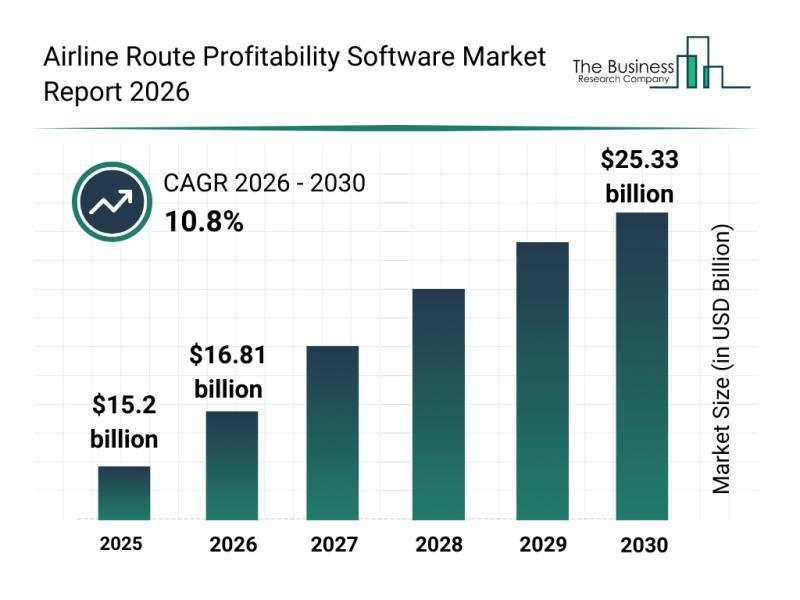
Industry projections estimate the airline route profitability software market will reach $25.33 billion by 2030, expanding at a compound annual growth rate (CAGR) of 10.8%. This growth is largely attributed to the widespread adoption of artificial intelligence-powered analytics, which facilitate more accurate assessments of route profitability. The integration of real-time operational and financial data into software platforms further strengthens decision-making capabilities. Cloud-based solutions are gaining prominence due to their scalability and flexibility in network planning, while advanced forecasting tools have become indispensable for navigating unpredictable demand patterns and market volatility.
The market expansion is also supported by comprehensive service offerings, including software updates, customization, and continuous performance monitoring. Key trends shaping the industry encompass real-time route profitability measurement, the integration of multi-channel fare data into pricing engines, and the rising demand for modular, adaptable profitability platforms. Additionally, there is notable growth in integrated scenario modeling for new route development and increased adoption of cloud-based route analytics, particularly among regional carriers.
Industry Leaders and Recent Developments
The competitive landscape is dominated by major players such as The Boeing Company, IBM, Infosys, Wipro, Amadeus IT Group, Sita Aero, Lufthansa Systems, Pros Inc., and Travelport Worldwide Ltd. These companies are heavily investing in innovation to sustain and enhance their market positions.
A significant development occurred in July 2024 when Portside, a US-based provider of cloud-based aviation software, acquired Takeflite, a New Zealand firm specializing in airline route profitability solutions. This strategic acquisition aims to broaden Portside’s portfolio, enabling airlines to better manage complex and dynamic operational demands through enhanced software capabilities.
Innovations and Emerging Trends
Industry participants are increasingly leveraging AI-driven tools to optimize flight schedules, thereby improving route efficiency, maximizing revenue, and refining operational decisions. These sophisticated algorithms analyze data related to scheduling, aircraft utilization, crew assignments, and route planning to enhance profitability while minimizing delays.
An illustrative example is the October 2024 partnership between Alaska Airlines and UP.Labs, which resulted in the launch of Odysee. This innovative tool can execute hundreds of simulations within seconds, significantly improving travel planning and enhancing the customer experience.
Market Challenges and Strategic Responses
Despite promising growth prospects, the market faces several challenges. Heightened competition and geopolitical volatility, underscored by concerns from carriers such as Korean Air, compel airlines to continuously adapt their strategies. Economic downturns pose particular risks to low-cost carriers that depend heavily on price-sensitive travelers, necessitating adjustments in routes, pricing structures, and service offerings.
In response, competitors are differentiating themselves through initiatives such as launching new routes, upgrading airport lounges, and modifying frequent flyer programs to sustain profitability. Furthermore, uncertainty in regions like Latin America and the Caribbean complicates route planning and profitability forecasting, demanding agile, data-driven approaches from airline executives.
Outlook
As airlines operate within a landscape characterized by rapid technological innovation and external uncertainties, the demand for sophisticated route profitability software is expected to accelerate. Providers capable of delivering adaptable, data-rich, and scalable solutions will be best positioned to support airlines in maintaining profitability and operational resilience amid an evolving global market.

Etihad Airways Suspends Airbus A380 Flights on Key Route

Aditya Birla Group Seeks Approval for Aircraft Leasing in GIFT City

Qatar Airways Highlights Innovation and Connectivity at Arabian Travel Market 2026

Hong Kong's Five-Year Plan Includes Andrew Fan's Aircraft Parts Processing Hub Proposal

ACIA Aero Leasing Delivers ATR72-600 to Air Nostrum

RTX Appoints Jill Albertelli as Head of Pratt & Whitney

TAT Technologies Joins Beyond Aero Hydrogen Aircraft Program

AURAK Study Highlights Barriers to Air Taxi Adoption in Emerging Economies

Xiamen Air Selects Altitude for 787 Maintenance at Heathrow

Etihad and Swissport Extend Global Partnership
