
Превращайте аналитические выводы ИИ в реальные действия

В тренде
Categories
MRO meets AI: The race to protect passengers and profit margins
MRO Meets AI: The Race to Protect Passengers and Profit Margins
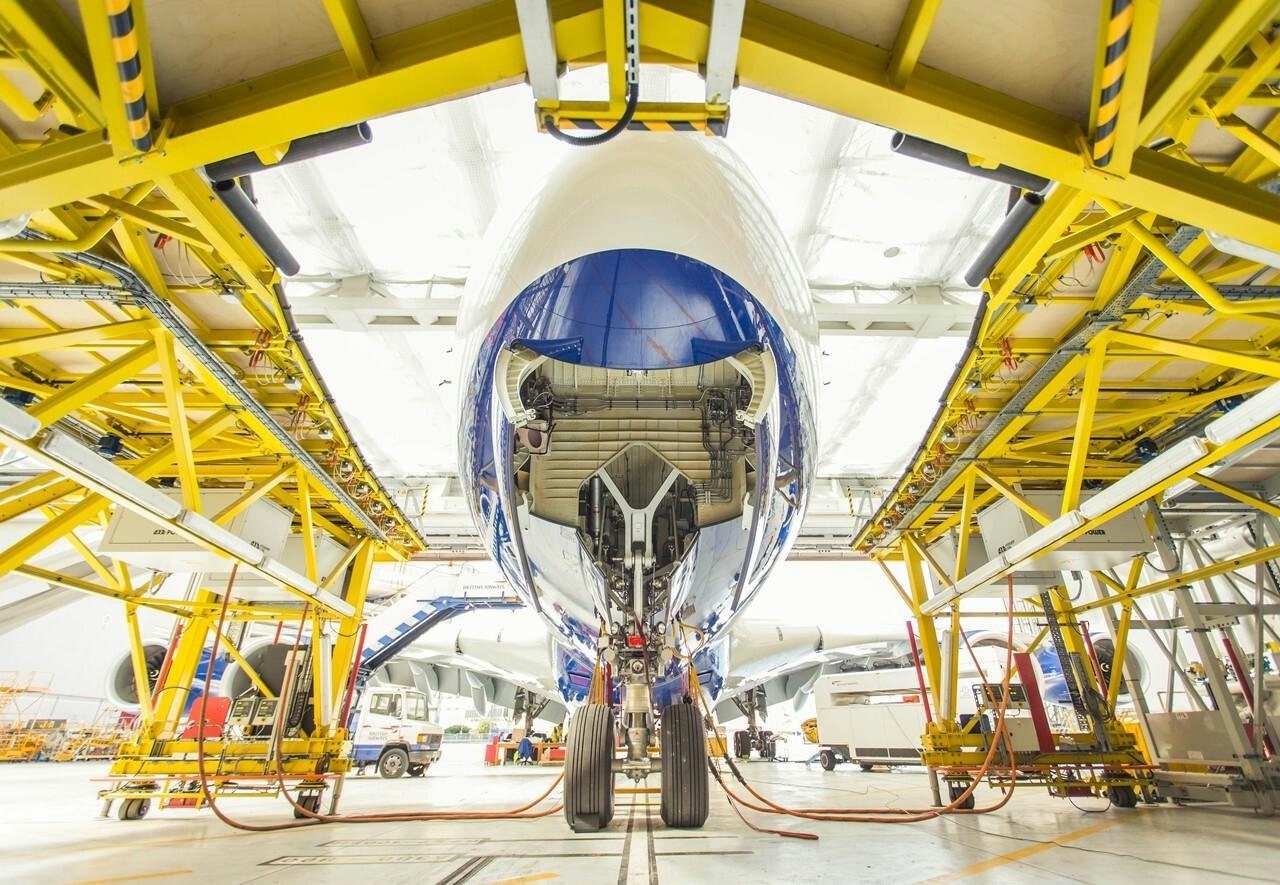
Maintenance, repair, and overhaul (MRO) costs in the aviation industry are escalating rapidly. EasyJet, for instance, has projected an MRO expenditure of £451 million for 2025, a significant increase from £390 million the previous year. This equates to approximately £8.7 million per week or £1.24 million daily. EasyJet’s figures reflect a broader industry challenge where the flawless performance of every aircraft component is critical. Even a minor oversight can lead to grounded flights, substantial financial losses, or more severe consequences.
For decades, aircraft maintenance has depended on the expertise of skilled technicians conducting thorough inspections and servicing under stringent time constraints. While indispensable, this traditional approach is inherently slow, labor-intensive, and limited by human capacity. The advent of artificial intelligence (AI) is now reshaping this landscape, offering new possibilities for efficiency and precision.
AI Enhances Detection and Predictive Maintenance
Aerospace engineers are increasingly employing AI to identify minute defects that escape human detection, analyze extensive sensor data within seconds, and forecast failures before they occur. Hybrid predictive models combined with real-time health monitoring have elevated detection rates to as high as 95 percent, marking a substantial advancement in maintenance capabilities.
Continuous monitoring is now possible for every major aircraft component, including engines, avionics, landing gear, and fuselage. This proactive approach enables early identification of issues that previously caused unexpected delays, thereby mitigating risks and reducing costs.
Transforming MRO Through Data-Driven Platforms
The most significant progress stems from AI-integrated platforms that convert raw aircraft and engine data into actionable intelligence. Systems such as Rolls-Royce’s IntelligentEngine, Airbus’ Skywise Predictive Maintenance, and Boeing’s Insight Accelerator harness data from thousands of onboard sensors tracking variables like engine temperature, oil consumption, and vibration. This information is processed in the cloud, allowing engineers to anticipate problems and optimize maintenance schedules effectively.
These platforms not only predict component lifespans but also create digital twins—virtual replicas that simulate real-world engine behavior. A Boeing engineer noted that the Insight Accelerator enables MRO teams to move beyond traditional scheduled maintenance toward predictive, condition-based strategies. This shift reduces aircraft on ground (AOG) events, accelerates repairs, and optimizes spare parts management.
The Role of Drones, Cobots, and Human Expertise
Technological advancements extend beyond AI algorithms. Autonomous drones equipped with high-resolution cameras, thermal imaging, and LiDAR can scan entire aircraft in under twenty minutes, a task that previously required up to ten hours of manual labor. Collaborative robots, or cobots, are increasingly deployed to perform repetitive or hard-to-reach tasks with enhanced speed and accuracy. Lufthansa Technik, for example, utilizes cobots to streamline inspection and repair processes.
Despite these innovations, human expertise remains indispensable. While AI can flag potential issues, only certified engineers possess the judgment to interpret anomalies, consider contextual factors, and ultimately certify an aircraft’s airworthiness in compliance with regulatory authorities such as the Civil Aviation Authority (CAA), Federal Aviation Administration (FAA), and European Union Aviation Safety Agency (EASA).
Challenges and Market Implications
The integration of advanced AI technologies into existing MRO operations presents significant challenges. Substantial investments in infrastructure and workforce training are often necessary. Market responses have been mixed; some companies report enhanced efficiency and profitability, while others grapple with the high costs and complexities associated with AI adoption. Industry competitors are adopting varied strategies, with some aggressively pursuing AI-driven innovation to gain a competitive advantage, while others prefer incremental improvements.
Although AI innovation is delivering record results in certain sectors, ongoing economic uncertainties and elevated costs may influence broader market dynamics. The race to harness AI in MRO continues, with critical implications for both passenger safety and the financial health of aviation operators.

Etihad Airways Suspends Airbus A380 Flights on Key Route

Aditya Birla Group Seeks Approval for Aircraft Leasing in GIFT City

Qatar Airways Highlights Innovation and Connectivity at Arabian Travel Market 2026

Hong Kong's Five-Year Plan Includes Andrew Fan's Aircraft Parts Processing Hub Proposal

ACIA Aero Leasing Delivers ATR72-600 to Air Nostrum

RTX Appoints Jill Albertelli as Head of Pratt & Whitney

TAT Technologies Joins Beyond Aero Hydrogen Aircraft Program

AURAK Study Highlights Barriers to Air Taxi Adoption in Emerging Economies

Xiamen Air Selects Altitude for 787 Maintenance at Heathrow

Etihad and Swissport Extend Global Partnership
