image

AeroGenie — ваш интеллектуальный второй пилот.

Спрашивайте о чём угодно. Анализируйте всё. Действуйте мгновенно.

В тренде

Categories

Munich Airport CEO Jost Lammers Named Chair of ACI World Governing Board
January 12, 2026By ePlane AI
Munich Airport CEO Jost Lammers Named Chair of ACI World Governing Board
0
0
Munich Airport
ACI World Governing Board
Airport Leadership

Munich Airport CEO Jost Lammers Appointed Chair of ACI World Governing Board

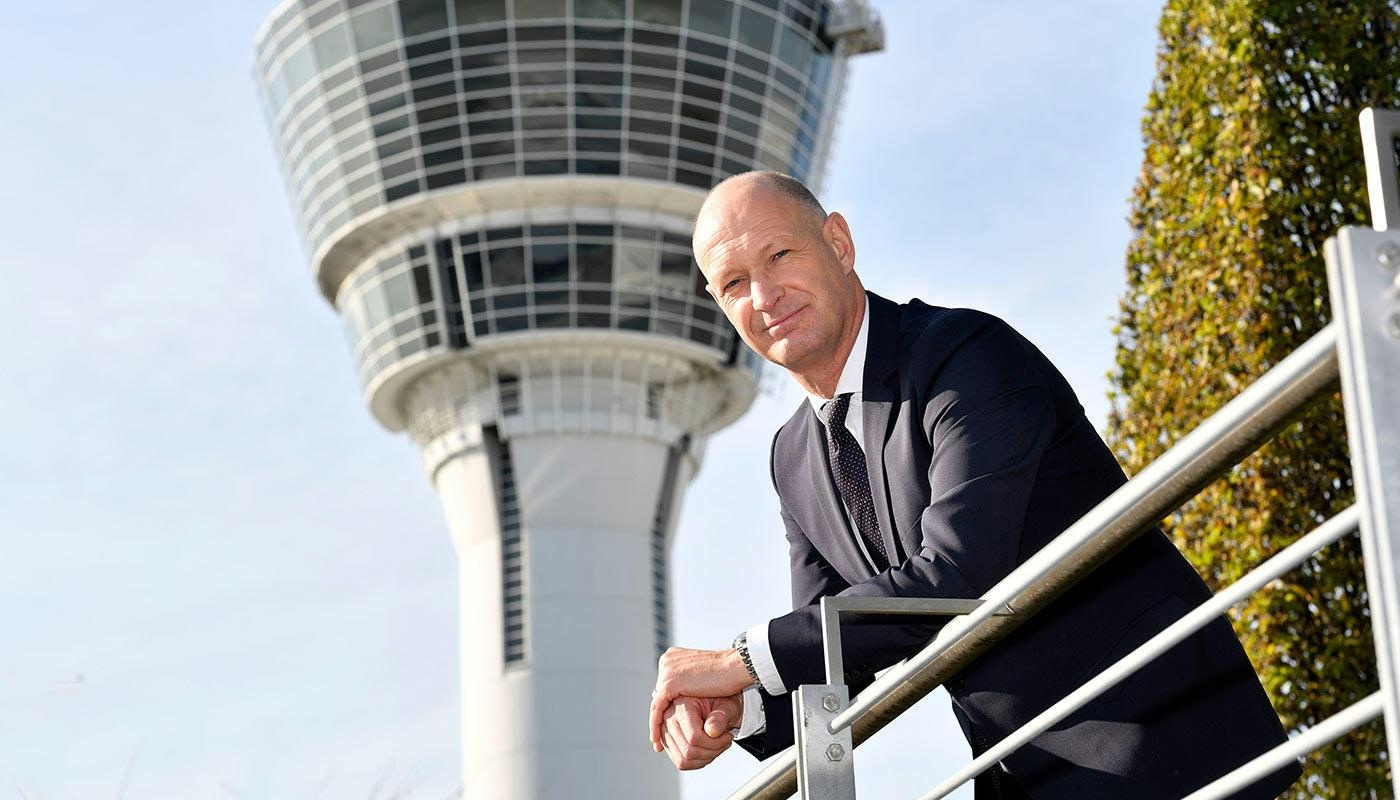
Jost Lammers, the Chief Executive Officer of Munich Airport, has been named Chair of the Airports Council International (ACI) World Governing Board for the 2026–2027 term. This appointment comes at a critical juncture for the global aviation sector, as the industry navigates profound transformation. Lammers is widely recognized for his extensive leadership experience in airport operations, with a strong emphasis on innovation and sustainability.

Leadership Transition and Board Role

Lammers succeeds Candace McGraw, the retired CEO of Cincinnati/Northern Kentucky International Airport (CVG), who notably was the first woman to chair the ACI World Governing Board. McGraw’s tenure was marked by enhanced global advocacy and strategic initiatives that supported airports through challenging periods, leaving a significant legacy within the organization.

The ACI World Governing Board, composed of 28 airport CEOs nominated by ACI’s five regional bodies, holds a pivotal role in shaping global airport policy. Its decisions impact critical areas such as sustainability, safety, operational efficiency, and technological advancement. As Chair, Lammers will be responsible for steering the board through a volatile operating environment characterized by ongoing post-pandemic recovery, supply-chain disruptions, and technical challenges such as engine reliability issues. These factors, recently highlighted by Air Canada’s network planning adjustments, have intensified scrutiny on industry leadership and underscored the need for resilient and adaptable strategies.

Experience and Vision

Lammers brings considerable expertise to his new position. He has been a member of the ACI World Governing Board since 2019 and served as Vice Chair for the 2024–2025 term. His leadership at ACI EUROPE, where he was President in 2019, was instrumental in guiding European airports through the COVID-19 crisis and fostering enhanced regional collaboration. Since January 2020, Lammers has led Munich Airport, one of Europe’s premier international hubs, with a focus on service excellence, innovation, and sustainable development. Prior to this, he was CEO of Budapest Liszt Ferenc Airport, overseeing significant modernization and expansion projects, and served as President of the German Aviation Association (BDL).

Looking forward, Lammers is expected to prioritize initiatives addressing the aviation industry’s most urgent challenges, including accelerating digital transformation and advancing sustainability objectives. His leadership will be crucial in ensuring that airports remain innovative, resilient, and sustainable amid ongoing global uncertainties.

With Lammers at the helm, ACI World embarks on a new chapter defined by both opportunity and heightened expectations as the aviation sector adapts to a rapidly evolving landscape.

More news
Airbus Confirms 2025 Delivery Target and Highlights A350 Sales

Airbus Confirms 2025 Delivery Target and Highlights A350 Sales

Airbus Confirms 2025 Delivery Target Amid Supply Chain Challenges Airbus announced that it delivered 793 aircraft in 2025, successfully meeting its revised annual target despite ongoing supply chain and production difficulties. The European aerospace manufacturer had initially projected around 820 deliveries at the start of the year but was compelled to lower its guidance to approximately 790 aircraft following quality issues with fuselage panels on its A320 model and a recall for a software upgrade. Surpassing this adjusted goal reflects Airbus’s operational resilience in a challenging market environment. The company also reported a significant reduction in the number of engineless A320 “gliders”—aircraft awaiting engines—from a peak of 60 last year to what officials described as a “manageable” small number. While supply chain disruptions persist, particularly concerning aircraft interiors, Christian Scherer, who stepped down as CEO of Airbus Commercial Aircraft on December 31, emphasized that no widebody aircraft are currently grounded awaiting components. Scherer, now in a transitional role alongside his successor Lars Wagner, addressed the media for the final time in his former capacity. Strong Momentum for the A350 Program and Market Dynamics Benoit de Saint-Exupéry, Executive Vice President of Sales for Commercial Aircraft, highlighted the growing momentum behind Airbus’s flagship A350 program. In 2025, Airbus secured orders for 193 A350s, including a significant Memorandum of Understanding with Air Europa for 20 A350-900s. This agreement, expected to be finalized within the year, aims to replace Air Europa’s aging Boeing 787 fleet. Saint-Exupéry noted that Air Europa’s decision underscores the A350 platform’s superior economics and performance as the ideal solution for the airline’s next phase of growth. As airlines approach the first wave of replacements for early 787 fleets, Airbus anticipates that more carriers will follow Air Europa’s lead, not only with the A350-900 but also with the larger A350-1000, which is increasingly favored as a replacement for Boeing 777s. Despite Airbus’s successes, Boeing also reported a strong year, announcing over 300 orders for its 787 Dreamliner in 2025—its best performance in years. When questioned about Boeing’s sales achievements and whether they stemmed from superior sales campaigns or political influence, Saint-Exupéry remarked, “I would simply say the answer is in the question.” He acknowledged that Airbus prevailed in two out of three open sales campaigns against Boeing in 2025 but recognized the 787’s earlier market entry and sustained appeal for repeat orders. Scherer conceded that Boeing benefited from political backing, stating, “Fair enough. What it means for us is that we just have to be more convincing than our competitor and its political support on the quality of our products.” Airbus is scheduled to release its audited year-end commercial data on January 12, which is expected to provide further insights into its 2025 performance and strategic outlook.
Airbus Aircraft Orders and Deliveries Through 2025

Airbus Aircraft Orders and Deliveries Through 2025

Airbus Exceeds Delivery Targets in 2025 Amid Robust Market Demand TOULOUSE — Airbus delivered a total of 793 commercial aircraft in 2025, surpassing its revised annual target of 790, according to Bloomberg News. This represents a 4% increase compared to the 766 aircraft delivered in 2024, with single-aisle models continuing to dominate the delivery mix. The company’s ability to exceed expectations highlights the sustained strength of its production capabilities despite facing operational challenges earlier in the year. Operational Challenges and Production Resilience Airbus encountered several hurdles in 2025, including a recall prompted by a necessary software upgrade and the identification of fuselage panels that failed to meet quality specifications. Despite these setbacks, the manufacturer maintained steady production momentum, demonstrating the resilience of its supply chain and manufacturing processes. This performance underscores Airbus’s capacity to manage complex operational issues without compromising delivery schedules. Order Book and Market Demand In 2025, Airbus secured 1,000 gross orders, translating to 889 net orders after cancellations, from 57 customers worldwide. The year ended with a record backlog of 8,754 aircraft, including 1,124 widebody jets, reflecting strong and sustained demand across its entire product range. A notable highlight was the firm order from China Aircraft Leasing Group Holdings Limited (CALC) for 30 additional A320neo Family aircraft, emphasizing the continued appeal of Airbus’s single-aisle models in key markets. Airbus is scheduled to release its audited year-end commercial data on January 12, 2026, which is expected to provide further insights into its delivery performance. The company’s full-year financial results will follow on February 19, 2026.
Dassault Aviation Leads $200 Million Investment in AI Defense Startup

Dassault Aviation Leads $200 Million Investment in AI Defense Startup

Dassault Aviation Leads $200 Million Investment in AI Defense Startup Dassault Aviation is leading a $200 million funding round in Harmattan AI, a Paris-based defense technology startup, highlighting the increasing significance of artificial intelligence in contemporary military systems. This investment values Harmattan AI at approximately $1.4 billion and is intended to accelerate the integration of sophisticated AI capabilities into future defense platforms, with a particular emphasis on unmanned aerial vehicles (UAVs). The decision to invest comes amid shifting global defense priorities driven by recent conflicts and escalating geopolitical tensions, which have heightened demand for autonomous systems and advanced threat assessment technologies. Dassault Aviation is already incorporating AI into its forthcoming Rafale F5 fighter jet and associated unmanned systems, aiming to enhance autonomous operations and enable real-time battlefield decision-making. French President Emmanuel Macron has publicly endorsed the investment, emphasizing its importance in reinforcing France’s strategic autonomy and technological leadership within its armed forces. The market has responded favorably, interpreting the deal as a crucial move to sustain France’s position at the forefront of defense innovation. Nonetheless, Dassault’s ambitious expansion into AI-driven defense technologies faces significant challenges. The integration of cutting-edge AI into existing military platforms presents both technical and operational complexities, while regulatory scrutiny concerning defense-related AI applications remains a potential impediment. Furthermore, this investment is expected to intensify competition, as rival defense companies may accelerate their own AI initiatives to remain competitive. Company Overview and Financial Position Dassault Aviation, a subsidiary of the French multinational Dassault Group, is a prominent designer and manufacturer of military fighter jets and business aircraft. The company holds a 26% stake in Thales, a major contributor to its net profit. In 2024, Dassault Aviation reported revenues of EUR 6.2 billion and employed approximately 14,600 people. Defense aircraft equipment and services constitute 62% of its revenue, with Falcon business jets accounting for the remaining 38%. Operating within the Industrials sector and the Aerospace & Defense industry, Dassault Aviation has a market capitalization of $28.03 billion. Despite its strong market presence, Dassault has experienced a 3% revenue decline over the past three years. The company, however, maintains solid profitability, with a net margin of 11.93% and an operating margin of 8.51%. Its balance sheet remains robust, characterized by a low debt-to-equity ratio of 0.03 and an interest coverage ratio of 76.01, indicating a strong capacity to service debt obligations. Nevertheless, the Altman Z-Score of 1.02 places Dassault in the distress zone, signaling a potential risk of financial instability within the next two years. From a valuation standpoint, Dassault’s price-to-earnings (P/E) ratio of 33.56 approaches its five-year high, while its price-to-sales (P/S) and price-to-book (P/B) ratios are also elevated, suggesting the stock may be overvalued. Technical indicators support this assessment, with a Relative Strength Index (RSI-14) of 72.03 indicating overbought conditions. Outlook Dassault Aviation’s substantial investment in Harmattan AI represents a significant milestone in the advancement of AI-powered defense technologies. While this initiative positions Dassault at the cutting edge of military innovation, it also introduces considerable integration and regulatory challenges, alongside increased competition within the sector. The company’s financial resilience and strategic foresight will be essential as it navigates the complexities of this rapidly evolving landscape.
Eutelsat Advances $2.56 Billion OneWeb Upgrade with 340-Satellite Airbus Order, Launches Set for 2026

Eutelsat Advances $2.56 Billion OneWeb Upgrade with 340-Satellite Airbus Order, Launches Set for 2026

Eutelsat Advances $2.56 Billion OneWeb Upgrade with 340-Satellite Airbus Order Eutelsat has reaffirmed its strategic commitment to the future of satellite communications by placing a €2.2 billion ($2.56 billion) order for 340 OneWeb satellites with Airbus. This significant contract, announced on January 12, follows an initial order of 100 satellites made in December 2024 and comes after Eutelsat successfully stabilized its financial position to support the full investment. The new satellites are slated for launch beginning in 2026, marking a critical phase in the company’s efforts to maintain and expand the OneWeb Gen 1 constellation into the next decade. Expansion and Strategic Positioning The planned satellite launches align with Eutelsat’s broader strategy to extend its low-Earth-orbit (LEO) network and strengthen its presence in the increasingly competitive global satellite internet market. This expansion is intended to ensure uninterrupted service for the OneWeb Gen 1 constellation well into the 2030s, providing a bridge to the eventual transition to the European Commission’s Iris2 secure communications network. By reinforcing its LEO capabilities, Eutelsat aims to secure a more robust foothold in the race to deliver high-speed, reliable internet access worldwide, particularly targeting underserved regions and addressing growing global data demands. Challenges and Market Dynamics Despite the ambitious nature of this upgrade, Eutelsat faces considerable challenges, including the high costs associated with satellite manufacturing and launch logistics. The company must also navigate complex regulatory approvals while contending with intensifying competition from other satellite internet providers. Notably, SpaceX’s Starlink continues to accelerate its satellite deployments and enhance its service offerings, heightening competitive pressures within the sector. Market reactions to Eutelsat’s announcement have been positive, with increased investor interest reflecting growing confidence in the long-term demand for global broadband connectivity. Industry competitors are expected to respond by accelerating their own deployment schedules or introducing new technologies to maintain market share. Eutelsat’s substantial investment underscores the escalating competition and innovation driving the satellite internet industry as operators strive to connect more users worldwide.
Russia Begins Flight Tests of Mi-34M1 Helicopter with New Engine

Russia Begins Flight Tests of Mi-34M1 Helicopter with New Engine

Russia Initiates Flight Testing of Upgraded Mi-34M1 Helicopter Featuring New Engine Russia has commenced flight tests of the modernized Mi-34M1 light multipurpose helicopter, as evidenced by recently released footage from a test airfield. The Mi-34M1 represents an updated iteration of the original Mi-34, which first took to the skies in 1986. Initially developed as a Soviet counterpart to Western light helicopters such as the Robinson R44, the Mi-34 saw limited production, with only around 30 units manufactured. Engine Upgrade and Technical Specifications The most notable enhancement in the Mi-34M1 is the integration of the domestically designed VK-650V turboshaft engine. This powerplant, engineered for helicopters with a maximum takeoff weight of up to four tons, delivers 650 horsepower during takeoff. Its performance metrics are comparable to those of the Ukrainian AI-450V engine, which currently powers several modern light helicopters and unmanned aerial vehicles. By adopting the VK-650V, Russia aims to reduce its dependence on Western and Ukrainian engine suppliers for this class of aircraft. Despite this significant upgrade, the Mi-34 airframe remains largely unchanged and is widely regarded as technically outdated. The design imposes inherent limitations on internal space, operational range, and payload capacity. Consequently, the Mi-34M1 is expected to serve primarily in roles such as pilot training, communications, and patrol missions, rather than competing as a versatile multi-role helicopter. The reliance on a design dating back to the 1980s underscores the persistent challenges Russia faces in developing and deploying modern light rotary-wing aircraft. Challenges and Market Context The introduction of the VK-650V engine presents its own set of hurdles. Ensuring the engine’s reliability and consistent performance across diverse operational environments will be critical, and the certification process may encounter delays. While the upgraded engine could attract interest from military customers seeking advanced helicopter technology, ongoing geopolitical tensions are likely to constrain international sales prospects. In the global market, Western manufacturers are anticipated to continue advancing helicopter and engine technologies. Companies such as Pratt & Whitney are developing high-performance engines, exemplified by the F119 used in the F-22 fighter jet, while the United States Air Force pursues autonomous fighter programs. These developments highlight the competitive environment Russia confronts as it endeavors to modernize its rotary-wing fleet. Ultimately, the Mi-34M1 appears to function more as a test platform for the VK-650V engine than as a serious contender in the global light helicopter market. The project reflects Russia’s broader efforts to achieve technological self-sufficiency amid the complex challenges of introducing new-generation aircraft in a highly competitive international landscape.
Harmattan AI Secures $200 Million Series B Led by Dassault Aviation, Achieves Unicorn Status

Harmattan AI Secures $200 Million Series B Led by Dassault Aviation, Achieves Unicorn Status

Harmattan AI Secures $200 Million Series B Led by Dassault Aviation, Achieves Unicorn Status French defense technology startup Harmattan AI has achieved a valuation of $1.4 billion following the successful closure of a $200 million Series B funding round led by Dassault Aviation, the renowned manufacturer of the Rafale fighter jet. Founded in 2024, Harmattan AI specializes in developing autonomy and mission-system software for defense aircraft, rapidly earning recognition from both the French and British ministries of defense. Strategic Partnership and Industry Positioning This latest investment represents a pivotal moment for Harmattan AI, which has often been compared to the U.S. defense technology firm Anduril. Initially positioning itself as a challenger to established defense contractors, the company is now embracing collaboration with industry leaders. The partnership with Dassault Aviation will focus on integrating advanced artificial intelligence capabilities into future generations of Rafale jets and drones, emphasizing technological sovereignty and scalability. This alliance underscores a shared commitment to advancing European defense innovation while maintaining strategic autonomy. Expanding Capabilities Amid Evolving Defense Needs The rapid evolution of drone warfare, particularly highlighted by recent conflicts in Ukraine, has intensified the need for NATO and allied forces to modernize their defense systems. This environment has created significant momentum for startups like Harmattan AI, which aims to broaden its portfolio to include drone interception, electronic warfare, and intelligence, surveillance, and reconnaissance (ISR) technologies. The company’s recent partnership with Russian drone manufacturer Skyeton further signals its ambition to expand manufacturing capabilities and extend its operational reach. French President Emmanuel Macron hailed the funding announcement as “excellent news for our strategic autonomy, for the technological superiority of our armed forces in the field of AI-activated defense drones, as well as for our economy.” Market responses have been largely positive, with analysts highlighting the strategic advantages this development offers to France and Europe. Beyond its domestic ambitions, Harmattan AI has articulated a vision to “empower the armed forces of liberal democracies and their allies.” The company is preparing to showcase its technology at the upcoming World Defense Show in Riyadh and is actively expanding its presence in the United States. Challenges and Competitive Landscape Despite its rapid rise, Harmattan AI faces considerable challenges. Sustaining a competitive edge in the fast-evolving defense AI sector will demand continuous innovation and rigorous adherence to security and international defense regulations, especially as the company pursues global expansion. The expectations accompanying this substantial funding round will also place pressure on Harmattan AI to deliver tangible results and maintain growth momentum. Competitors are anticipated to intensify their investments in AI-driven defense technologies, heightening the race for technological leadership. As Harmattan AI leverages its new resources and strategic partnerships, its capacity to navigate these challenges will be crucial in securing its position at the forefront of European defense technology innovation.
Eutelsat Orders 340 OneWeb Satellites from Airbus

Eutelsat Orders 340 OneWeb Satellites from Airbus

Eutelsat Orders 340 OneWeb Satellites from Airbus Eutelsat, the satellite operator supported by the French and British governments, has placed an order for 340 new satellites from Airbus to upgrade and expand its OneWeb low-Earth-orbit (LEO) network. The announcement was made jointly by the companies on Monday, marking a significant step in the evolution of OneWeb’s satellite constellation. Expansion and Replacement of OneWeb Satellites The newly ordered satellites will gradually replace OneWeb’s earliest spacecraft, which are approaching the end of their operational lifespans. These initial satellites were launched approximately six years ago, prior to OneWeb’s merger with Eutelsat in 2023. This latest order, combined with a previous contract for 100 satellites secured in December 2024, brings the total number of new satellites contracted for OneWeb to 440. Deliveries are expected to commence at the end of 2026. Although financial details were not disclosed, Eutelsat has previously estimated that extending the constellation until the European Union’s Iris² network becomes operational will require an additional 340 satellites beyond the initial 100. The total cost of this extension program is projected to range between €2 billion and €2.2 billion over the period from 2024 to 2029. Strategic Positioning Amid Intensifying Competition Eutelsat’s expansion occurs against the backdrop of intensifying competition in the LEO satellite market, particularly from SpaceX’s Starlink, which remains the dominant player. Both companies are engaged in a race to provide satellite-based broadband connectivity to businesses, governments, and consumers in underserved regions worldwide. Currently, OneWeb’s network stands as the only other LEO constellation of comparable scale to Starlink, attracting heightened interest from European governments concerned with digital sovereignty and connectivity. The financial backing from France, the United Kingdom, and other anchor investors has fortified Eutelsat’s position in this competitive landscape. In 2025, France led a €1.5 billion capital increase, joined by the UK and other stakeholders, to strengthen the company’s financial foundation and support its ambitious satellite deployment plans. Market analysts suggest that Eutelsat’s latest satellite order could stimulate increased investor interest in satellite broadband services. Competitors may respond by accelerating their own satellite launches or enhancing existing offerings to maintain their market share. As the global race for satellite internet coverage intensifies, Eutelsat’s expanded collaboration with Airbus, combined with robust government support, positions the company as a key contender in the rapidly evolving LEO satellite sector.
Allegiant and Sun Country Airlines Announce Merger Agreement

Allegiant and Sun Country Airlines Announce Merger Agreement

Allegiant and Sun Country Airlines Announce $1.5 Billion Merger Agreement Allegiant Air and Sun Country Airlines have reached a definitive agreement for Allegiant to acquire Sun Country in a transaction valued at approximately $1.5 billion, inclusive of $400 million in net debt. The deal, structured as a cash-and-share exchange, values Sun Country shares at $18.89 each. Shareholders will receive 0.1557 Allegiant shares plus $4.10 in cash per Sun Country share, representing a premium of 19.8% over Sun Country’s closing price on January 9, 2026, and an 18.8% premium relative to the 30-day volume-weighted average price. Upon closing, Allegiant shareholders will hold approximately 67% ownership of the combined entity, with Sun Country shareholders owning the remaining 33%. The merger is set to create one of the largest leisure-focused airlines in the United States, expanding the network to include a broader range of popular domestic vacation destinations alongside select international routes. The unified airline aims to enhance access to affordable and convenient air travel while establishing a resilient business model capable of swiftly adapting to fluctuations in demand, market conditions, and opportunities in charter and cargo services. Strategic Implications and Operational Structure Both carriers emphasized that the merger of two financially robust leisure airlines is expected to deliver significant benefits to customers, employees, and communities by fostering greater stability, improved growth prospects, and sustained investment in innovation. The transaction is also projected to yield operational synergies and cost efficiencies, thereby strengthening the combined group’s competitive position within the industry. Investor response to the announcement has been largely positive, reflecting optimism about the potential for enhanced growth and operational efficiency. Nevertheless, the merger may face regulatory scrutiny amid ongoing concerns regarding consolidation in the airline sector. Competitors are anticipated to monitor the development closely and may respond with pricing strategies or expanded leisure service offerings to protect their market share. Allegiant will remain the publicly traded parent company, and the merged airline will operate under the Allegiant brand. Until the Federal Aviation Administration issues a single operating certificate, Allegiant and Sun Country will continue to operate as separate airlines, maintaining their existing ticketing systems, flight schedules, customer experiences, and the Sun Country brand. Customers will be able to book and travel with both airlines as usual during this interim period. Leadership and Headquarters Leadership of the combined company will be led by Allegiant CEO Gregory C. Anderson, with Robert Neal serving as President and Chief Financial Officer. Sun Country President and CEO Jude Bricker will join the Allegiant Board of Directors, accompanied by two additional Sun Country board members, expanding the board to 11 directors. Maury Gallagher will continue in his role as Chairman, while Bricker will also act as an advisor to facilitate the integration process. The headquarters of the merged airline group will be located in Las Vegas, with a significant operational presence maintained in Minneapolis–St. Paul, the home base of Sun Country Airlines.
US$200m JV to build autonomous cargo aircraft in Abu Dhabi

US$200m JV to build autonomous cargo aircraft in Abu Dhabi

US$200 Million Joint Venture to Manufacture Autonomous Cargo Aircraft in Abu Dhabi Barq Group and US-based Elroy Air have announced a US$200 million joint venture to establish a manufacturing facility in Abu Dhabi dedicated to producing the Chaparral autonomous cargo aircraft. Pending regulatory approvals, the partnership aims to position Abu Dhabi as a regional hub for advanced air mobility, targeting commercial and humanitarian logistics markets across the Middle East and North Africa (MENA). Strategic Partnership and Technological Innovation The collaboration leverages Barq Group’s expertise in smart mobility and logistics solutions throughout the MENA region alongside Elroy Air’s pioneering work in autonomous aerial systems for middle-mile logistics. The new facility will manufacture the Chaparral, a hybrid-electric vertical take-off and landing (VTOL) uncrewed aircraft system designed specifically for cargo operations. The Chaparral can carry a 300-pound payload over distances exceeding 300 miles, utilizing a hybrid-electric powertrain that enables extended range missions without dependence on charging infrastructure. This capability is particularly advantageous for remote and infrastructure-light environments prevalent in the region. Beyond manufacturing, the joint venture will offer comprehensive aftermarket support, including maintenance, repair, and overhaul services, thereby creating an integrated regional capability. Local production is expected to enhance scalability, reduce lead times, and strengthen supply chain reliability. These improvements address the region’s increasing demand for resilient and efficient logistics solutions amid rapid economic growth and complex geographic challenges. Economic and Regulatory Context Ahmed AlMazrui, CEO of Barq Group, described the initiative as a strategic commitment to Abu Dhabi’s role in shaping the future of mobility. He highlighted that the investment supports the development of a self-sustaining aerospace ecosystem within the UAE and aligns with the national “Make it in the Emirates” initiative. The project also complements the objectives of Abu Dhabi’s Smart and Autonomous Vehicle Industry (SAVI) cluster, aiming to generate high-value aerospace jobs, stimulate regional supply chain development, and deliver long-term economic benefits. Nevertheless, the venture faces several challenges. Regulatory hurdles remain significant, as the autonomous cargo aircraft sector is still evolving and subject to stringent aviation standards. Technological uncertainties, particularly regarding the reliability and safety of autonomous flight systems, could affect project timelines and market readiness. Market acceptance is another critical factor, with investor sentiment divided between optimism for advanced air mobility and caution due to the industry’s nascent stage. Competition within the autonomous cargo segment is expected to intensify, with established players such as Textron eAviation and Pipistrel likely to increase their efforts to secure market share. The success of the Barq-Elroy Air joint venture could catalyse further investments and partnerships in the sector, reflecting recent developments such as Archer Aviation’s new UK aerospace engineering hub and the US Federal Aviation Administration’s ongoing overhaul of beyond-visual-line-of-sight (BVLOS) regulations. The Chaparral marked a significant milestone in November 2023 by completing the world’s first flight of a turbo generator hybrid-electric aircraft. As the joint venture progresses, its developments will be closely monitored as an indicator of the future trajectory of autonomous cargo aviation in the region and beyond.
The Battle for the Skies: Air India’s Widebody Bet vs IndiGo’s XLR Gambit

The Battle for the Skies: Air India’s Widebody Bet vs IndiGo’s XLR Gambit

The Battle for the Skies: Air India’s Widebody Bet vs IndiGo’s XLR Gambit Shifting Dynamics in Indian Aviation For much of the past decade, the Indian aviation sector has been characterized by a clear division of roles: IndiGo dominated the domestic market through relentless operational efficiency, while Air India, supported by state backing and legacy international routes, maintained its position as a key player on the global stage. As 2026 approaches, this familiar landscape is undergoing a profound transformation. Air India’s post-privatisation phase is evolving from internal restructuring to a visible overhaul of its fleet, while IndiGo is ambitiously extending its reach beyond short-haul dominance into the long-haul international market. Divergent Fleet Strategies and Market Philosophies At the core of this emerging rivalry lies a fundamental clash of business philosophies and fleet strategies. Tata Group-backed Air India is committing to a traditional hub-and-spoke model, investing heavily in widebody aircraft to attract premium travelers and provide non-stop intercontinental connectivity. The airline’s introduction of its first post-privatisation “line-fit” Boeing 787-9 Dreamliners marks a significant milestone, enabling Air India to offer a premium product aligned with global standards. This is a critical step in regaining the confidence of international business travelers. Air India’s strategy focuses on yield management, targeting high-spending corporate and long-haul passengers who prioritize comfort, reliability, and the time savings afforded by direct routes. Equipped with true widebody aircraft featuring lie-flat business class seats, the airline aims to deliver a consistent and premium experience that narrowbody aircraft cannot easily replicate. An industry analyst encapsulated this approach by stating, “Air India isn’t just selling a seat; it’s selling time, comfort, and direct access.” However, this widebody-centric approach carries inherent risks. The substantial costs associated with acquiring and maintaining larger aircraft, the potential for overcapacity, and the challenge of competing with IndiGo’s expanding long-haul network present significant hurdles. Market responses have been mixed, with some experts describing Air India’s strategy as ambitious yet fraught with risk, particularly given the pressure to maintain high load factors on ultra-long-haul routes. In contrast, IndiGo is capitalizing on the Airbus A321XLR—a long-range, fuel-efficient narrowbody aircraft—as a disruptive force in the long-haul market. Rather than competing on luxury, IndiGo is reshaping the economics of long-haul flying by deploying aircraft that serve thinner international routes with fewer seats and lower operating costs. This approach mitigates the risk of underfilled widebodies and makes direct flights viable on routes where demand is still emerging. IndiGo’s aggressive expansion is already visible. The airline recently received its first A321XLR and plans to deploy it on routes such as Athens, signaling a strategic push into new international markets. By leveraging its scale, pricing discipline, and operational efficiency on longer sectors, IndiGo is capturing market share and challenging traditional long-haul models. The carrier is also evolving its product offering, introducing a premium “IndiGoStretch” service designed to attract higher-yield passengers, particularly business travelers seeking enhanced comfort on extended flights. A High-Stakes Contest for India’s Aviation Future As Air India and IndiGo pursue markedly different strategies—one betting on the strength of premium widebody aircraft, the other on efficient, direct narrowbody connectivity—the competition for India’s skies transcends mere market share. It has become a high-stakes contest of business models, fleet composition, and the future trajectory of long-haul travel in one of the world’s fastest-growing aviation markets.
Ask AeroGenie










