
Превращайте аналитические выводы ИИ в реальные действия

В тренде
Categories
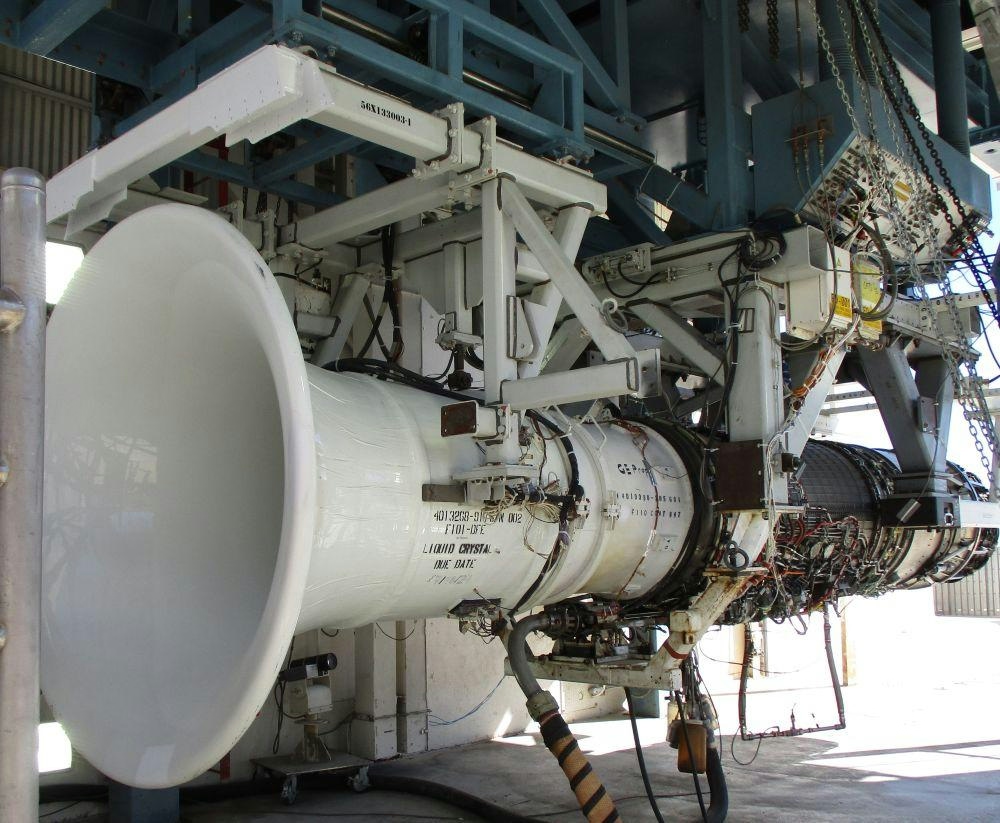
New Research Seeks to Improve Aircraft Engine Durability
New Research Seeks to Improve Aircraft Engine Durability
Gas turbine engines, which power the majority of commercial aircraft, operate under extreme conditions, frequently enduring temperatures exceeding 800 degrees Celsius. These harsh environments present significant challenges to both the durability and efficiency of engines, prompting ongoing research into innovative materials and technologies capable of withstanding such stress.
Advancements in Protective Coatings
At Concordia University’s Department of Chemical and Materials Engineering, postdoctoral researcher Andre Mayer has been exploring methods to enhance the resilience of aircraft engines. His recent study, published in Communications Materials, investigates advanced coatings designed to improve engine performance under intense heat. Conducted at Concordia’s Thermal Spray and Surface Engineering Research Centre under the guidance of Pantcho Stoyanov, Mayer’s work benefited from technical support provided by Fadhel Ettouil, who assisted with specialized equipment.
Mayer’s research centers on the formation of oxides—commonly perceived as corrosive rust—on engine components. Contrary to conventional views, he highlights that these oxides can form protective layers at high temperatures, preventing metal surfaces from adhering to one another during operation. He references NASA’s Galileo mission as a cautionary example, where the absence of such oxide layers contributed to mechanical components seizing in the vacuum of space.
Challenges and Industry Response
Despite the promise of these durability improvements, their implementation faces considerable challenges. New technologies must undergo rigorous testing to confirm their effectiveness and compatibility with existing aircraft fleets. The substantial costs associated with development and deployment further complicate adoption, necessitating broad collaboration across the aviation industry to ensure integration across diverse engine models.
The sector is actively responding to the demand for more robust engines. Operators are increasingly seeking solutions that reduce maintenance expenses and minimize operational downtime, driving market interest in durability-enhancing innovations. In response, manufacturers are accelerating research and development efforts, forging strategic partnerships, and pursuing acquisitions to maintain competitive advantage. Notable industry milestones, such as CFM International’s certification of Leap 1B engine durability kits and ongoing improvements in high-pressure turbine and fuel nozzle reliability, underscore the commitment to addressing these challenges.
As Mayer and his team continue their investigations, their findings hold the potential to influence the development of the next generation of aircraft engines, promising safer, more efficient, and longer-lasting performance in commercial aviation.

Etihad Airways Suspends Airbus A380 Flights on Key Route

Aditya Birla Group Seeks Approval for Aircraft Leasing in GIFT City

Qatar Airways Highlights Innovation and Connectivity at Arabian Travel Market 2026

Hong Kong's Five-Year Plan Includes Andrew Fan's Aircraft Parts Processing Hub Proposal

ACIA Aero Leasing Delivers ATR72-600 to Air Nostrum

RTX Appoints Jill Albertelli as Head of Pratt & Whitney

TAT Technologies Joins Beyond Aero Hydrogen Aircraft Program

AURAK Study Highlights Barriers to Air Taxi Adoption in Emerging Economies

Xiamen Air Selects Altitude for 787 Maintenance at Heathrow

Etihad and Swissport Extend Global Partnership
