
Превращайте аналитические выводы ИИ в реальные действия

В тренде
Categories
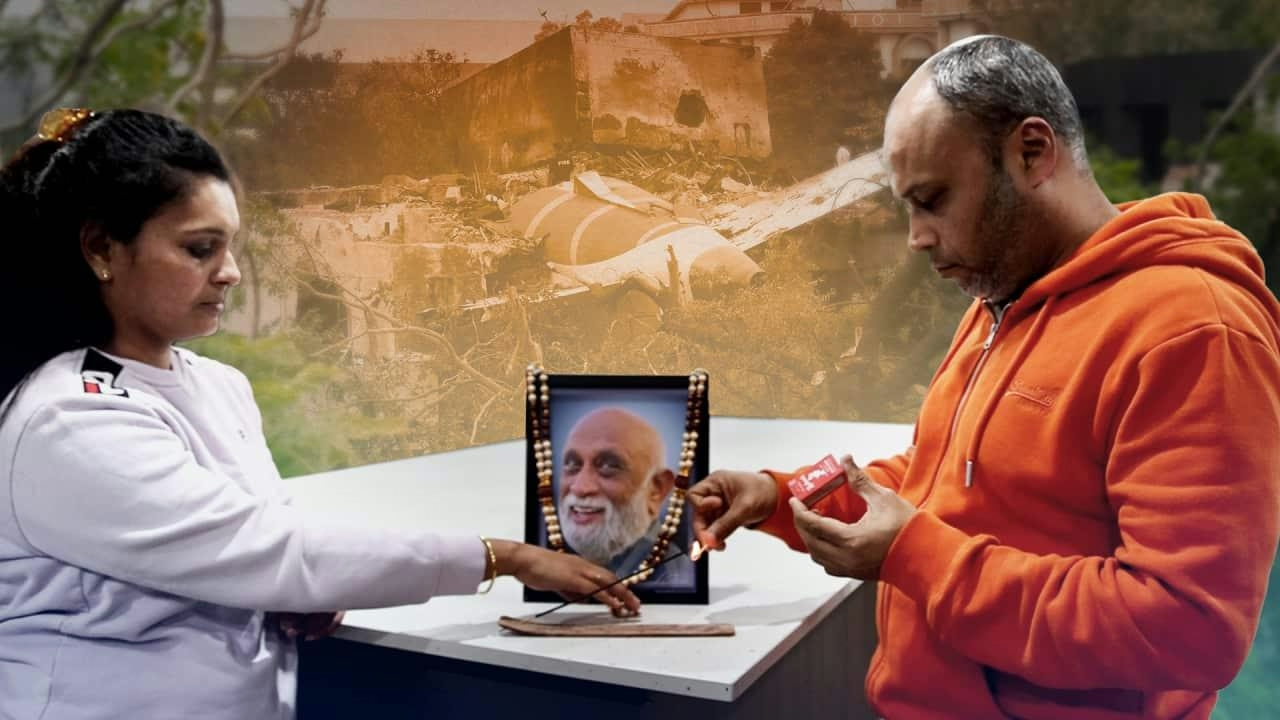
One Year After Air India Crash, Families Continue to Seek Answers
One Year After Air India Crash, Families Continue to Seek Answers
One year following the devastating Air India crash, the families of the victims remain in search of clarity and accountability. Vishwash Kumar Ramesh, the sole survivor of the tragedy, has publicly urged authorities to uphold honesty and transparency, highlighting the enduring psychological trauma and financial difficulties he continues to face. Many relatives of those lost express deep frustration as they await a conclusive investigative report, struggling to find closure and justice amid prolonged uncertainty.
Investigation Delays and Growing Frustrations
Despite the passage of a year, the Aircraft Accidents Investigation Bureau (AAIB) has yet to release substantive new technical information regarding the sequence of events or the potential causes of the crash. This lack of transparency has intensified the anguish experienced by bereaved families, who feel further victimized by what they perceive as a slow and opaque investigative process. The absence of detailed findings has left many questioning the effectiveness and integrity of the inquiry.
Concerns about the impartiality of the investigation have also emerged. Rachel Chitra of The Caravan interviewed an anonymous AAIB insider who alleged that the investigation’s independence was compromised by the involvement of major aviation corporations. According to this whistleblower, the preliminary report was effectively a negotiated outcome between Air India, Tata, General Electric (the engine supplier for the Dreamliner 787), and Boeing, with the Indian and US regulators playing a largely passive role. The insider revealed that in the days leading up to the July 12, 2025 deadline, extensive email exchanges occurred primarily between the airline and the manufacturer, suggesting that these companies influenced which aspects of the investigation would be disclosed.
The whistleblower further claimed that the final decisions on the report’s content were made mere minutes before its release. This, they argued, explains why the preliminary report was published at 1 a.m. in India without any accompanying press conference, official announcement, date, or signature. The source suggested that Boeing aimed to shape public perception through Western media outlets before the report reached Indian audiences.
Expert Criticism and Gaps in the Official Narrative
Aviation experts and pilots have voiced skepticism regarding the AAIB’s preliminary timeline, contending that it does not align with the operational realities of modern aircraft systems. Chitra’s investigative work, which incorporated insights from approximately 30 aviation specialists, indicates that the report omits critical details and presents a simplified narrative that may not capture the complexity of the incident. Experts emphasize that contemporary aircraft are engineered with multiple redundant safety layers designed to prevent catastrophic failures such as those experienced by flight AI-171. The absence of a detailed analysis of the crucial 32 seconds preceding the crash has further fueled doubts about the report’s completeness.
According to the AAIB’s account as of July 12, 2025, the aircraft was cleared for departure at 13:18:38 IST and took off at 13:38:39, reaching a maximum airspeed of 180 knots within three seconds. Beyond this point, the report becomes vague, stating only that fuel supply to both engines was cut off “immediately thereafter,” with a one-second interval between the two events. The sole cockpit voice recording detail disclosed involves an exchange in which one pilot asks, “why did you cut off,” and the other denies doing so. Following this, the engines lost power and the aircraft began to lose electrical systems, with the timeline resuming only when black box data is referenced.
As the families continue to await definitive answers, their demands for transparency and justice remain unfulfilled, underscoring the enduring impact of the tragedy and the pressing need for a comprehensive, independent investigation.

Bangladesh Launches Initiative to Become Regional Aviation Hub
Russia Transports PD-8 Engine to India for International Certification

Kyrgyzstan to Adopt EMPIC GmbH Software for Flight Safety Oversight

Why Hawaiian Airlines Is Waiting Until 2028 To Add A Premium Economy Cabin To Its Airbus A330 Fleet

Engine Fault Causes Royal Navy Helicopter Crash Fatality

Joby Aviation Begins Texas Air Taxi Test Flights Amid Stock Decline

Iberia Receives Full Approval for Airbus A350 Heavy Maintenance

NetJets to Construct Terminal and Hangar at Dallas Love Field

Using AI in Aircraft Purchases

CIAM Unveils RPD-150T Engine to Replace Rotax 150 hp Model
