
Превращайте аналитические выводы ИИ в реальные действия

В тренде
Categories
Pratt & Whitney Engine Achieves Airtight Seal Only at High Temperatures
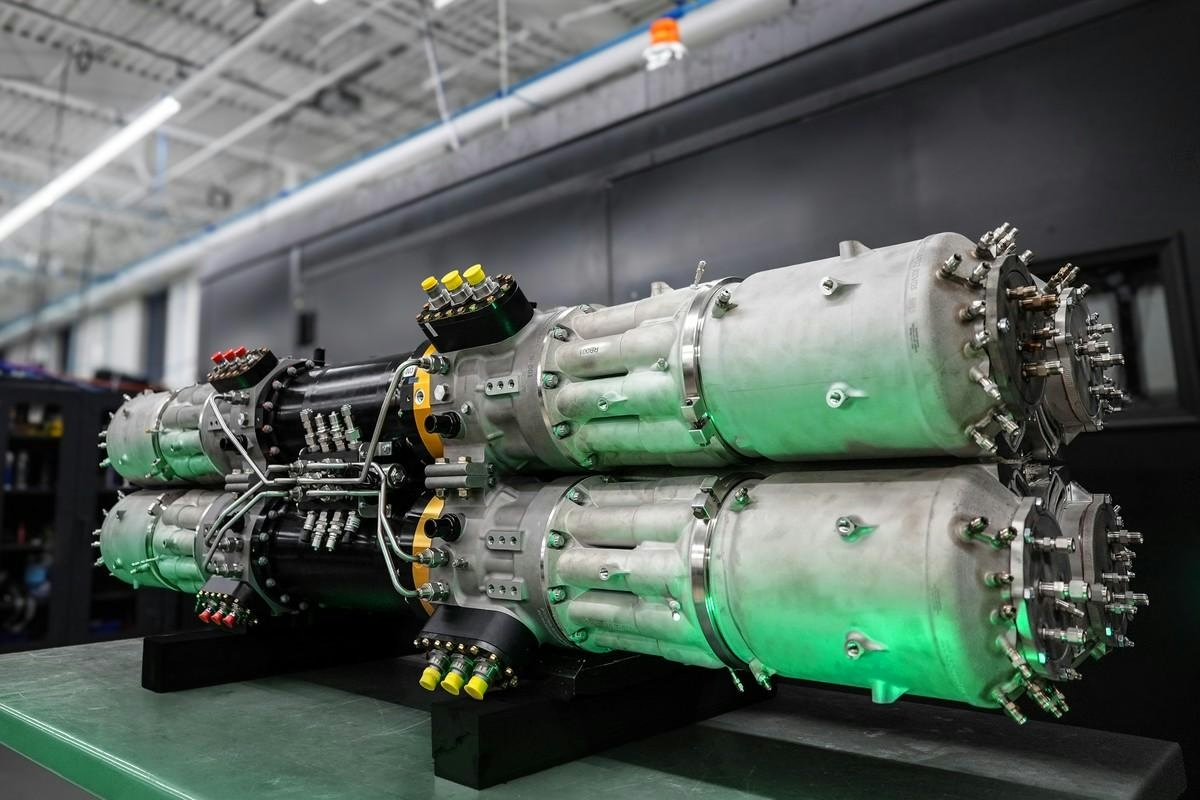
Pratt & Whitney Engine Achieves Airtight Seal Only at High Temperatures
From Canceled Navy Project to Aviation Legend
In a remarkable chapter of aviation history, the Pratt & Whitney J58 engine, renowned for powering the Mach 3 Lockheed SR-71 Blackbird, originated from a canceled US Navy flying boat program. Initially developed for the Martin P6M amphibious jet, the J58 was sidelined when the Navy chose the J75 engine due to developmental delays. Following the P6M’s cancellation, Pratt & Whitney sought to repurpose the J58 for several other aircraft, including the Convair B58 Hustler, Vought F-8 Crusader III, and North American Vigilante, but none selected the engine. The J58 eventually found a home in the Convair Kingfish project, which was also canceled, before becoming the powerhouse behind the Lockheed A-12 and subsequently the SR-71.
The engine underwent extensive re-engineering to satisfy Navy specifications, driven by the extreme demands of sustained Mach 3.2 flight. This process involved redesigning the compressors, introducing new metal alloys, and implementing numerous modifications to endure the intense temperatures encountered at such speeds. These adaptations transformed the J58 into the formidable core of the fastest aircraft ever built.
Innovative Hybrid Design and Operational Challenges
The J58’s design is notably hybrid in nature. While classified as a turbojet, it is often described as a turbo-ramjet due to its unique bleed-bypass air routing and dependence on the afterburner for primary thrust during cruise. At Mach 3, the engine redirects recovered bleed air to bypass the compressor stages, channeling more air directly into the afterburner. This configuration enables the SR-71 to cruise in afterburner for thousands of miles, improving fuel efficiency as speed and temperature rise—a rare capability among jet engines.
However, this reliance on elevated temperatures for optimal performance presents significant engineering challenges. The J58 achieves an airtight seal only at high temperatures, a characteristic that resonates in Pratt & Whitney’s contemporary engine designs. For example, the PW1500G engine, employed by airlines such as Swiss, AirBaltic, and Delta Air Lines, has encountered reliability and availability issues partly due to similar high-temperature sealing requirements. These difficulties have resulted in aircraft groundings and maintenance challenges, prompting close collaboration between airlines and Pratt & Whitney to enhance engine availability and spare parts support.
Despite these operational disruptions, airlines continue to endorse Pratt & Whitney’s geared turbofan (GTF) technology, acknowledging its long-term efficiency advantages. Meanwhile, competitors are intensifying efforts on alternative engine technologies and improved maintenance strategies to address comparable reliability concerns.
Complex Aerodynamics and Enduring Legacy
The J58’s complex aerodynamics further underscore its engineering sophistication. At speeds exceeding Mach 3, the turbojet core ceases to contribute thrust and instead generates aerodynamic drag, effectively functioning as a gas generator. This delicate balance between innovation and operational complexity highlights Pratt & Whitney’s lasting impact on both historic and modern aviation propulsion systems.

Etihad Airways Suspends Airbus A380 Flights on Key Route

Aditya Birla Group Seeks Approval for Aircraft Leasing in GIFT City

Qatar Airways Highlights Innovation and Connectivity at Arabian Travel Market 2026

Hong Kong's Five-Year Plan Includes Andrew Fan's Aircraft Parts Processing Hub Proposal

ACIA Aero Leasing Delivers ATR72-600 to Air Nostrum

RTX Appoints Jill Albertelli as Head of Pratt & Whitney

TAT Technologies Joins Beyond Aero Hydrogen Aircraft Program

AURAK Study Highlights Barriers to Air Taxi Adoption in Emerging Economies

Xiamen Air Selects Altitude for 787 Maintenance at Heathrow

Etihad and Swissport Extend Global Partnership
