
Превращайте аналитические выводы ИИ в реальные действия

В тренде
Categories
Russia Delivers First Production PD-8 Engines Despite Sanctions
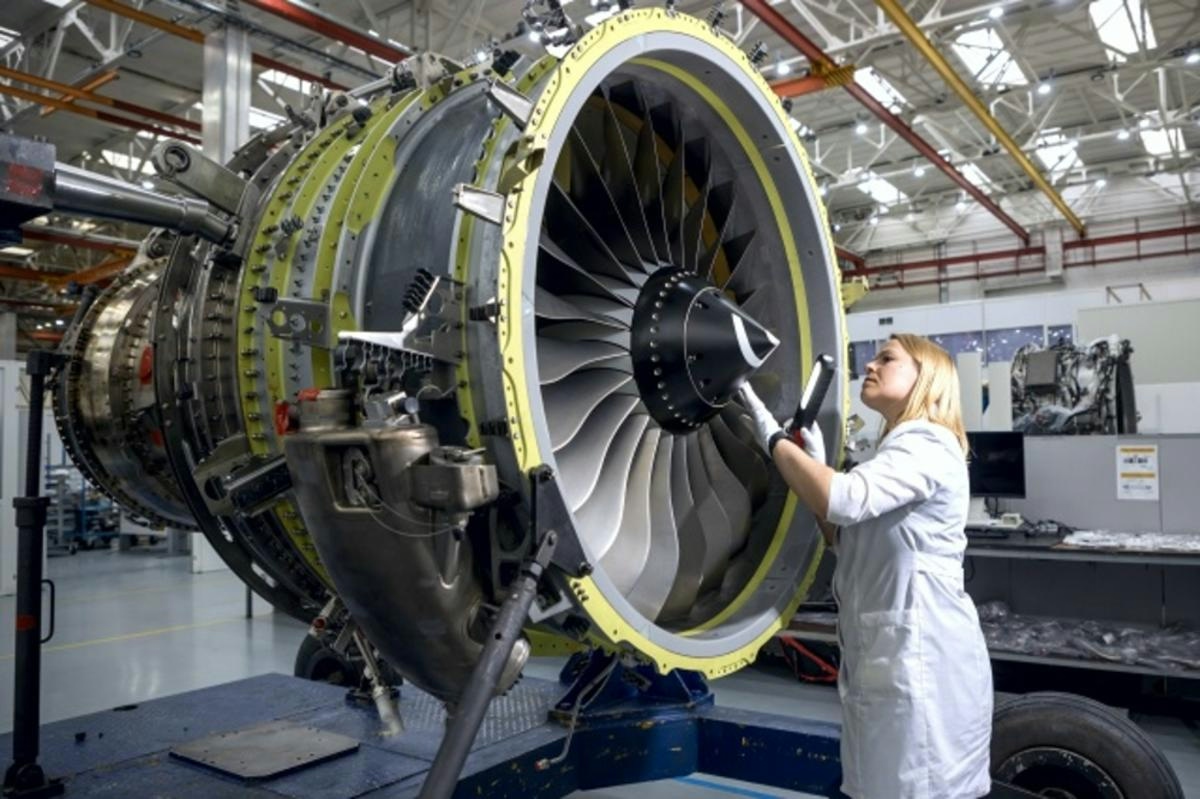
Russia Delivers First Production PD-8 Engines Despite Sanctions
A Milestone in Russian Aviation Sovereignty
Russia’s United Engine Corporation (UEC) has marked a significant milestone by delivering the first two serially produced Aviadvigatel PD-8 turbofan engines to the Yakovlev SJ-100 program. This development, confirmed by UEC-Saturn CEO Ilya Konyukhov during a government meeting on technological sovereignty, represents a crucial step in Moscow’s pursuit of technological self-sufficiency amid stringent Western sanctions. Although the delivery provides powerplants sufficient for only a single production aircraft, it signals progress toward the government’s ambitious goal of producing 142 SJ-100 aircraft by 2030.
The technical achievement is particularly noteworthy given the PD-8’s incorporation of a domestically designed Full Authority Digital Engine Control (FADEC) system. This critical technology had been a focal point of Western sanctions aimed at restricting Russia’s access to advanced digital engine management systems. The successful independent development of a working FADEC system addresses a key challenge that sanctions sought to impose, though questions remain about Russia’s ability to produce these engines reliably and at scale.
From Western Dependence to Domestic Innovation
The PD-8’s serial production began in late June 2026, with the first two engines completed in approximately ten weeks. This marks a dramatic departure from the original Sukhoi Superjet 100 (SSJ100), which was heavily reliant on Western technology. The SSJ100’s PowerJet SaM146 engine was produced through a joint venture between Russia and France’s Safran, combining European safety standards with proprietary digital control systems. This partnership ended abruptly in March 2022 following Russia’s invasion of Ukraine, when Safran withdrew support and the European Union Aviation Safety Agency revoked the SSJ100’s type certificate. The resulting shortage of spare parts forced Russian airlines to resort to cleaning and reusing worn components, underscoring both the impact of sanctions and Russia’s willingness to accept operational risks to maintain its fleet.
In response, Russia undertook a comprehensive redesign of the aircraft, replacing over 80 percent of previously imported components—including avionics, landing gear, auxiliary power units, environmental control systems, and the engine itself—with domestically produced equivalents. The rebranded SJ-100, now developed under the Yakovlev name within the state-owned United Aircraft Corporation (UAC), has become the centerpiece of Russia’s civil aviation self-sufficiency strategy, with the PD-8 turbofan engine at its core.
Technical and Market Challenges Ahead
The FADEC system, which serves as the computational heart of a modern jet engine by managing all operating parameters without manual override, is among the most complex and closely guarded technologies in commercial aviation. The PD-8’s independently developed FADEC represents a significant technical leap for Russian engineering.
Nevertheless, substantial challenges remain. The PD-8 engines must undergo extensive testing and certification to meet international standards, while Russia continues to face the task of training specialists for maintenance and support. Domestic airlines have expressed cautious optimism regarding the new engines, but skepticism persists in international markets amid ongoing geopolitical tensions. Competitors may accelerate their own domestic engine development programs to reduce reliance on Russian components, and there could be increased pressure for stricter certification processes on engines produced under sanctions.
While the delivery of the first PD-8 engines marks a breakthrough for Russia’s aviation industry, the critical test will be whether production can be scaled reliably and whether these engines can gain broader acceptance in the global market.

Etihad Airways Suspends Airbus A380 Flights on Key Route

Aditya Birla Group Seeks Approval for Aircraft Leasing in GIFT City

Qatar Airways Highlights Innovation and Connectivity at Arabian Travel Market 2026

Hong Kong's Five-Year Plan Includes Andrew Fan's Aircraft Parts Processing Hub Proposal

ACIA Aero Leasing Delivers ATR72-600 to Air Nostrum

RTX Appoints Jill Albertelli as Head of Pratt & Whitney

TAT Technologies Joins Beyond Aero Hydrogen Aircraft Program

AURAK Study Highlights Barriers to Air Taxi Adoption in Emerging Economies

Xiamen Air Selects Altitude for 787 Maintenance at Heathrow

Etihad and Swissport Extend Global Partnership
