
Превращайте аналитические выводы ИИ в реальные действия

В тренде
Categories
Singapore Airlines Highlights Rising Climate Costs Amid Emissions Increase
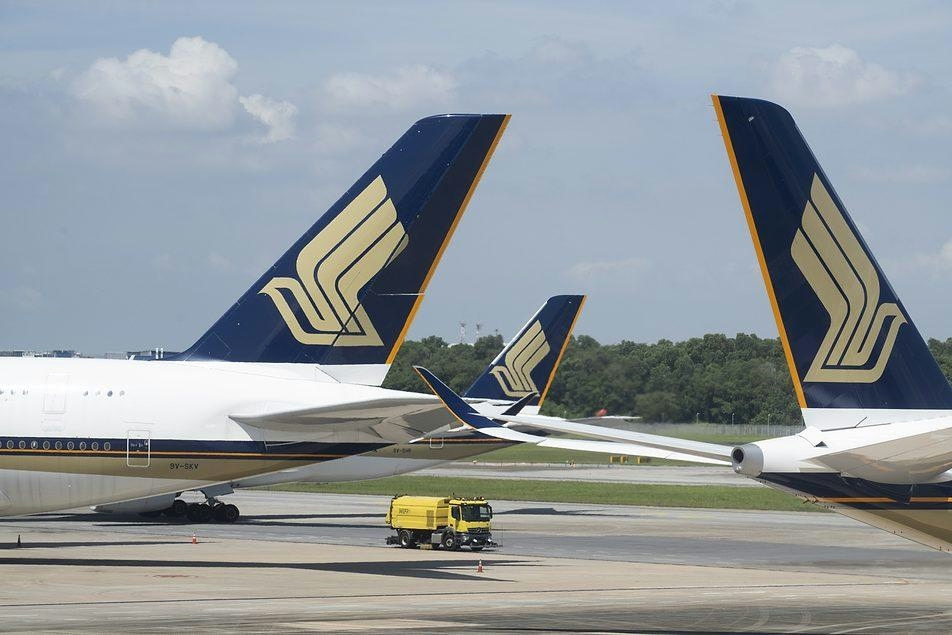
Singapore Airlines Highlights Rising Climate Costs Amid Emissions Increase
Escalating Emissions and Financial Risks
Singapore Airlines Ltd. has issued a warning regarding escalating financial pressures linked to climate-related compliance as its emissions rise in tandem with expanding passenger and freight operations. In its latest sustainability report released on June 25, the airline projected that costs associated with climate compliance—including the purchase of carbon credits under the Carbon Offsetting and Reduction Scheme for International Aviation (CORSIA)—could represent a “high risk” financial burden exceeding S$200 million (approximately $156 million) by 2030.
The report disclosed a 14% increase in Scope 1 emissions over the 12 months ending March 31. These emissions, directly tied to flight operations, constitute the largest segment of the carrier’s carbon footprint. The rise was attributed to increased fuel consumption driven by passenger growth and airspace restrictions that extended certain flight routes. As Singapore Airlines continues to expand, it faces mounting challenges under CORSIA regulations, which mandate airlines to purchase carbon credits if their emissions exceed 85% of 2019 levels.
Industry Challenges and Decarbonization Efforts
Chief Executive Officer Goh Choon Phong underscored that the aviation sector’s primary near-term approach to decarbonization involves replacing older aircraft with newer, more fuel-efficient models that significantly reduce carbon emissions. However, the transition to greener operations is impeded by limited market competition and insufficient policy incentives to encourage aircraft manufacturers to accelerate innovation in sustainable aviation technologies.
Globally, airlines are also exploring the deployment of cleaner fuels and the use of carbon credits to offset emissions. Despite these initiatives, aviation is projected to remain a substantial source of greenhouse gases through 2050, driven by continued growth in passenger demand, according to BloombergNEF.
Regulatory Uncertainty and Market Implications
The United Nations-led CORSIA initiative has attracted participation from carriers in approximately 130 countries during its initial voluntary phase. Nevertheless, the program faces uncertainty amid evolving climate policies, including the United States scaling back its commitments and the European Union preparing to revise environmental regulations. Airlines with a significant focus on international routes, such as Singapore Airlines, are particularly vulnerable to the financial impacts of CORSIA compliance. Bloomberg Intelligence analysts estimate that Singapore Airlines could incur an additional $13 million in annual costs under certain scenarios.
The prospect of rising operational expenses may prompt market concerns regarding Singapore Airlines’ financial outlook. Competitors are likely to respond by adopting comparable sustainability strategies or accelerating investments in green technologies. As the aviation industry confronts regulatory and financial challenges, achieving net zero emissions by 2050 remains a formidable task, highlighting the critical need for coordinated policy support and industry collaboration to advance sustainable aviation.

Etihad Airways Suspends Airbus A380 Flights on Key Route

Aditya Birla Group Seeks Approval for Aircraft Leasing in GIFT City

Qatar Airways Highlights Innovation and Connectivity at Arabian Travel Market 2026

Hong Kong's Five-Year Plan Includes Andrew Fan's Aircraft Parts Processing Hub Proposal

ACIA Aero Leasing Delivers ATR72-600 to Air Nostrum

RTX Appoints Jill Albertelli as Head of Pratt & Whitney

TAT Technologies Joins Beyond Aero Hydrogen Aircraft Program

AURAK Study Highlights Barriers to Air Taxi Adoption in Emerging Economies

Xiamen Air Selects Altitude for 787 Maintenance at Heathrow

Etihad and Swissport Extend Global Partnership
