
Превращайте аналитические выводы ИИ в реальные действия

В тренде
Categories
South Korea Develops Sixth-Generation Stealth Fighter
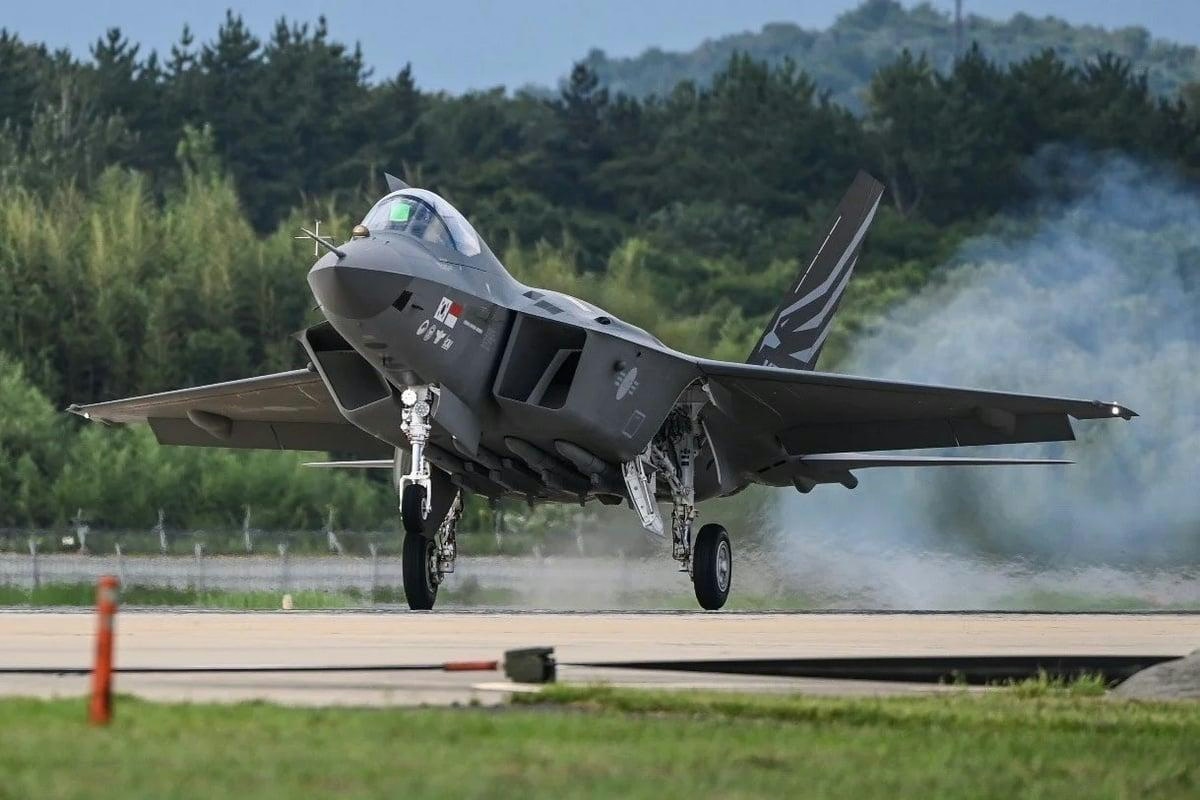
South Korea Advances Sixth-Generation Stealth Fighter Program
South Korea has embarked on an ambitious initiative to develop a sixth-generation stealth fighter, marking a significant escalation in its aerospace and defense capabilities. Building on the recent introduction of the KF-21 Boramae, the country aims to position itself alongside global leaders such as the United States, Europe, and China in the development of next-generation combat aircraft anticipated for deployment in the 2040s.
Concept Study and Technological Vision
On August 21, the Defense Acquisition Program Administration (DAPA) of South Korea issued a tender for a 14-month concept study, with industry proposals due by October 1, 2026. The study, funded with a budget of approximately KRW 900 million, seeks to define a fighter jet featuring a tailless, highly stealthy airframe capable of broadband radar invisibility across L, S, and X bands. The envisioned aircraft will incorporate two adaptive-cycle engines designed for supercruise, a single-seat cockpit, and internal weapons bays. A key element of the design is the integration of artificial intelligence and manned-unmanned teaming, enabling the fighter to operate as the central node within a swarm of drones.
This program builds directly upon the technological foundation established by the KF-21 Boramae. Rather than abandoning its first indigenous fighter, South Korea plans to evolve the KF-21 into a fully stealth-capable fifth-generation platform, leveraging the experience gained to inform the development of a clean-sheet sixth-generation design. The Agency for Defense Development has already revealed an in-house sixth-generation concept at a recent aerospace conference in Daejeon, underscoring the government’s commitment to this advanced project.
Global Context and Challenges
The specifications outlined by DAPA align with global trends emphasizing enhanced stealth and networked warfare capabilities. Proposed configurations include tailless designs with innovative control surfaces, reflecting approaches seen in the American Next Generation Air Dominance (NGAD) program and Europe’s Future Combat Air System (FCAS) and Global Combat Air Programme (GCAP). The requirement for broadband stealth aims to counter a broader spectrum of radar threats than current stealth fighters can address, while adaptive-cycle engines promise improved efficiency and performance.
Despite these ambitions, South Korea faces considerable challenges in closing the technological gap with established Western programs, particularly in areas such as artificial intelligence and advanced defense systems. Experts like KJ Hwang of BOFA Global Research emphasize that overcoming these hurdles will be essential for Seoul to compete on equal footing. The initiative is also expected to intensify competition with established defense technology providers, potentially prompting accelerated development efforts by rivals, especially the United States, to maintain their technological advantage.
Broader Defense Ambitions
South Korea’s pursuit of a sixth-generation fighter is part of a broader strategy to enhance its military capabilities. Parallel projects include the development of a long-range air-to-air missile by Hyundai Rotem, Korea Aerospace Industries (KAI), and Hanwha Group. These efforts reflect a regional emphasis on advancing military technology and signal South Korea’s determination to emerge as a significant player in next-generation defense systems.
As the concept study progresses, South Korea’s sixth-generation stealth fighter program represents a bold declaration of intent that could influence the future balance of air power in East Asia and beyond.
Comments

Etihad Airways Suspends Airbus A380 Flights on Key Route

Aditya Birla Group Seeks Approval for Aircraft Leasing in GIFT City

Qatar Airways Highlights Innovation and Connectivity at Arabian Travel Market 2026

Hong Kong's Five-Year Plan Includes Andrew Fan's Aircraft Parts Processing Hub Proposal

ACIA Aero Leasing Delivers ATR72-600 to Air Nostrum

RTX Appoints Jill Albertelli as Head of Pratt & Whitney

TAT Technologies Joins Beyond Aero Hydrogen Aircraft Program

AURAK Study Highlights Barriers to Air Taxi Adoption in Emerging Economies

Xiamen Air Selects Altitude for 787 Maintenance at Heathrow

Etihad and Swissport Extend Global Partnership
