
Превращайте аналитические выводы ИИ в реальные действия

В тренде
Categories
Southwest Airlines Reports First-Quarter Results with Margin Improvement
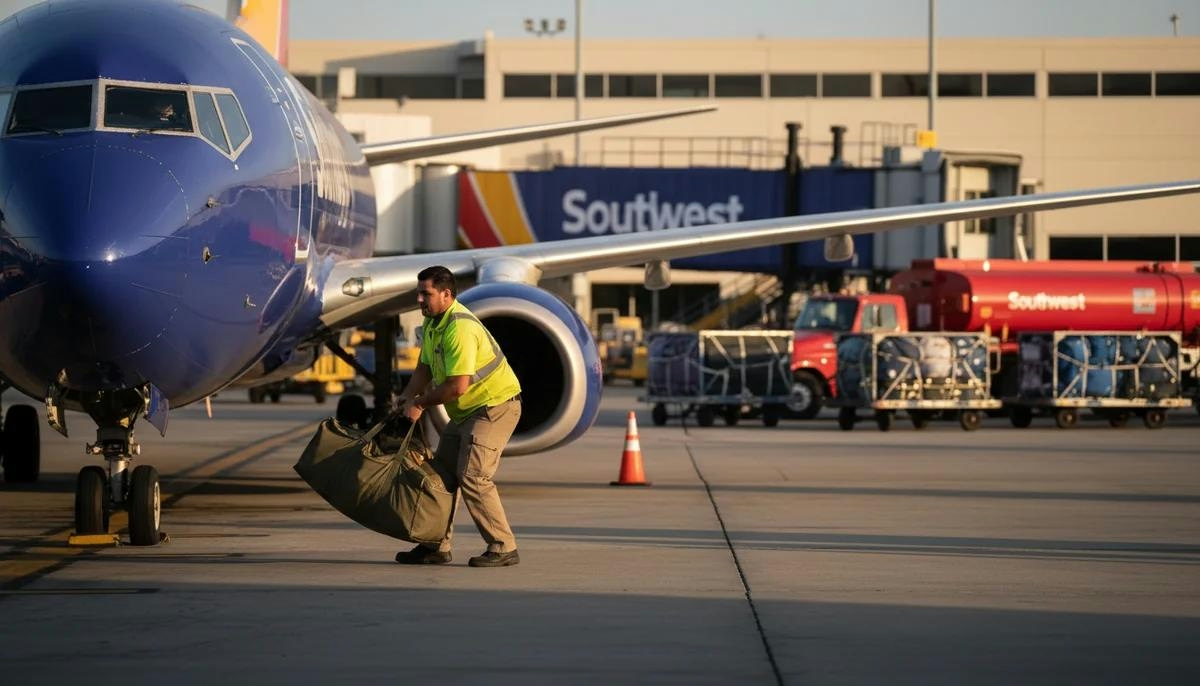
Southwest Airlines Reports First-Quarter Results with Margin Improvement Amid Rising Fuel Costs
DALLAS, April 22, 2026 – Southwest Airlines Co. (NYSE: LUV) announced robust financial results for the first quarter of 2026, demonstrating significant margin improvement and record revenues despite escalating fuel expenses that continue to challenge the airline industry.
Financial Performance and Strategic Progress
Southwest achieved operating revenues of $7.25 billion in the first quarter, marking a nearly 13% increase compared to the same period last year. Net income stood at $227 million, or $0.45 per diluted share, aligning with company guidance. The operating margin rose sharply to 4.6%, an improvement of 8.1 percentage points year-over-year. Operating cash flow surged by 65% to $1.4 billion relative to the first quarter of 2025. Shareholder returns remained strong, exceeding $1.3 billion through a combination of share repurchases and dividends.
These results reflect the full execution of Southwest’s transformational plan, initiated 18 months ago. President and CEO Bob Jordan highlighted the significance of the quarter, stating, “First quarter 2026 marked a turning point for Southwest, as our broad set of commercial, operational, and cost initiatives is now translating into terrific results. Demand for our new product offerings drove record first-quarter revenues, double-digit unit revenue growth, and significant improvement in earnings and margins. These results were achieved despite significantly higher fuel costs, underscoring the momentum across the business and the strength of our transformed business model.”
Operational Enhancements and Customer Engagement
In a notable shift, Southwest ended its longstanding open-seating policy, introducing assigned seating and extra legroom options on January 27, 2026. This change contributed to a surge in customer engagement, with approximately 60% of passengers upgrading from the base product, a substantial increase from 20% a year earlier. The airline also reported a 37% rise in Rapid Rewards enrollments and a 62% increase in tier-status earners year-over-year.
Managed business revenue reached record levels, with March and quarterly performances up 25% and 16%, respectively. Fleet modernization efforts continued, with plans to equip two-thirds of aircraft with in-seat power and larger overhead bins by late 2026. Additionally, Southwest announced the forthcoming deployment of Starlink ultra-fast Wi-Fi, with initial aircraft expected to enter service in summer 2026.
Industry Challenges and Forward Outlook
Despite the strong quarterly performance, Southwest issued a cautious outlook for the second quarter, projecting earnings between $0.35 and $0.65 per share, below analyst expectations of $0.55. The company attributed this conservative forecast primarily to rising jet fuel prices. Southwest chose not to revise its full-year guidance amid ongoing macroeconomic uncertainties and persistent cost pressures.
The broader airline industry continues to face significant headwinds from soaring fuel costs, prompting competitors such as United Airlines and American Airlines to reduce their 2026 earnings forecasts. Southwest’s disciplined cost management limited operating expense growth to 4.0% year-over-year, with unit costs (CASM-X) increasing by 2.3% on a 1.5% capacity expansion.
Jordan emphasized the company’s strategic focus, stating, “Demand continues to be strong, and we remain focused on controlling what we can control by managing costs, optimizing revenue initiatives, and directing capacity toward higher-return opportunities. While the external environment remains uncertain, we are confident in our positioning and the strong momentum we are seeing at Southwest.”

Etihad Airways Suspends Airbus A380 Flights on Key Route

Aditya Birla Group Seeks Approval for Aircraft Leasing in GIFT City

Qatar Airways Highlights Innovation and Connectivity at Arabian Travel Market 2026

Hong Kong's Five-Year Plan Includes Andrew Fan's Aircraft Parts Processing Hub Proposal

ACIA Aero Leasing Delivers ATR72-600 to Air Nostrum

RTX Appoints Jill Albertelli as Head of Pratt & Whitney

TAT Technologies Joins Beyond Aero Hydrogen Aircraft Program

AURAK Study Highlights Barriers to Air Taxi Adoption in Emerging Economies

Xiamen Air Selects Altitude for 787 Maintenance at Heathrow

Etihad and Swissport Extend Global Partnership
