
Превращайте аналитические выводы ИИ в реальные действия

В тренде
Categories
Spirit Airlines Collapse Highlights Broader Struggles in Low-Cost Carriers
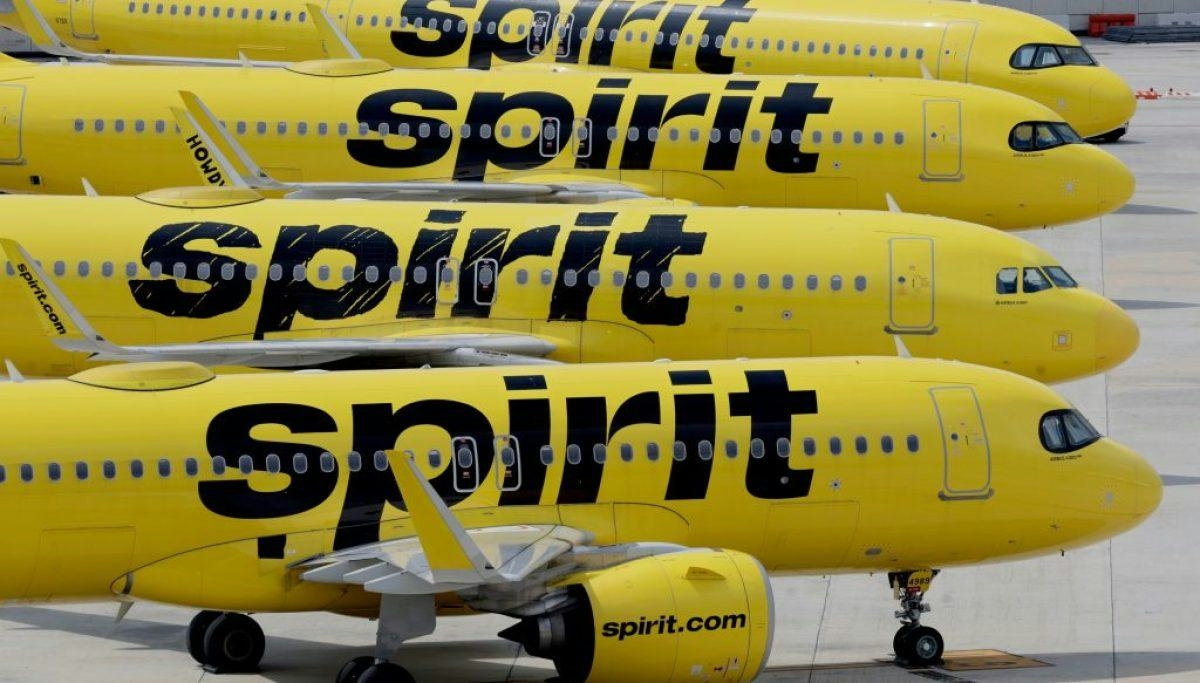
Spirit Airlines Collapse Highlights Broader Struggles in Low-Cost Carriers
The recent collapse of Spirit Airlines has brought renewed attention to the mounting challenges confronting the low-cost carrier (LCC) sector. Industry analysts warn that Spirit’s failure may signal deeper, systemic issues within the ultra-low-cost carrier (ULCC) business model. According to aviation intelligence firm IBA, Spirit’s financial health deteriorated sharply in the year leading up to its shutdown, culminating in a net loss of $2.8 billion and an EBIT margin of -23.6% in 2025. Data from IBA’s Insight platform further revealed a widening disparity between Revenue per Available Seat Kilometre (RASK) and Cost per Available Seat Kilometre (CASK), with a negative gap of 1.4 cents per ASK, highlighting persistently unfavorable unit economics.
Erosion of Cost Advantage and Strategic Challenges
Spirit’s once-defining cost advantage, which underpinned its ULCC model, significantly eroded throughout 2025, even prior to the recent surge in fuel prices. When compared to other major US LCCs such as Southwest, JetBlue, Frontier, and Sun Country, Spirit’s cost base rose to levels comparable with or exceeding some competitors, notably surpassing Frontier Airlines. This shift undermined the fundamental cost differential that ULCCs depend on to maintain competitiveness.
At the time of its closure on May 2, Spirit operated a fleet of 179 Airbus narrow-body aircraft with an average age of seven years, of which 83% were leased. While the spike in fuel prices served as the immediate catalyst for the airline’s collapse, IBA emphasizes that the underlying causes were more deeply rooted in financial fragility. Spirit faced negative operating cash flow amounting to $930 million and sustained negative unit margins, leaving it ill-equipped to absorb further cost increases.
Spirit’s strategic positioning further complicated its prospects. Unlike some ULCCs that focus on niche markets, Spirit competed directly with major US network carriers on most of its routes. Only approximately 6% of its capacity was allocated to exclusive routes, exposing the airline to intense pricing pressure from rivals with more extensive distribution networks, loyalty programs, and broader schedules.
Industry Impact and Future Outlook
The aftermath of Spirit’s collapse is already reshaping the competitive landscape. Rival airlines are moving quickly to capture Spirit’s market share and assets, a development that could ultimately lead to higher basic economy fares as competition within the ultra-low-cost segment diminishes. Frontier Airlines, which faces similar cost pressures, is expected to benefit by absorbing some of Spirit’s routes, although it continues to contend with rising fuel expenses.
The broader LCC sector remains precarious. Airlines burdened with high lease obligations, limited fuel hedging strategies, weak liquidity, and persistent negative unit economics are increasingly vulnerable, particularly if fuel prices remain elevated or new external shocks arise. The ongoing repercussions of the pandemic and ongoing industry bailout discussions add further layers of uncertainty.
Dan Taylor, Head of Consulting at IBA, encapsulated the situation by stating, “Spirit Airlines’ collapse reflects a structural breakdown in its cost model rather than a single external shock. Airlines with lease-heavy fleets and limited pricing power are particularly exposed when cost pressures rise, especially if the underlying unit economics have already deteriorated. In this environment, the combination of negative margins and limited financial flexibility can quickly become unsustainable.”

Etihad Airways Suspends Airbus A380 Flights on Key Route

Aditya Birla Group Seeks Approval for Aircraft Leasing in GIFT City

Qatar Airways Highlights Innovation and Connectivity at Arabian Travel Market 2026

Hong Kong's Five-Year Plan Includes Andrew Fan's Aircraft Parts Processing Hub Proposal

ACIA Aero Leasing Delivers ATR72-600 to Air Nostrum

RTX Appoints Jill Albertelli as Head of Pratt & Whitney

TAT Technologies Joins Beyond Aero Hydrogen Aircraft Program

AURAK Study Highlights Barriers to Air Taxi Adoption in Emerging Economies

Xiamen Air Selects Altitude for 787 Maintenance at Heathrow

Etihad and Swissport Extend Global Partnership
