Изображение

AeroGenie — Ваш интеллектуальный второй пилот.

Спрашивайте что угодно. Анализируйте все. Действуйте незамедлительно.

В тренде

Categories

SR Technics to Provide MRO Services for North American Carrier's CFM56-7B Engines
March 3, 2026By ePlane AI
SR Technics to Provide MRO Services for North American Carrier's CFM56-7B Engines
0
0
SR Technics
CFM56-7B Engines
Engine MRO

SR Technics Secures Multi-Year MRO Contract for North American Carrier’s CFM56-7B Engines

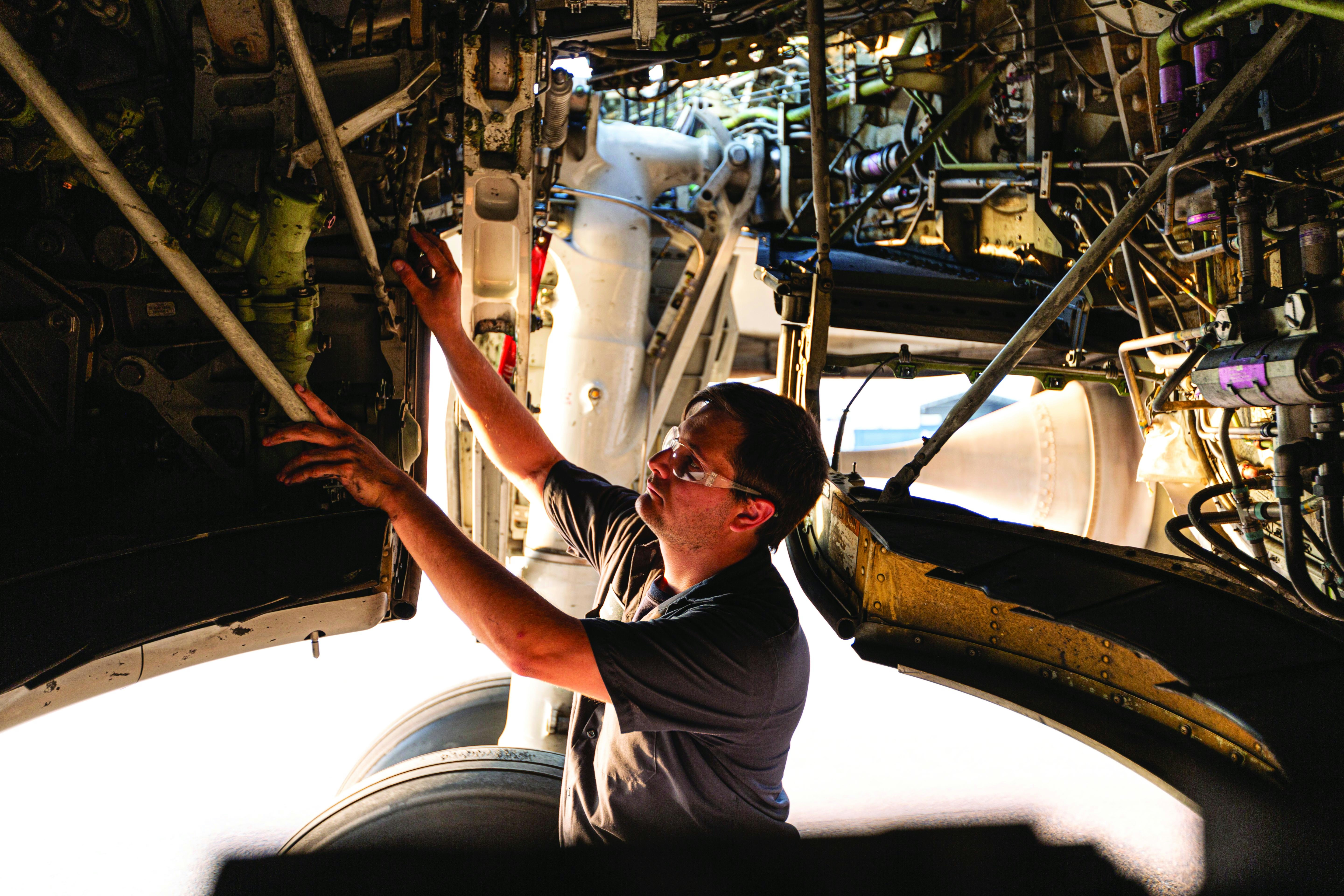
SR Technics has entered into a multi-year agreement to provide heavy shop visit maintenance for CFM56-7B engines operated by a leading North American airline. This contract represents a strategic advancement for the Swiss-based maintenance, repair, and overhaul (MRO) provider as it seeks to expand its presence in the increasingly competitive North American market.

Strengthening Regional Presence Amid Intensifying Competition

Owen McClave, Chief Executive of SR Technics, underscored the company’s dedication to fostering strong customer relationships and delivering operational excellence. He stated, “We treasure our relationships with our customers and the trust placed in our capabilities. Our people are aware of all our commitments and are ready to deliver every time.” McClave further emphasized that expanding long-term engagements in North America is a critical step in reinforcing the company’s regional footprint and providing dependable engine MRO solutions to operators.

The agreement arrives at a time when the MRO sector is experiencing heightened competition from established providers such as GATES SPAH and Willis Module Shop, both of which offer comparable services for the CFM56-7B engine. These competitors are actively broadening their service portfolios; for instance, GATES SPAH has recently introduced new maintenance offerings for Leap engines, while TimeTooth Technologies has secured seating approval in India, signaling their ambitions to capture a larger share of the global aviation aftermarket.

Market Shifts and Emerging Challenges

The dynamics of the aviation maintenance market are evolving, with airlines increasingly prioritizing powerplant availability over traditional MRO slot allocations. Steven Greenway, CEO of flyadeal, recently highlighted this shift, noting that operators demand greater flexibility and reliability to maintain fleet operations amid ongoing supply chain disruptions.

Adding to the competitive pressures, IER MRO has announced plans to establish a significant engine maintenance facility in Dubai. This development is expected to attract customers from North America and other regions, compelling existing providers to innovate and expand their service capabilities to retain market share.

Despite these challenges, SR Technics remains confident in its extensive expertise with CFM engine platforms and its capacity to deliver reliable maintenance solutions. The company’s ongoing investments in regional infrastructure, exemplified by the recent opening of its Zurzach facility, demonstrate its commitment to supporting customers in key markets.

As the MRO industry continues to evolve, SR Technics’ latest agreement highlights its resilience and determination to remain a trusted partner for North American carriers navigating a rapidly changing maintenance environment.

More news
DASI Reaches Inventory Agreement with Mesa Airlines

DASI Reaches Inventory Agreement with Mesa Airlines

DASI Reaches Inventory Agreement with Mesa Airlines Strategic Partnership Amid Industry Consolidation DASI, a global leader in aviation inventory and logistics solutions, has formalized an agreement with Mesa Airlines to support the carrier’s ongoing fleet transitions and its integration with Republic Airways Holdings Inc. Under this arrangement, DASI will acquire spare parts inventories for Mesa’s entire CRJ700 and CRJ900 fleet. The inventory uplift will be coordinated across several key U.S. locations, managed by DASI’s specialist logistics team to ensure seamless execution. Mike Heaton, President of DASI, emphasized the importance of such agreements in the current market environment, stating, “As fleets evolve and industry consolidation continues, airlines require a clear route to unlock capital tied up in surplus inventory. DASI provides that route with minimal operational impact.” This deal reflects the growing need for airlines to optimize working capital amid fleet changes and sector consolidation. Market Dynamics and Operational Challenges The regional airline sector is undergoing significant transformation, with fleet transitions and consolidations frequently generating surplus inventory that can restrict liquidity. DASI’s structured inventory acquisition programs are designed to assist airlines and maintenance, repair, and overhaul (MRO) providers in releasing capital from non-core stock while minimizing operational disruption. In 2025 alone, DASI supported over 20 airlines and MROs in freeing up capital, expanding its inventory holdings, and reinforcing its position as a trusted industry partner. Despite these opportunities, the agreement introduces new challenges for DASI. As Mesa Airlines expands its inventory, declining market prices for aviation parts exert pressure on DASI to maintain competitive pricing structures. Furthermore, falling real estate values in Mesa, Arizona, have raised investor concerns regarding DASI’s ability to sustain profitability amid a shifting economic landscape. The deal may also prompt competitors to recalibrate their strategies, potentially intensifying competition within the regional airline sector as other carriers seek to counterbalance DASI’s enhanced market position. Context Within Republic Airways Holdings Republic Airways, established in 1974, operates a combined fleet exceeding 300 Embraer 170/175 aircraft. Its airlines provide more than 1,300 daily flights to over 100 cities across the United States, Canada, the Caribbean, and Mexico. These operations are conducted under the brands of major codeshare partners, including American Eagle, Delta Connection, and United Express. The group employs over 8,000 aviation professionals. DASI’s collaboration with Mesa Airlines highlights both the opportunities and competitive pressures confronting aviation inventory specialists as the industry continues to evolve rapidly.
Budget 2026 Introduces AI Talent Visa and Expands Cabin Crew Hiring Options

Budget 2026 Introduces AI Talent Visa and Expands Cabin Crew Hiring Options

Budget 2026 Introduces AI Talent Visa and Expands Cabin Crew Hiring Options New AI and Technology Track under One Pass Singapore will introduce a dedicated artificial intelligence (AI) and technology track within its Overseas Networks and Expertise (One) Pass scheme starting January 2027. This new track will replace the existing Tech.Pass programme and is designed to attract elite global digital and AI professionals, reinforcing Singapore’s position as a leading hub in the global digital economy. The announcement was made by Manpower Minister Tan See Leng during the Committee of Supply debate on March 3, highlighting the government’s commitment to enhancing the country’s competitive edge in the technology sector. The One Pass (AI and Tech) will offer more favourable terms to top-tier technology talent, aligning with recommendations from the Economic Strategy Review committees and priorities set out by Prime Minister and Finance Minister Lawrence Wong in the recent Budget speech. Accelerating AI adoption is central to Singapore’s growth strategy, and the new visa track aims to secure the presence of influential professionals who can drive innovation and development in this critical field. Eligibility and Application Criteria Since its launch in 2021, the Tech.Pass scheme has allowed distinguished technology professionals to contribute flexibly to Singapore’s tech ecosystem by running businesses, investing, mentoring, or lecturing without the need for multiple work passes. The broader One Pass, introduced in 2023, extended this flexibility to talent across various sectors, enabling holders to concurrently start, operate, and work for multiple companies. Minister Tan reported that over 8,000 individuals currently hold the One Pass, many of whom are active in sectors vital to Singapore’s economic future. To qualify for the new AI and Tech track, applicants must demonstrate a monthly salary of at least S$30,000, either earned in the 12 months preceding the application or offered by a prospective Singapore-based employer. Recognising the unique compensation structures prevalent in the technology sector, the Ministry of Manpower (MOM) will permit applicants to meet this salary threshold through a combination of cash and equity-based remuneration, including stock options and share ownership. Additional eligibility requirements include employment with a large technology company or venture capital firm and at least five years of recent experience in senior leadership or specialised technical roles. MOM expects that the stringent criteria will limit the number of successful applicants, focusing on attracting “movers and shakers, rainmakers and network brokers,” as described by Minister Tan. Context and Market Implications The introduction of the AI and Tech track comes amid a challenging global hiring environment marked by a significant skills gap. In the United States, only 6% of hiring managers report having access to the talent necessary for high-priority projects. The rise of AI-generated job applications has further complicated recruitment efforts, with 65% of managers finding it increasingly difficult to evaluate candidates effectively. In response, some companies, such as IBM, plan to significantly increase entry-level hiring in 2026, targeting roles less vulnerable to AI automation. While the market’s response to Singapore’s AI Talent Visa and expanded cabin crew hiring options remains uncertain, the government’s targeted initiatives underscore the importance of attracting and retaining top talent as AI adoption accelerates. The overall hiring landscape in 2026 is expected to remain complex, necessitating strategic approaches to workforce development in key sectors.
The Role of Argo Turboserve Components in Modern Aviation Engineering

The Role of Argo Turboserve Components in Modern Aviation Engineering

The Role of Argo Turboserve Components in Modern Aviation Engineering In the realm of modern aviation engineering, the pursuit of reliability hinges on precision manufacturing and stringent quality control. Aircraft systems comprise thousands of specialized components that must function harmoniously under demanding conditions. Among the pivotal suppliers in this intricate ecosystem is Argo Turboserve Corporation. Rather than relying on marketing narratives, it is imperative to assess Argo Turboserve’s contributions through the lens of engineering and maintenance, where safety and performance remain paramount. Aerospace Hardware and Operational Demands Aircraft represent complex assemblies of mechanical and electronic systems, each component engineered to endure extreme operational stresses. These include continuous vibration during flight, significant temperature variations at high altitudes, mechanical loads generated by thrust, and prolonged service intervals. Engine accessory components provided by firms such as Argo Turboserve are specifically designed to meet these rigorous demands, thereby ensuring the integrity and safety of aircraft operations. Integration within the Aviation Supply Chain Argo Turboserve is distinguished for supplying specialized aircraft hardware and turbine-related parts, frequently cataloged under the National Stock Number (NSN) system. This classification facilitates efficient identification and verification of compatible replacement components by both military and commercial maintenance teams. The use of certified and traceable parts is critical to maintaining operational readiness and compliance with aviation standards. Engine Components and Turbine Performance Aircraft engines operate in some of the most challenging mechanical environments, where turbine assemblies must sustain structural and thermal stability at high rotational speeds. Components supplied by Argo Turboserve play essential roles in regulating airflow, distributing thermal loads, maintaining mechanical housing integrity, and optimizing fuel combustion efficiency. Even minimal deviations in component geometry can adversely affect engine performance over extended flight hours, underscoring the necessity for exacting precision in manufacturing. The Critical Role of Fastening Technology Precision fasteners, though often overlooked, are fundamental to the structural integrity of aviation assemblies. Aerospace fasteners are engineered to resist vibration and maintain load stability, preventing fatigue failures, micro-movements, and accelerated wear. This sector of the industry, while less visible, is indispensable to ensuring the overall safety and durability of aircraft structures. Engineering Standards and Certification Aviation engineering is governed by the principle of predictable performance under stress. Components undergo rigorous testing for thermal cycling endurance, dynamic vibration resistance, material fatigue thresholds, and long-term reliability. Manufacturers like Argo Turboserve must comply with stringent certification protocols before their products are approved for use in flight, reflecting the uncompromising safety standards of the industry. Industry Challenges and Market Dynamics The American Institute of Aeronautics and Astronautics (AIAA) highlights the ongoing challenges faced by suppliers such as Argo Turboserve in integrating advanced materials and propulsion technologies. The aerospace sector’s evolution toward smart maintenance monitoring and predictive failure detection has increased demand for innovative components. However, as noted by Aviation Week, these technological advances also introduce concerns regarding data privacy and security in maintenance operations. Competitive pressures further shape the market landscape. For instance, Honeywell’s expansion into the Asia-Pacific defense sector, emphasizing autonomous flight and counter-drone technologies, signals a rising demand for sophisticated turboserve components. Such developments are likely to influence both the pace of innovation and the competitive dynamics among suppliers. Future Outlook As aircraft systems become increasingly digitally integrated and reliant on lightweight, high-strength materials, companies like Argo Turboserve will continue to play a vital role in supporting next-generation flight platforms. Their capacity to adapt to technological progress and evolving industry requirements will be essential in upholding the safety, reliability, and performance standards that define contemporary aviation.
United Airlines flight makes emergency landing in Los Angeles after engine fire

United Airlines flight makes emergency landing in Los Angeles after engine fire

United Airlines Flight Makes Emergency Landing in Los Angeles Following Engine Fire United Airlines Flight 2127 was compelled to execute an emergency landing at Los Angeles International Airport (LAX) on Thursday morning after an engine fire was detected less than an hour after departure. The flight, operated by a Boeing 787-9 Dreamliner, had taken off from LAX at approximately 10:15 a.m. when the left engine encountered a critical issue, prompting the crew to return to the airport. Incident and Response According to a statement from the Federal Aviation Administration (FAA), the flight crew responded promptly to the engine fire, ensuring the aircraft’s safe return to LAX. Upon landing, passengers were evacuated using emergency slides and airstairs. United Airlines confirmed that all passengers were safely transported back to the terminal by bus, with no injuries reported. The airline emphasized that passenger and crew safety remains its highest priority, commending the swift actions of both the flight crew and emergency responders. Investigation and Industry Implications The FAA has announced a comprehensive investigation into the incident to determine the cause of the engine fire. This emergency landing has drawn attention to the Boeing 787-9 Dreamliner model involved, raising concerns about in-flight safety and maintenance protocols. Industry analysts suggest that such events may influence market dynamics, affecting competitors and insurance providers, while also prompting a renewed focus on aircraft safety standards. United Airlines and federal authorities have pledged full cooperation with the investigation, underscoring the importance of identifying the root cause to prevent similar occurrences in the future. The incident highlights the critical role of rapid response procedures in ensuring passenger safety during unforeseen emergencies.
What Is the Average Lifespan of a Jet Engine?

What Is the Average Lifespan of a Jet Engine?

The Average Lifespan of a Jet Engine The advent of the jet age transformed commercial aviation, enabling faster and more affordable travel while significantly enhancing safety standards. Over the years, aircraft have grown larger and more efficient, with millions of flights conducted annually and fatal accidents becoming increasingly rare. Despite this, occasional incidents involving engine failures—such as the February 2026 JetBlue flight that returned to Newark and the Delta Air Lines flight that caused a grass fire near Savannah/Hilton Head International Airport—continue to draw public attention. Importantly, investigations into these events have not attributed the failures to engine age. Design and Operational Lifespan Modern commercial jet engines are typically designed to last between 25 and 35 years, or approximately 150,000 flight hours, assuming they undergo proper maintenance. This contrasts sharply with military jet engines, which operate under more strenuous conditions and are generally retired after 5,000 to 10,000 mission hours. The lifespan of a jet engine, however, is not a fixed metric; it is influenced by a complex combination of design specifications, maintenance regimes, and the operational environments in which the engines function. Challenges in Engine Durability and Reliability Recent developments in the aviation sector have highlighted the challenges associated with engine durability. The GE9X engine, which powers Boeing’s 777X, has come under scrutiny due to potential issues with a critical seal, raising concerns about its long-term reliability. Similarly, Southwest Airlines has reported difficulties related to the availability of CFM Leap-1B engines, citing durability problems with disk components that could result in engine shortages and operational disruptions. Next-generation engines, such as those installed on the Airbus A320neo and Boeing 737 MAX, have also faced reliability challenges. Reports of early removals and retrofits have surfaced, sometimes compromising the anticipated fuel efficiency gains these advanced engines were designed to provide. These instances underscore the ongoing technical and logistical obstacles that manufacturers and airlines must navigate to ensure both the longevity and dependability of jet engines. Balancing Innovation and Durability While commercial jet engines are engineered for decades of service, their actual operational lifespan depends on numerous factors, including technological innovation, manufacturing quality, real-world operating conditions, and stringent maintenance practices. As the aviation industry continues to evolve, achieving an optimal balance between performance, efficiency, and durability remains a critical challenge for the future of air travel.
ACHR Achieves FAA Compliance Milestone, Strengthens Liquidity Ahead of 2025 Air Taxi Launch

ACHR Achieves FAA Compliance Milestone, Strengthens Liquidity Ahead of 2025 Air Taxi Launch

ACHR Achieves FAA Compliance Milestone, Strengthens Liquidity Ahead of 2025 Air Taxi Launch Archer Aviation Inc. (NYSE: ACHR) has announced a significant advancement in its efforts to commence commercial air taxi operations, marking a major milestone in flight testing and compliance with Federal Aviation Administration (FAA) standards. The company’s recent fourth-quarter 2025 update highlighted strong liquidity and disciplined financial management as it prepares for the anticipated launch of its air taxi service in 2025. Archer is positioning itself to leverage the global spotlight of the 2028 Olympics, which it views as a pivotal event for accelerating industry adoption. Progress Amidst a Competitive and Regulatory Landscape Archer’s achievement of FAA compliance represents a critical step forward in the rapidly evolving urban air mobility sector. Despite this progress, the company faces a complex path to commercial launch, navigating regulatory challenges, technological uncertainties, and intensifying competition. Industry peers such as Joby Aviation are similarly engaged in securing certification and preparing for market entry, underscoring the competitive dynamics within the nascent air taxi market. Market observers acknowledge Archer’s solid financial footing and advancements across both commercial and defense programs as positive indicators. Nonetheless, investor sentiment remains cautious, reflecting a balance between optimism about the transformative potential of air taxis and concerns regarding the pace of regulatory approvals and the development of necessary infrastructure to support widespread operations. Industry Dynamics and Future Outlook In response to these challenges, competitors are ramping up research and development efforts, forging strategic partnerships, and revising timelines and financial strategies to better position themselves for certification and commercialization. The trajectory of the urban air mobility industry will be heavily influenced by regulatory progress, technological innovation, and the capacity to scale operations sustainably. Archer’s prudent approach to liquidity and expenditure management aims to ensure readiness to capitalize on emerging opportunities, particularly with the 2028 Olympics serving as a potential catalyst for broader adoption. However, the company, along with the wider industry, must continue to address ongoing regulatory, technical, and market risks as it advances toward the commercial deployment of air taxi services.
United Flight to Newark Returns to LAX After Reported Fire

United Flight to Newark Returns to LAX After Reported Fire

United Flight to Newark Returns to LAX Following Reported Engine Fire A United Airlines flight destined for Newark, New Jersey, was compelled to return to Los Angeles International Airport (LAX) on Monday after a reported fire incident, triggering an emergency evacuation and a temporary ground stop at one of the busiest airports in the United States. Incident Details and Emergency Response United Flight 839 departed LAX at 10:43 a.m. but turned back less than 40 minutes into the flight, safely landing at 11:19 a.m. The flight crew reported an issue with one of the aircraft’s engines, prompting the return. While United Airlines initially cited an engine problem without confirming a fire, the Los Angeles Fire Department later confirmed that a fire had occurred and was contained within an hour of the aircraft’s arrival. The Boeing 787-9 Dreamliner, carrying more than 250 passengers and crew, was evacuated on the taxiway using emergency slides and stairs. Fortunately, no injuries were reported during the evacuation. The Federal Aviation Administration (FAA) responded by imposing a ground stop at LAX for approximately 30 minutes to facilitate emergency operations and ensure passenger safety. This temporary halt affected numerous flights at the airport during the incident. Regulatory and Industry Implications The FAA is expected to conduct a thorough review of the incident, which may lead to a formal investigation and potential regulatory measures targeting United Airlines. Such events often prompt increased scrutiny of airline safety protocols and operational procedures. In addition to regulatory consequences, United Airlines could face market repercussions, including a possible decline in its stock value due to the negative publicity surrounding the event. Competitors within the airline industry, including Delta Air Lines and American Airlines, may leverage the situation to emphasize their own safety records, aiming to reassure passengers and attract travelers concerned about airline safety standards. Ongoing Investigation and Passenger Impact Passengers were transported back to the terminal following the evacuation, though United Airlines has yet to announce details regarding rebooking or compensation for those affected. The Boeing 787-9 involved in the incident is a long-haul variant of the Dreamliner series, recognized for its advanced safety features. The precise cause of the reported fire remains under investigation by both the airline and federal authorities.
Transfer from Car to Plane

Transfer from Car to Plane

Transfer from Car to Plane Crossing the Divide Between Automotive and Aviation Cultures In a recent conversation aimed at coaxing me back to my writing desk, a colleague challenged me to explore the transition from car enthusiast to pilot. While my aviation experience is limited to weekend flights in a reliable Cessna 150, my credentials as a car aficionado are extensive. Shortly after high school, I worked at an airport gas station to fund my private pilot certificate, then honed my mechanical skills in an independent Mercedes garage. Over three decades as a full-time automotive journalist, I have raced with the Sports Car Club of America and driven a vast array of vehicles—from modest economy cars to classic Jaguars, iconic gullwing Mercedes, and even Jack Roush’s Trans Am Mustangs. The distant roar of a finely tuned V-8 engine remains a powerful call to memory and identity. The intersection of car and aviation enthusiasts reveals surprising common ground, yet the transition between these worlds is rarely straightforward. Pilots tend to be methodical, rule-abiding individuals shaped by military and airline traditions that emphasize discipline, conformity, and leadership. They thrive in structured environments, value quality instruction, and operate comfortably within aviation’s rigorous regulatory framework. Although the stereotypical crew cut may have fallen out of fashion, the underlying mindset endures. Conversely, car enthusiasts often embody a more rebellious spirit, embracing a cowboy or pirate ethos that prizes style and a willingness to challenge authority. Their excitement frequently stems from pushing boundaries, sometimes at the expense of safety. Many begin with street cars capable of exceeding legal limits, where performance exploration can blur into rule-breaking—a temptation that resonates with youthful exuberance. Automotive regulations, unlike aviation rules, are often viewed as constraints designed for the general public rather than guidelines for experts. Technological Shifts and Their Impact on Enthusiasts This cultural divide is further accentuated by the rapid technological evolution confronting both industries. The shift toward electric vehicles exemplifies the challenges car and aviation enthusiasts face in adapting to new paradigms. Automakers in the United States and China are pursuing markedly different electrification strategies, generating uncertainty and volatility in global transport markets. Recent analytical reports have triggered significant sell-offs in related stocks, while manufacturers scramble to forge strategic partnerships aimed at addressing affordability and infrastructure hurdles. This collaborative approach echoes the safety-driven culture long established in aviation. Simultaneously, automakers are responding to consumer demands by reintroducing physical buttons in vehicle cabins, addressing concerns over touchscreen reliability. This development underscores a shared priority in both fields: the importance of dependable, tactile controls. For car enthusiasts venturing into aviation, these technological shifts highlight the necessity of balancing innovation with the discipline and safety protocols that define flying. The journey from car to plane thus represents more than a mere change in machinery; it entails a fundamental shift in mindset. Both domains require passion and skill, yet the rules governing each are distinct. For those prepared to embrace the demands of both, the experience offers thrills as potent as the roar of a V-8 engine or the steady hum of a Lycoming overhead.
New $4 Million Aviation Complex at Flagler County Airport Will Accommodate Flight Schools

New $4 Million Aviation Complex at Flagler County Airport Will Accommodate Flight Schools

New $4 Million Aviation Complex Approved at Flagler County Airport The Flagler County Commission has authorized a lease agreement that will facilitate the development of a $4 million aviation complex at Flagler County Airport. This initiative is poised to significantly impact the local aviation sector and may attract flight schools to the region. Under the terms of the agreement, Upstate Companies II of St. Augustine, led by Brian Zaczek, will lease 3.5 acres of airport land at a rate of $1,089 per acre per month, subject to a 3 percent annual increase. The company plans to construct a 52,000-square-foot facility featuring four hangars, office space, a large apron, a taxiway, and a parking lot. The lease is set for 30 years, with two optional extensions of 10 years each. Potential for Flight Schools and Community Concerns Although there are no confirmed plans to lease space to flight schools, the lease does not exclude such tenants. Commissioner Kim Carney proposed excluding flight schools from the agreement due to resident concerns about noise generated by existing flight training operations. However, her proposal was not adopted. Airport Director Roy Sieger highlighted that federal and state grant conditions require the airport to permit any legitimate aviation-related business, including flight schools, to avoid discrimination claims. The new complex will be situated on Finn Way near the control tower and will be substantially larger than the airport’s current 14,000-square-foot Ginn hangar. Comparable in size to the Sheriff’s Operations Center in Bunnell, the facility is expected to provide essential business space, attract aviation companies, generate employment opportunities, and increase airport revenue through higher fuel sales and land lease income. Market Challenges and Strategic Considerations Despite the anticipated benefits, the project faces challenges in a competitive regional aviation market. Nearby airports are investing heavily in new hangars, terminals, and infrastructure to attract and retain flight schools and other aviation enterprises. Recent expansions, such as Garmin’s facility at Mesa Gateway Airport, underscore the importance of strategic location and robust infrastructure in securing aviation tenants. Flagler County Airport will need to distinguish itself to remain competitive and avoid market saturation. Commissioner Andy Dance expressed concerns about flight schools potentially becoming primary tenants amid ongoing noise complaints from residents. Both County Attorney Michael Rodriguez and Airport Director Sieger reiterated that the airport is legally obligated to allow aviation-related businesses, including flight schools, due to federal and state funding requirements. Brian Zaczek indicated that at least one hangar is being considered for an avionics or repair shop currently operating in Daytona Beach, suggesting a diverse tenant mix is anticipated. With 138 acres of developable property on its south side, the airport aims to leverage the new complex to attract a broad range of aviation businesses. As the aviation industry evolves, Flagler County’s investment in this new infrastructure positions it to compete for business. The ultimate success of the project will depend on how effectively the airport navigates regulatory obligations, community concerns, and the dynamics of the regional market.
United Airlines Flight to Newark Makes Emergency Landing at LAX

United Airlines Flight to Newark Makes Emergency Landing at LAX

United Airlines Flight to Newark Makes Emergency Landing at LAX Following Engine Fire A United Airlines flight destined for Newark Liberty International Airport was compelled to execute an emergency landing at Los Angeles International Airport (LAX) on Monday morning after an engine fire was detected shortly after takeoff. United Flight 2127, operated by a Boeing 787-9 Dreamliner carrying over 250 passengers, departed LAX at approximately 10:15 a.m. but returned less than an hour later due to a malfunction in its left engine. Emergency Response and Passenger Evacuation The Federal Aviation Administration (FAA) confirmed that the aircraft landed safely at around 11:19 a.m. local time. Upon touchdown, emergency responders were immediately on the scene, applying water to the smoking engine as a precautionary measure. Aerial footage showed passengers evacuating the aircraft via emergency slides, while others disembarked using stairs. The Los Angeles Fire Department reported no serious injuries during the evacuation, with only one passenger sustaining a minor finger laceration. All passengers were subsequently transported by bus back to the terminal. United Airlines issued a statement acknowledging the incident and commended the flight crew for their prompt and professional response, affirming their commitment to ensuring passengers reach their final destinations. FAA Investigation and Context In response to the emergency, the FAA imposed a ground stop at LAX until 12:30 p.m. The agency has initiated an investigation into the engine fire. This incident follows closely on the heels of a similar emergency landing involving a JetBlue flight at Newark Liberty International Airport, which also experienced smoke and engine complications, resulting in a temporary suspension of flights at that airport. The FAA is actively investigating both events. Passenger Accounts of the Incident Passengers aboard Flight 2127 described a tense and unsettling experience. Harry Gestetner, founder and CEO of Orion Sleep, recounted hearing loud knocking noises shortly after takeoff, followed by flight attendants urgently signaling a fire in the engine. He described the evacuation as “a surreal feeling to be sprinting away from a flaming plane on the tarmac at LAX.” Gestetner, seated in an exit row, was the second passenger to evacuate via the emergency slide, noting wryly that the exit row offers more than just extra legroom. Among those on board was renowned music producer Terry Lewis, who exited the aircraft using the stairs. Lewis, en route to New York for media engagements with his longtime collaborator Jimmy Jam, described his evacuation as comparatively straightforward. United Airlines reiterated its dedication to passenger safety and praised the crew’s professionalism during the emergency. The FAA’s investigation into the cause of the engine fire remains ongoing.
line










