
Превращайте аналитические выводы ИИ в реальные действия

В тренде
Categories
University of Michigan Engineers Develop Next-Generation Airliner Concept
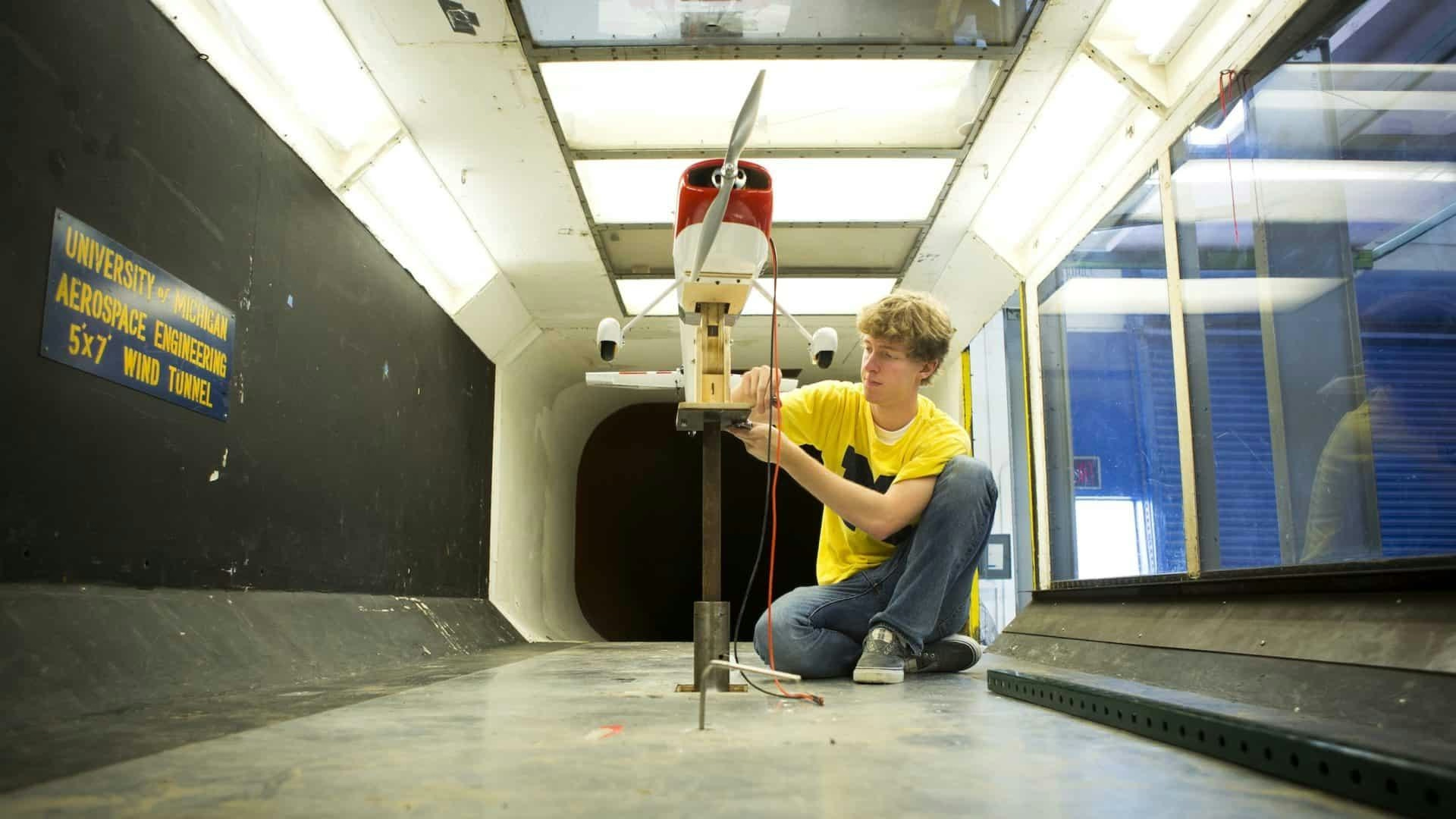
University of Michigan Engineers Develop Next-Generation Turboelectric Airliner Concept
In a notable advancement for sustainable aviation, engineers at the University of Michigan, in partnership with hybrid-electric aviation firm Electra, have unveiled a turboelectric airliner concept that promises a 17% improvement in efficiency compared to current projections for standard airliners in 2050. Presented at the recent AIAA AVIATION Forum, this innovative design aims to transform commercial aviation by enhancing both environmental sustainability and aircraft performance.
Multidisciplinary Design and Optimization
The project is spearheaded by the University of Michigan’s Aerospace Engineering team, led by assistant professor Gökçin Çınar and Pauline M. Sherman Collegiate Professor Joaquim Martins. Their expertise in multidisciplinary design and optimization has enabled the exploration of a wider array of aircraft architectures than previously achievable. By extending NASA’s open-source Aviary design platform, the team conducted simultaneous optimization across aerodynamics, structural integrity, propulsion, and thermal management—critical and interdependent aspects of modern aircraft design.
This initiative aligns with NASA’s Advanced Aircraft Concepts for Environmental Sustainability (AACES 2050) program, reflecting a broader industry commitment to reducing carbon emissions through electrification. Despite the promise, the path to implementation remains complex. Integrating advanced technologies, navigating regulatory approvals, and securing market acceptance present significant challenges. Established aviation companies may approach the concept with caution unless it clearly demonstrates superior efficiency and cost-effectiveness. Meanwhile, global competitors are likely to intensify their development efforts, particularly as regulatory frameworks evolve. For instance, the European Union’s aggressive push for zero-emission flight technologies could reshape market dynamics in favor of designs that meet stringent environmental standards.
Innovative Configurations and Technical Challenges
Throughout the study, the Michigan team evaluated twenty distinct aircraft configurations across more than 100,000 scenarios, employing both low- and high-fidelity simulations to balance computational efficiency with detailed accuracy. Initial results from simplified models favored highly distributed propulsion systems, featuring numerous electric propellers distributed across the wings and tail. However, advanced simulations revealed significant trade-offs, including increased structural weight, aerodynamic drag, and complex thermal management challenges. These insights led the team to adopt a hybrid configuration: conventional turbofan engines mounted under each wing, supplemented by electric fans near the rear fuselage.
This partially electrified propulsion system capitalizes on the advantages of electric propulsion while mitigating some limitations associated with full electrification, such as current battery energy density constraints and heat dissipation issues. A distinctive feature of the design is the “double-bubble” wide-body fuselage, originally conceptualized at MIT, which contributes to lift generation rather than serving solely as a payload carrier. The rear-mounted electric fans employ fuselage boundary-layer ingestion, an advanced technique that reduces wake turbulence and decreases the thrust demand on the underwing turbofans.
By integrating aerodynamic shaping with propulsion innovation, the University of Michigan’s concept exemplifies the multidisciplinary optimization essential for next-generation airliners. As the aviation sector confronts increasing pressure to decarbonize, such comprehensive approaches may prove vital, though their ultimate success will depend on overcoming technological, regulatory, and market challenges within a rapidly evolving global environment.

Etihad Airways Suspends Airbus A380 Flights on Key Route

Aditya Birla Group Seeks Approval for Aircraft Leasing in GIFT City

Qatar Airways Highlights Innovation and Connectivity at Arabian Travel Market 2026

Hong Kong's Five-Year Plan Includes Andrew Fan's Aircraft Parts Processing Hub Proposal

ACIA Aero Leasing Delivers ATR72-600 to Air Nostrum

RTX Appoints Jill Albertelli as Head of Pratt & Whitney

TAT Technologies Joins Beyond Aero Hydrogen Aircraft Program

AURAK Study Highlights Barriers to Air Taxi Adoption in Emerging Economies

Xiamen Air Selects Altitude for 787 Maintenance at Heathrow

Etihad and Swissport Extend Global Partnership
