
Превращайте аналитические выводы ИИ в реальные действия

В тренде
Categories
Venus Aerospace develops rotating detonation engine for defense and space
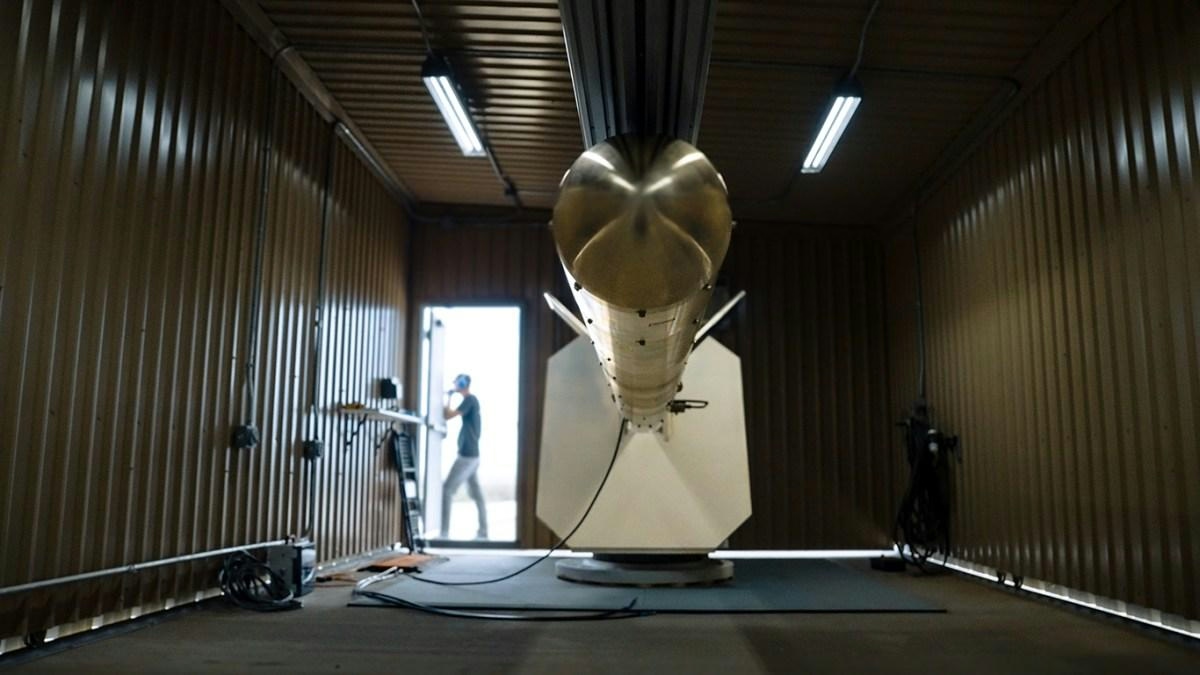
Venus Aerospace Advances Rotating Detonation Engine for Defense and Space
Innovative Propulsion Technology
Venus Aerospace, based in Houston, is making notable progress in the development of its rotating detonation rocket engine (RDRE), a propulsion system designed to surpass the efficiency of conventional rocket engines. As global interest in hypersonic defense capabilities and advanced space vehicles grows, the company has secured additional funding to accelerate vehicle development and expand testing of this cutting-edge technology.
Unlike traditional rocket engines that generate thrust through a steady, controlled flame, the RDRE utilizes a continuous detonation wave traveling around a circular combustion chamber. This method extracts more energy from the same amount of propellant, offering the potential for greater thrust with reduced fuel consumption. Such efficiency gains could enable future launch vehicles and hypersonic systems to carry heavier payloads over longer distances.
Overcoming Technical Challenges and Market Shifts
Although the concept of rotating detonation engines has existed for decades, practical implementation has been hindered by challenges such as controlling the detonation wave and managing extreme internal temperatures. Advances in 3D printing and computer modeling have recently allowed Venus Aerospace to move beyond laboratory experimentation. In a milestone achievement last year, the company became the first to successfully fly a rotating detonation rocket engine, demonstrating its viability outside controlled ground tests.
Initially, Venus Aerospace envisioned the RDRE as a power source for hypersonic passenger aircraft. However, increasing interest from defense and space sectors has shifted the company’s focus. The engine’s enhanced efficiency and controllable thrust make it particularly attractive for high-speed military vehicles and future space systems, where it could offer significant advantages over traditional solid rocket motors.
Investment and Future Development
The market response to Venus Aerospace’s advancements has been positive, with major investors such as Lockheed Martin Ventures and Mercury Fund providing financial backing. This influx of capital is expected to support scaling production to meet both defense and commercial space demands. Nonetheless, the company faces challenges in ensuring the engine’s reliability and efficiency under real-world conditions, while competing against established aerospace firms. Although competitors may accelerate their own development of similar technologies, Venus Aerospace’s unique approach and demonstrated performance could provide a competitive advantage.
Looking ahead, the company’s next focus is on extending the RDRE’s operational endurance. While the engine has proven capable of short-duration operation, engineers are working to increase burn times and broaden testing as the technology advances toward operational deployment. Through these efforts, Venus Aerospace is positioning itself at the forefront of aerospace innovation, with the potential to transform both defense and space travel.

Etihad and Swissport Extend Global Partnership

Sepehran Airlines B737 Returns to Mashhad After Tyre and Engine Issues

Etihad Deploys Widebody Fleet to Meet Strong Demand

Korean Air Finalizes $36.2 Billion Deal with Boeing

Australia’s RFDS Queensland Section Orders Six King Air 260Cs

Korean Air Finalizes Order for 103 Boeing Jets and Engines

Embraer E195-E2 Features Distinctive Engine Placement Among Regional Jets

What Passengers Can Expect on Boeing’s New 777X Jet

How Ethiopian Airlines Became Africa’s Leading Carrier Amid Gulf Competition

Joby Aviation Extends Autonomous Flight Capabilities with Cross-Country Tour
