
KI-Erkenntnisse in konkrete Maßnahmen überführen

Trends
Categories
Japan Airlines Tests Humanoid Robots to Address Worker Shortage
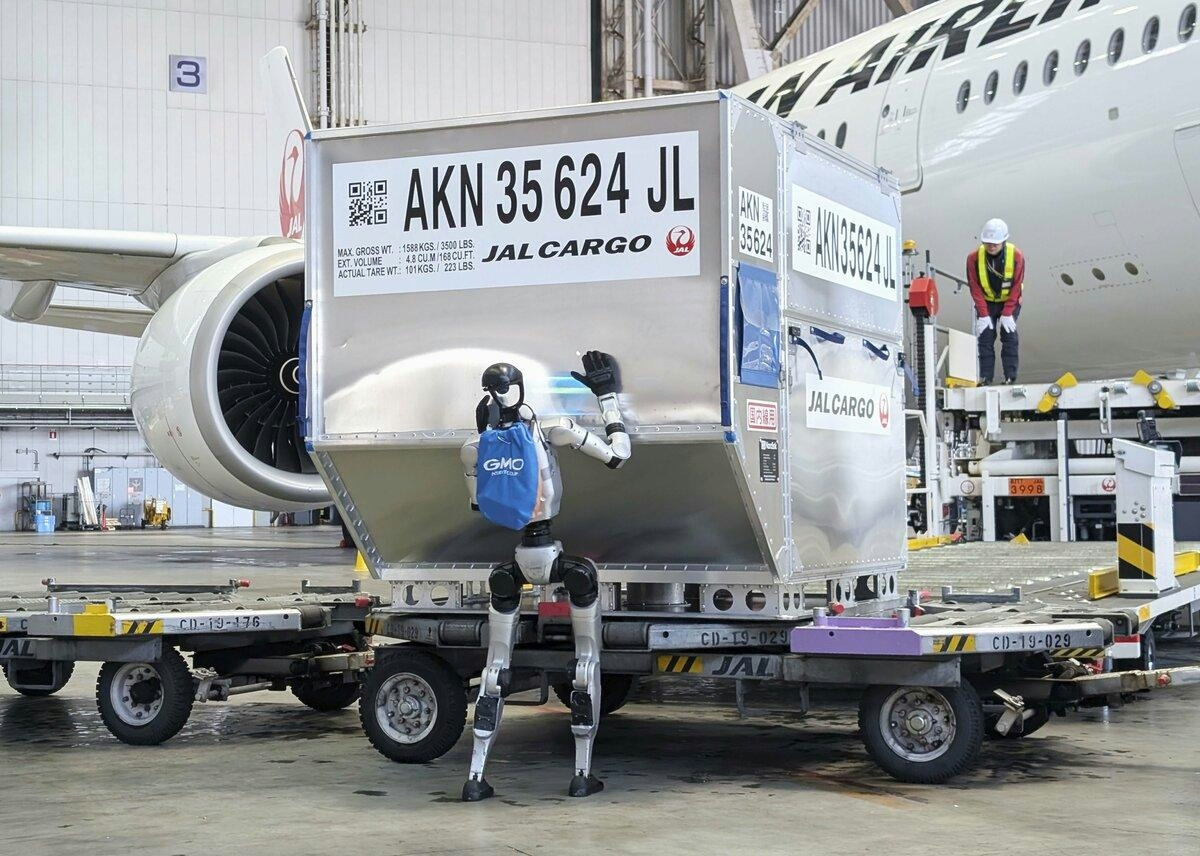
Japan Airlines to Trial Humanoid Robots Amid Labor Shortages
Japan Airlines (JAL) is preparing to introduce humanoid robots into airport ground operations as part of a strategic response to the country’s escalating labor shortage. Starting in May 2026, JAL Grand Service, in collaboration with GMO AI & Robotics Trading, will initiate a phased trial at Japanese airports. This marks the first large-scale experiment in Japan deploying humanoid robots for ground handling tasks, reflecting an innovative approach to addressing workforce deficits in the aviation sector.
Addressing Labor Challenges with Humanoid Robotics
Japan’s aviation industry is grappling with a shrinking working-age population alongside a surge in inbound tourism, creating a widening gap between labor supply and operational demand. The trial aims to assess whether humanoid robots, designed to mimic human form and movement, can assist with physically demanding duties such as baggage loading, cargo transport, and potentially aircraft cabin cleaning. Unlike traditional automation systems, which often require extensive infrastructure modifications and struggle with the dynamic, unpredictable environment of airport ground operations, humanoid robots offer the promise of greater adaptability and seamless integration within existing facilities.
Despite the potential benefits, the initiative faces considerable skepticism. Research from Stanford University highlights that humanoid robots currently fail 88% of the time when performing routine household tasks, casting doubt on their reliability in the high-pressure context of airport operations. Industry experts, including ASI CEO Mel Torrie, have questioned the economic feasibility of humanoid robots compared to autonomous vehicles, which are already gaining traction in logistics by combining mobility with manipulation capabilities.
Structure and Objectives of the Experiment
The project will commence with a comprehensive analysis of current airport workflows to identify tasks suitable for robotic assistance. Subsequent phases will involve rigorous testing within simulated airport environments to evaluate performance and safety. The overarching goal is for humanoid robots to collaborate with human staff by undertaking repetitive or physically strenuous tasks, thereby alleviating workload pressures and contributing to more sustainable operational models.
JAL Grand Service, leveraging its extensive experience in ground operations, will establish operational criteria and oversee the evaluation of the robots’ safety and effectiveness. GMO AI & Robotics Trading, a subsidiary of GMO Internet Group, will supply the humanoid robots and develop their movement algorithms. The company recently inaugurated a humanoid research facility in Shibuya and launched a “Humanoid Dispatch Service,” underscoring its broader ambition to integrate robotic solutions into everyday life.
Industry Implications and Cultural Context
While some competitors prioritize autonomous vehicles and other complementary technologies, Japan’s deep-rooted expertise in robotics and cultural receptiveness to automation may provide a competitive advantage in advancing humanoid solutions. However, as artificial intelligence increasingly drives robotics innovation, Japan’s traditional strength in physical hardware may not guarantee sustained leadership in this evolving field.
GMO Internet Group has designated 2026 as the “First Year of Humanoids,” signaling a strong commitment to expanding the societal role of robots. Should JAL’s experiment demonstrate success, it could catalyze wider adoption of humanoid robots across airports and other sectors confronting similar labor shortages. Nonetheless, significant technical and economic challenges remain before humanoid robots can reliably assume the demanding responsibilities of airport ground operations.

Etihad Airways Suspends Airbus A380 Flights on Key Route

Aditya Birla Group Seeks Approval for Aircraft Leasing in GIFT City

Qatar Airways Highlights Innovation and Connectivity at Arabian Travel Market 2026

Hong Kong's Five-Year Plan Includes Andrew Fan's Aircraft Parts Processing Hub Proposal

ACIA Aero Leasing Delivers ATR72-600 to Air Nostrum

RTX Appoints Jill Albertelli as Head of Pratt & Whitney

TAT Technologies Joins Beyond Aero Hydrogen Aircraft Program

AURAK Study Highlights Barriers to Air Taxi Adoption in Emerging Economies

Xiamen Air Selects Altitude for 787 Maintenance at Heathrow

Etihad and Swissport Extend Global Partnership
