
KI-Erkenntnisse in konkrete Maßnahmen überführen

Trends
Categories
New F-47 Engine Design May Extend Range Beyond China’s J-36
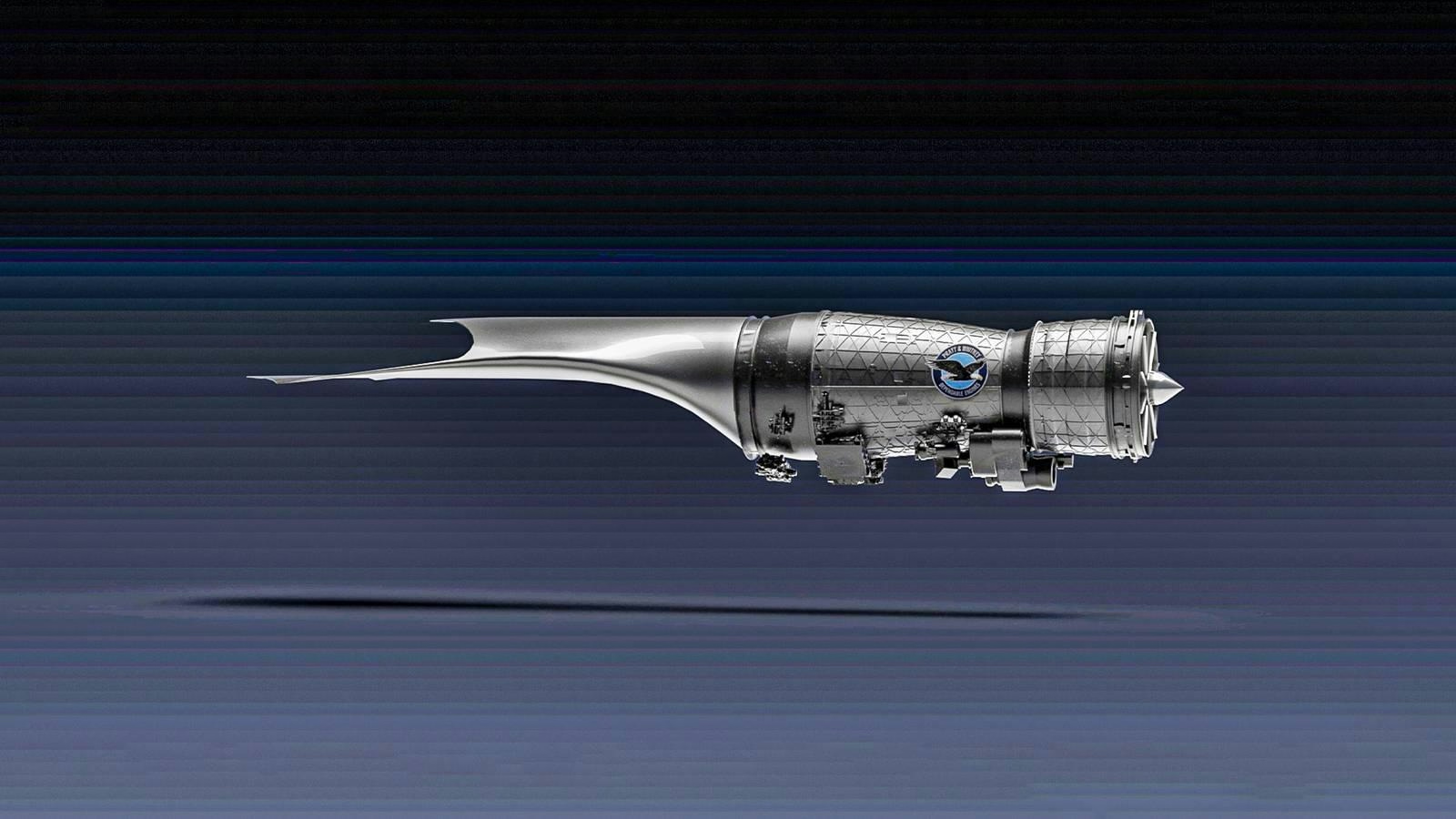
New F-47 Engine Design May Extend Range Beyond China’s J-36
Online rankings of fighter jets often emphasize individual attributes such as speed, range, payload, or radar cross-section. However, such comparisons can be misleading, as fighter aircraft are tailored to specific missions, operational environments, and the strategic needs of their respective operators. This distinction is particularly relevant when examining the emerging Chinese J-36 and the US F-47 next-generation fighters. While these aircraft share some overlapping requirements, they are being developed with different strategic objectives in mind.
Strategic Importance of Range in the Asia-Pacific Theater
Range is a critical factor for both the J-36 and F-47, given the vast distances characteristic of the Asia-Pacific region. The ability to conduct operations far from home bases is essential for maintaining air superiority and projecting power. Reliable information on these aircraft remains limited. Details about the J-36 are largely speculative, derived from limited imagery and unofficial sources, as China has released minimal official data. Conversely, most insights into the F-47 come from statements by the US Air Force and industry reports, with no official images available and some public renderings suspected to be deliberately misleading.
F-47 and the Next Generation Air Dominance Program
The United States is developing the F-47 as part of the Next Generation Air Dominance (NGAD) program, aiming to produce a dedicated air superiority fighter to succeed the F-22 Raptor. The F-47 is designed to restore a decisive technological advantage, often described as a “silver bullet,” to ensure continued US air dominance amid emerging threats. These threats include new adversary fighters and advanced radar systems that challenge the F-22’s current supremacy. The NGAD program also encompasses the development of Collaborative Combat Aircraft (CCAs), which will operate in conjunction with the manned F-47 to enhance combat effectiveness.
A paramount requirement for the F-47 is an extended unrefueled combat radius, with the US Air Force targeting a range exceeding 1,000 nautical miles (approximately 1,852 kilometers). This capability is driven by the necessity to operate at greater distances as China’s J-20 and other long-range systems increasingly threaten high-value support aircraft and forward bases. The operational environment is further complicated by the proliferation of ballistic missiles and one-way attack drones, elevating range as a top priority.
Boeing, the lead contractor for the F-47, is reportedly developing a new engine design that could significantly extend the aircraft’s range, potentially surpassing that of China’s J-36. This advancement occurs amid strong demand for advanced fighters, as evidenced by Boeing’s F-15EX production line being effectively sold out through 2034-2035. The competition in the fighter market is intensifying as both US and Chinese manufacturers race to deliver next-generation capabilities.
China’s Aerospace Advancements and the Competitive Landscape
China is rapidly advancing its aerospace propulsion technologies. The Aero Engine Corporation of China (AECC) recently announced the maiden flight test of a new 600-kgf engine designed for unmanned aerial vehicles, signaling progress that may have broader implications for future fighter engines. Additionally, China’s Mega Engine Technology has achieved significant test time on a high-pressure oxygen-rich staged-combustion engine, underscoring the country’s commitment to developing indigenous high-performance propulsion systems.
These developments illustrate a competitive landscape in which both Boeing and Chinese engine manufacturers are pushing technological boundaries. As both nations strive to enhance the range and performance of their next-generation fighters, the outcome will play a crucial role in shaping the balance of air power in the Asia-Pacific region for years to come.
Etihad CEO Cites Aircraft Capacity as Limiting Factor Amid Growth in China and Africa

How Southwest Airlines is using technology, data and AI to strengthen CX while keeping the human touch
Red Sea Airlines to Lease Two Boeing 737 MAX 8 Aircraft
Su-30 and Su-34 Fighter Jets' Engines Contribute to Urban Heat

Airlines Urge Increased Competition in Used Jet Engine Parts Market
Future Developments Planned for NWF Beaches Airport
airBaltic Files for Chapter 11 Bankruptcy Protection
PD-8 Engine Encounters Corrosion Issues from Saltwater Exposure

Weekly Summary: August Deliveries, Year-to-Date Orders, and 4.1 Million Share Buyback
Linking Ireland’s Aircraft Leasing Industry to Elite Football
