
KI-Erkenntnisse in konkrete Maßnahmen überführen

Trends
Categories
Safran Revises Pricing for LEAP Jet Engine Program
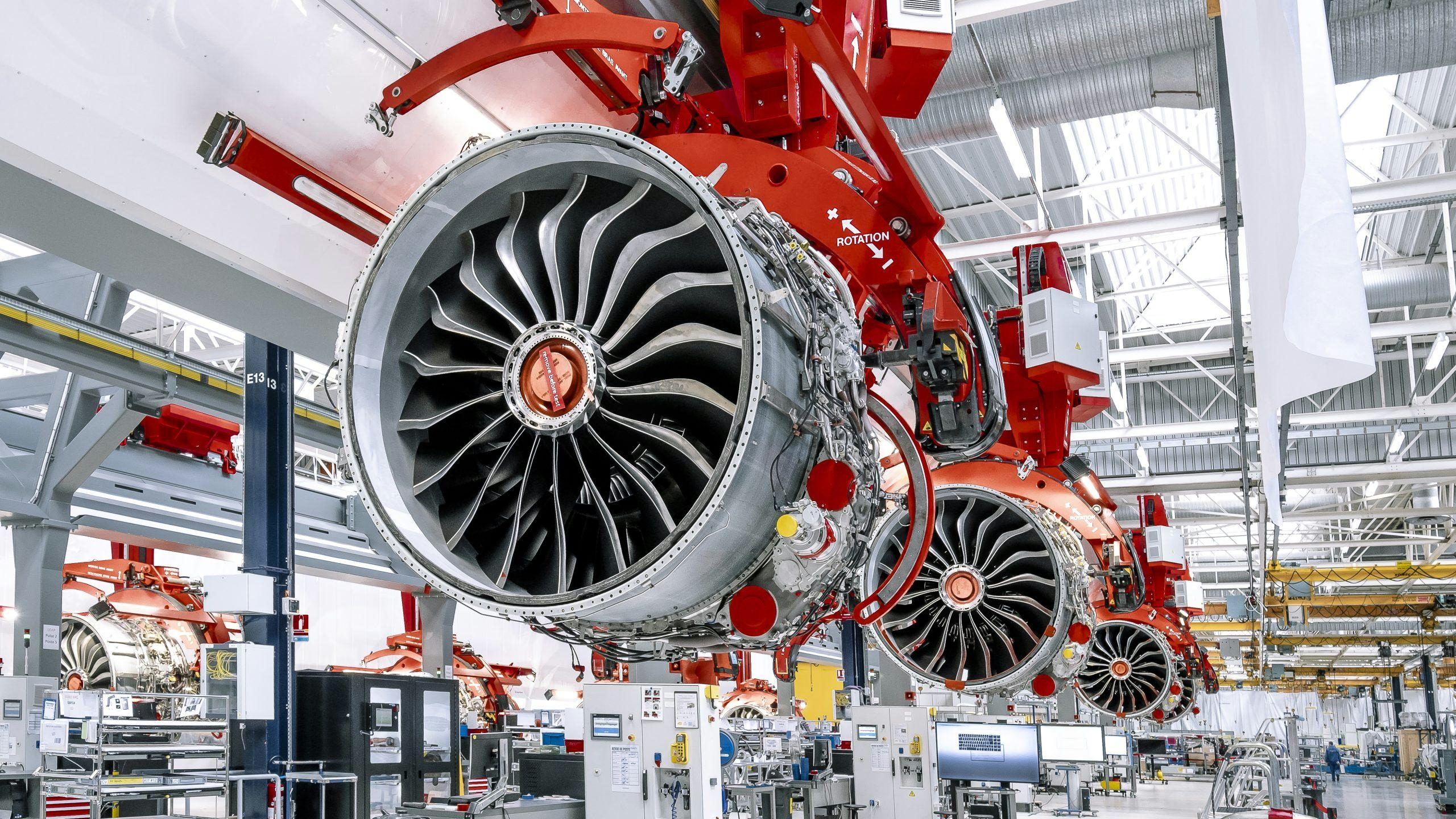
Safran Revises Pricing for LEAP Jet Engine Program
Safran has recently announced a revision in the pricing of its LEAP turbofan engine program, a development that has drawn renewed attention to the engine’s operational efficiency, maintenance profile, and strategic significance for airlines managing narrowbody fleets. The LEAP engine, a product of the CFM International partnership between Safran and General Electric (GE), powers the Boeing 737 MAX and Airbus A320neo families, making it a cornerstone of Safran’s commercial aviation portfolio.
Technological Advancements and Variants
Positioned as the next-generation successor to the widely deployed CFM56 engine, the LEAP offers up to 15% reductions in fuel consumption and CO₂ emissions under comparable operating conditions. These improvements are achieved through a combination of advanced technologies, including a higher overall pressure ratio, a sophisticated 3D-aero compressor design, and a two-stage high-pressure turbine. Noise reduction has also been a key focus, with the incorporation of a large-diameter composite fan and an optimized nacelle design that meets the latest regulatory standards.
The LEAP family comprises several variants tailored to specific aircraft models. The LEAP-1A is designed for the Airbus A320neo, the LEAP-1B serves exclusively on the Boeing 737 MAX, and the LEAP-1C powers the COMAC C919. Despite differences in application, all variants share a common architecture featuring a single-stage fan, a three-stage low-pressure compressor, a ten-stage high-pressure compressor, a two-stage high-pressure turbine, and a five-stage low-pressure turbine. Notably, the LEAP-1A’s fan diameter measures approximately 78 inches, while the LEAP-1B’s slightly smaller fan accommodates the Boeing 737 MAX’s ground clearance requirements.
Materials Innovation and Manufacturing Techniques
Central to the LEAP’s performance are innovations in materials and manufacturing. The use of 3D-woven carbon-fiber composites for fan blades and cases reduces engine weight while enhancing resistance to foreign-object damage. In the engine’s hot section, ceramic-matrix composite (CMC) components enable higher operating temperatures, which in turn improve efficiency and durability. Additive manufacturing techniques are employed for certain fuel nozzle components, allowing for part consolidation that enhances reliability and streamlines production processes.
Economic Impact and Market Position
From an airline economics perspective, the LEAP’s fuel efficiency translates into significantly lower operating costs per seat, particularly on high-utilization, short-haul routes. Industry analyses suggest that the double-digit percentage gains in fuel efficiency can result in millions of dollars in annual savings for carriers operating large fleets of 737 MAX or A320neo aircraft. This cost advantage has contributed to a substantial order backlog for the LEAP family across Airbus, Boeing, and COMAC programs, despite recent challenges related to delivery schedules and certification.
Safran’s recent pricing revision has sparked discussions within the industry regarding potential market reactions and challenges. Competitors, including GE Aerospace, have expressed confidence in the LEAP’s durability, emphasizing ongoing design and component enhancements aimed at achieving reliability comparable to the CFM56. The competitive landscape is further influenced by Safran’s joint venture with SIA Engineering, which provides global maintenance, repair, and overhaul (MRO) services for LEAP engines, reflecting growing demand for engine support. Additionally, Safran’s investment in precision navigation sensors in France highlights its commitment to advancing critical engine technologies.
As airlines evaluate new contracts and operational expenditures, the LEAP program’s combination of efficiency, durability, and comprehensive support services continues to play a pivotal role in the evolving narrowbody aircraft market.
Embraer Delivers 2,000th E-Jet as Airbus A220 Seeks Market Share
iniBuilds Releases Second In-Depth A380 Video
Ryanair and Alaska Airlines Apply AI to Operational Decision-Making

Digital Payments, AI, and Aviation Strengthen Philippines-India Relations
PlaneSense Suspends PC-12 Jet Card Sales
How AI Could Transform Bird-Strike Prevention for Business Aviation
American Airlines and Boeing Complete First 737 MAX Landing Gear Swap

Vietjet and Thales sign major MRO and AI deals in Paris
Etihad CEO Cites Aircraft Capacity as Limiting Factor Amid Growth in China and Africa
Artificial Intelligence Enters the Cockpit
