
Orquesta conocimientos de IA para convertirlos en acción

Tendencias
Categories
Spirit Airlines Shutdown Highlights Supply Chain Challenges
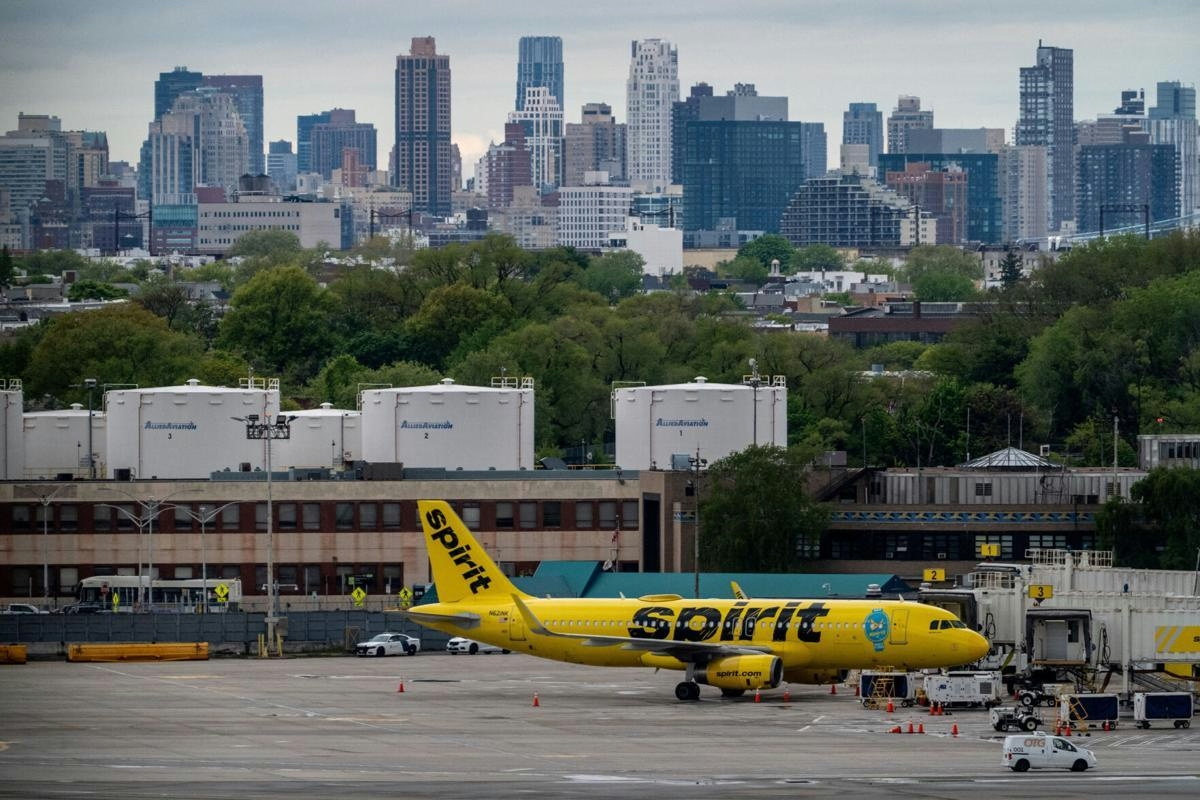
Spirit Airlines Shutdown Highlights Supply Chain Challenges
The sudden cessation of Spirit Airlines’ operations on May 2, 2026, starkly illustrates the fragility of highly optimized supply chains when underlying assumptions shift more rapidly than organizations can adapt. Once a disruptive force in U.S. air travel, Spirit Airlines pioneered a low-cost, high-utilization model that expanded demand and pressured larger competitors. However, after failing to secure a crucial $500 million bailout, the airline abruptly halted all flights, leaving thousands of passengers stranded and scrambling for refunds or alternative travel arrangements. Competitors such as American Airlines and United Airlines have since stepped in to assist affected customers and offer employment opportunities to displaced Spirit employees.
The Vulnerabilities of Lean Supply Chains
Spirit’s business model was grounded in principles familiar to supply chain leaders across industries: high asset utilization, low unit costs, dense scheduling, and price-sensitive demand. These strategies, while effective in stable environments, rely heavily on lean inventories, consolidated supplier networks, and minimal slack. Such optimization drives efficiency but also exposes organizations to significant risk when variability or disruptions increase.
The airline industry vividly exposes these vulnerabilities. Each aircraft, crew, and flight operates within a tightly sequenced network where a single delay, maintenance issue, or missed rotation can cascade into widespread disruptions. When multiple constraints accumulate, isolated problems escalate into systemic failures. This dynamic mirrors broader supply chain challenges, where a delay from a single supplier can halt production lines, shift allocations, and disrupt transportation and service delivery. What may begin as a minor disruption can quickly propagate, causing extensive network-wide consequences.
Many organizations mistakenly interpret these challenges as issues of visibility, investing heavily in dashboards, alerts, and tracking systems. Spirit Airlines, for instance, maintained real-time awareness of aircraft locations and operational pressures. The core difficulty, however, lies in decision-making under constraint—when every available option involves trade-offs among cost, service quality, regulatory compliance, labor considerations, or customer impact. Supply chain leaders face similar dilemmas daily: whether to expedite freight at higher cost or accept delays, reallocate scarce inventory at the risk of disappointing key customers, or shift production and potentially create new bottlenecks elsewhere.
These challenges are not merely data gaps but complex decision problems constrained by competing priorities. The future of supply chain performance will depend less on additional data visualization tools and more on improved decision architecture—systems and processes capable of rapidly evaluating trade-offs, understanding cross-functional impacts, and coordinating actions across planning, procurement, production, transportation, and customer service.
Resilience Beyond Efficiency
Spirit’s collapse also highlights the critical distinction between buffer and optionality. Buffer refers to extra capacity, inventory, or time built into a system, while optionality is the ability to reconfigure the network dynamically when plans falter. In supply chains, optionality might manifest as alternate suppliers, flexible routing, dynamic inventory positioning, or the capacity to shift production before disruptions escalate.
The broader repercussions of Spirit’s liquidation will be felt across the travel industry and among consumers. The airline’s exit is likely to lead to higher fares and reduced travel options, particularly on routes where Spirit had historically offered lower prices. Additionally, uncertainty looms for holders of Spirit’s co-branded credit cards issued by Bank of America, as the future of these programs remains unclear.
Ultimately, the downfall of Spirit Airlines serves as a cautionary example for supply chain leaders. Achieving resilience requires more than pursuing efficiency; it demands the capacity to adapt, reconfigure operations, and make difficult decisions in the face of unforeseen challenges.
Embraer Delivers 2,000th E-Jet as Airbus A220 Seeks Market Share
iniBuilds Releases Second In-Depth A380 Video
Ryanair and Alaska Airlines Apply AI to Operational Decision-Making
Digital Payments, AI, and Aviation Strengthen Philippines-India Relations
PlaneSense Suspends PC-12 Jet Card Sales
How AI Could Transform Bird-Strike Prevention for Business Aviation
American Airlines and Boeing Complete First 737 MAX Landing Gear Swap

Vietjet and Thales sign major MRO and AI deals in Paris
Etihad CEO Cites Aircraft Capacity as Limiting Factor Amid Growth in China and Africa
Artificial Intelligence Enters the Cockpit
