
Orquesta conocimientos de IA para convertirlos en acción

Tendencias
Categories
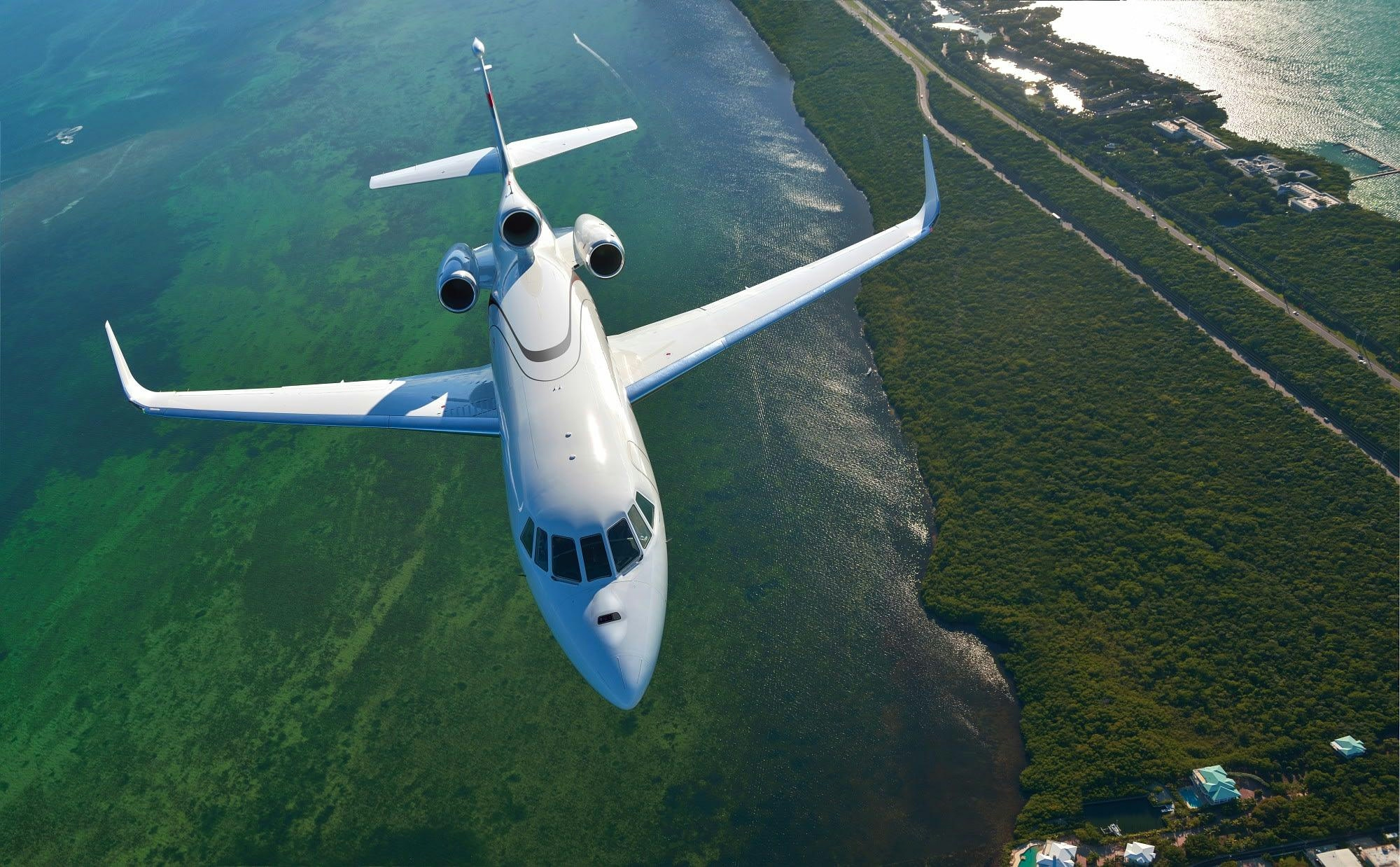
The Last Three-Engine Aircraft Still in Operation
The Last Three-Engine Aircraft Still in Operation
Three-engine aircraft, commonly known as trijets, once represented a significant phase in the evolution of commercial aviation. Positioned between early twin-engine jets and larger four-engine airliners, trijets such as the Boeing 727, McDonnell Douglas DC-10, and MD-11 provided airlines with a distinctive combination of redundancy, range, and operational flexibility. Their capability to operate from shorter runways and serve remote airports made them invaluable during an era when engine reliability was less assured and regulatory constraints limited twinjets, while four-engine aircraft were often too large or expensive for many routes.
By the early 21st century, however, advancements in engine technology, stricter noise regulations, and the relaxation of Extended-range Twin-engine Operational Performance Standards (ETOPS) significantly diminished the role of trijets in passenger service. The emergence of highly efficient twinjets, driven by fuel economy and lower operating costs, led to the gradual retirement of most trijet models from commercial fleets. Nevertheless, as of 2026, a small number of these aircraft continue to operate, primarily in cargo transport, government service, military roles, and specialized missions, underscoring the enduring utility of the trijet configuration.
The Boeing 727: An Enduring Icon
Among trijets, the Boeing 727 stands out as the most iconic and widely produced model, with 1,832 units delivered between its maiden flight in 1963 and the conclusion of its production run. Engineered to meet the demands of the expanding domestic jet market, the 727 featured three rear-mounted Pratt & Whitney JT8D engines, a distinctive T-tail, and an integrated airstair, enabling it to access shorter runways and less-developed airports. Throughout the 1970s and 1980s, major carriers including United Airlines, American Airlines, Eastern Airlines, Pan Am, and Northwest Airlines relied heavily on the 727, making it a cornerstone of mid-20th-century air travel.
Despite its early success, the 727 encountered increasing challenges by the late 1980s. Rising fuel prices, more stringent noise regulations, and the improved reliability and extended range of twin-engine jets—facilitated by expanded ETOPS certifications—accelerated the aircraft’s withdrawal from passenger service. By the early 2010s, scheduled passenger flights using the 727 had effectively ceased.
As of January 2026, several operators continue to utilize the Boeing 727 in various capacities. These include 2Excel Aviation in the United Kingdom, which operates a B727-200F for special missions and testing; Air Class in Uruguay, with two B727-200Fs dedicated to cargo transport; and the Force Aérienne du Congo, which employs two B727-100Cs for military transport. Additional operators include the Guardia Nacional Mexicana in Mexico, RTX Corporation in the United States using a B727-200 as a testbed for research and development, USA Jet Airlines with two B727-200Fs for cargo, and the Zero Gravity Corporation, which uses a B727-200F for parabolic flight and testing purposes.
Trijets Amidst a Shifting Aviation Landscape
The persistence of these remaining trijets occurs against the backdrop of a rapidly changing aviation industry. The Federal Aviation Administration’s recent removal of production caps on Boeing’s 737 MAX, coupled with increased production rates, reflects a highly competitive market in which Boeing is striving to regain ground against Airbus. Concurrently, Embraer’s strategic emphasis on expanding sales of its E2 family rather than developing new airliners signals evolving priorities among aircraft manufacturers. Operational challenges persist as well, exemplified by increased ground time for CFM56-powered narrowbody aircraft, which raises concerns about reliability and influences perceptions of safety and efficiency.
Within this dynamic context, the last operational trijets serve as both historical artifacts and functional assets. Their continued deployment in specialized roles highlights the robustness of their original engineering and the adaptability required to maintain relevance amid ongoing industry transformation. Although their numbers continue to decline, the legacy of three-engine aircraft remains a significant chapter in the history of aviation.
BBN Airlines Becomes IATA Member
FAA Orders Breeze Airways and Delta to Inspect Airbus A220 Fuel Hoses

Philippine Aviation Navigates Expansion and Costs Amid Fuel Price Volatility
On April 26, 1971, an SR-71 Blackbird Flew Over 15,000 Miles in 10.5 Hours, Limited by Liquid Nitrogen Supply
Boeing 747 Airframe Valued Less Than One Landing Gear Component
The Rear-Fan Engine Behind the Crash of the World's Fastest Airliner
Morphing Aircraft Skin Improves Safety and Fuel Efficiency

BRICS Nations Commit to Enhanced Cooperation on Sustainable Transport and Green Aviation
CFM Turbine Upgrade Doubles LEAP Engine Service Life in Harsh Conditions
CFM Upgrade Doubles LEAP Engine Lifespan in Harsh Climates
