
Orchestrer les insights d’IA pour les transformer en actions

Tendances
Categories
Dario Amodei Urges AI Regulation Inspired by Aviation and Pharmaceuticals
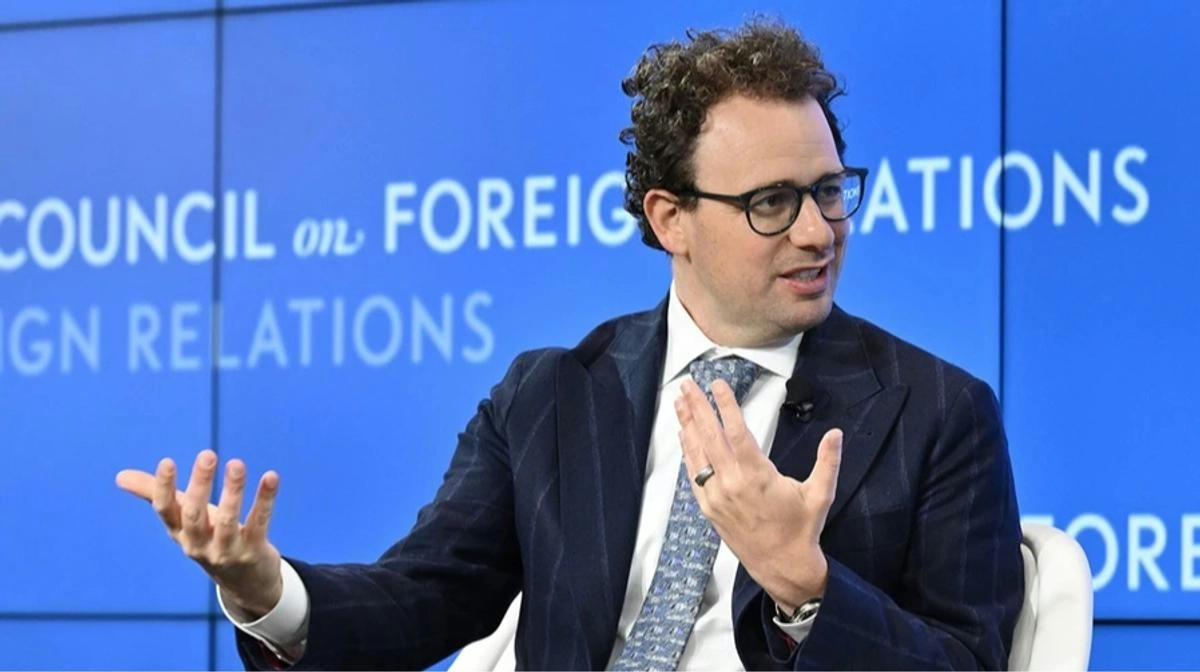
Dario Amodei Advocates for AI Regulation Modeled on Aviation and Pharmaceuticals
Anthropic CEO Dario Amodei has issued a compelling appeal for comprehensive regulation of artificial intelligence, emphasizing that transparency alone is insufficient amid the rapid advancement of AI technologies. In his recent policy essay, "Policy on the AI Exponential," Amodei urges lawmakers to implement oversight frameworks inspired by the aviation and pharmaceutical sectors, both of which are characterized by stringent safety standards and robust regulatory institutions.
The Need for Independent Oversight
Amodei opens his essay with an analogy drawn from The Lord of the Rings, contrasting the slow pace of political institutions with the exponential growth of AI capabilities. He highlights that within just four years, AI models have evolved from producing incoherent code to generating much of the software utilized by leading AI companies. Should this trajectory continue, Amodei warns society may soon confront what he terms “a country of geniuses in a datacentre,” underscoring the unprecedented speed and scale of AI development.
Central to his proposal is the establishment of an independent AI oversight agency, modeled after the U.S. Federal Aviation Administration (FAA). This body would require third-party testing for any AI model exceeding a specified computational threshold, focusing on four critical risk areas: cybersecurity, biological threats, loss of control over AI systems, and automated research that could exacerbate these risks. The agency would possess the authority to block the deployment of hazardous models while incorporating safeguards to prevent political bias. Additionally, developers would be mandated to secure model weights and report incidents promptly.
Addressing Economic and Regulatory Challenges
Amodei’s call for regulation coincides with Anthropic’s release of a legislative proposal advocating mandatory testing of frontier AI models alongside a framework to mitigate potential mass job displacement. The company has committed financial resources to support both initiatives.
Economic concerns are central to Amodei’s argument. He warns of a future marked by “hyper-growth with hyper-inequality,” where rapid GDP expansion is accompanied by significant and prolonged job displacement. To counter these effects, he proposes a range of policy measures, including state monitoring of AI’s impact on employment, wage insurance for workers transitioning to lower-paid roles, tax incentives for companies that retain staff, and consideration of universal basic income or universal capital accounts funded through taxes on AI firms and capital gains.
Amodei also draws attention to a regulatory paradox: while AI has the potential to accelerate breakthroughs in biomedicine, energy, and materials science, existing agencies such as the FDA and EMA may be overwhelmed by the volume of innovations. He urges these bodies to develop standards for incorporating AI-driven simulations into clinical trials and approval processes to keep pace with technological progress.
Industry and Regulatory Reactions
Amodei’s proposals have ignited significant debate within the technology sector and regulatory circles. Some industry players and stakeholders endorse stringent oversight to ensure safety and maintain public trust, while others caution that excessive regulation could hinder innovation and result in fragmented governance. Market responses have included increased scrutiny from regulators and investors, intensifying discussions on how to balance rapid technological advancement with the necessity of robust safeguards.
As AI systems become increasingly embedded in critical infrastructure, finance, and national security, Amodei’s advocacy for regulation modeled on aviation and pharmaceuticals highlights the urgent imperative for policymakers to adapt regulatory frameworks before the technology outpaces society’s capacity to manage its risks.

Etihad Airways Suspends Airbus A380 Flights on Key Route

Aditya Birla Group Seeks Approval for Aircraft Leasing in GIFT City

Qatar Airways Highlights Innovation and Connectivity at Arabian Travel Market 2026

Hong Kong's Five-Year Plan Includes Andrew Fan's Aircraft Parts Processing Hub Proposal

ACIA Aero Leasing Delivers ATR72-600 to Air Nostrum

RTX Appoints Jill Albertelli as Head of Pratt & Whitney

TAT Technologies Joins Beyond Aero Hydrogen Aircraft Program

AURAK Study Highlights Barriers to Air Taxi Adoption in Emerging Economies

Xiamen Air Selects Altitude for 787 Maintenance at Heathrow

Etihad and Swissport Extend Global Partnership
