
Orchestrer les insights d’IA pour les transformer en actions

Tendances
Categories
FAA Approves Swift Fuels 100R for Use in 840 Engines
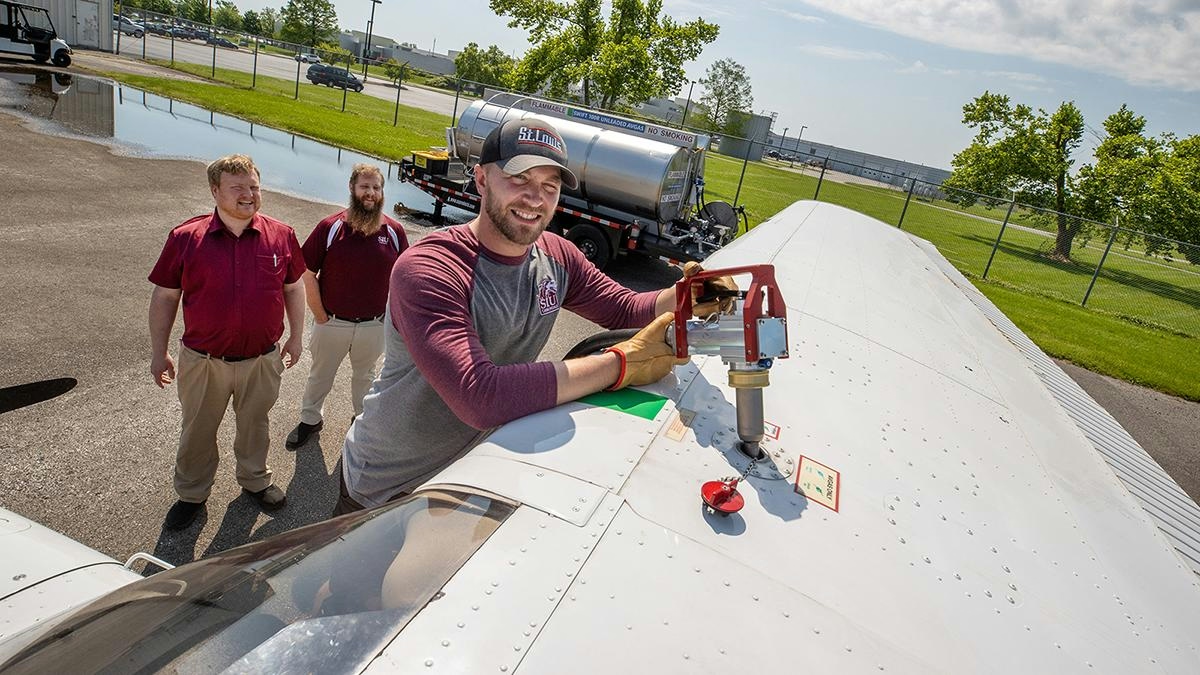
FAA Expands Approval of Swift Fuels 100R to 840 Aircraft Engines
The Federal Aviation Administration (FAA) has significantly broadened its approval of Swift Fuels’ 100R unleaded aviation gasoline, now authorizing its use in 840 different aircraft engines. The update, effective March 11, 2026, amends the FAA’s Approved Model List (AML) for Swift Fuels’ Supplemental Type Certificate (STC), encompassing a wide range of engines from 65-horsepower Continentals to high-performance Lycoming 540s, as well as models from Franklin, Pratt & Whitney, and several radial engines.
This development marks a crucial advancement in the aviation industry’s transition away from leaded fuels. Since introducing its UL94 unleaded avgas in 2015, Swift Fuels has supplied this 94-octane fuel to over 100 airports across the United States. While UL94 has served lower-compression engines—covering approximately 65 to 70 percent of the piston engine fleet—high-performance engines have continued to depend on leaded 100LL fuel for detonation protection. The expanded approval of 100R aims to address this gap by providing a high-octane unleaded alternative suitable for a broader range of engines.
Progress Toward Unleaded Aviation Fuel
The path to wider adoption of 100R began in late 2024 when the FAA granted a limited STC for its use in Cessna 172 R and S models equipped with Lycoming IO-360-L2A engines. Over the following 18 months, 100R was employed as a “test-bed” fuel by ten flight schools across the United States and Europe. A significant milestone occurred in September 2025 when ASTM International published a production specification for 100R, facilitating broader acceptance and distribution of the fuel.
Swift Fuels has underscored the importance of ASTM certification, emphasizing that a global specification is vital for international distribution and securing approvals from Original Equipment Manufacturers (OEMs). Leveraging its existing UL94 infrastructure, the company plans to expand the rollout of 100R, gradually replacing the lower-octane fuel as additional engine approvals are secured.
Implications for Operators and the Market
Aircraft owners wishing to use 100R must obtain an STC. Swift Fuels offers a “Forever STC” for $100, which includes ongoing notifications, placards, licensing rights, and all necessary FAA documentation at no extra cost. This streamlined approach is intended to facilitate a smoother transition for operators as 100R becomes available at more airports.
The FAA’s expanded approval is expected to have a significant impact on the general aviation fuel market. As eligibility for 100R use grows, demand is likely to increase, potentially accelerating its distribution throughout the United States and Europe. However, this transition also presents challenges, including market acceptance and the need for airports and operators to adapt to new fuel specifications and infrastructure requirements.
Competitive Landscape in Unleaded Avgas
Competition in the unleaded aviation gasoline market remains intense. Swift Fuels is among three companies striving to deliver a viable unleaded 100-octane fuel for general aviation by 2030. General Aviation Modifications Inc. (GAMI) secured FAA approval for its G100UL fuel in 2022, which covers every spark-ignition piston engine and airframe listed in the FAA’s Type Certificate database. Meanwhile, LyondellBasell continues to develop its UL100E fuel.
As the industry navigates these changes, the expanded FAA approval of Swift Fuels’ 100R represents a pivotal moment in efforts to eliminate lead from aviation fuel and modernize the energy landscape of general aviation.

Etihad Airways Suspends Airbus A380 Flights on Key Route

Aditya Birla Group Seeks Approval for Aircraft Leasing in GIFT City

Qatar Airways Highlights Innovation and Connectivity at Arabian Travel Market 2026

Hong Kong's Five-Year Plan Includes Andrew Fan's Aircraft Parts Processing Hub Proposal

ACIA Aero Leasing Delivers ATR72-600 to Air Nostrum

RTX Appoints Jill Albertelli as Head of Pratt & Whitney

TAT Technologies Joins Beyond Aero Hydrogen Aircraft Program

AURAK Study Highlights Barriers to Air Taxi Adoption in Emerging Economies

Xiamen Air Selects Altitude for 787 Maintenance at Heathrow

Etihad and Swissport Extend Global Partnership
