
画像

エアロジニー — あなたのインテリジェントな副操縦士。

何でも尋ねてください。全てを分析してください。即座に行動してください。

現在のトレンド

Categories

Leading Companies Solidify Their Presence in the Advanced Air Mobility Market
February 9, 2026By ePlane AI
Leading Companies Solidify Their Presence in the Advanced Air Mobility Market
0
0
Advanced Air Mobility
Urban Air Mobility
Electric Propulsion

Leading Companies Solidify Their Presence in the Advanced Air Mobility Market

The advanced air mobility (AAM) sector is undergoing rapid transformation, with the potential to revolutionize urban transportation in the near future. This evolution is driven by significant technological advancements and expanding regulatory frameworks, which together are poised to redefine the movement of people and goods within metropolitan areas.

Market Growth and Strategic Shifts

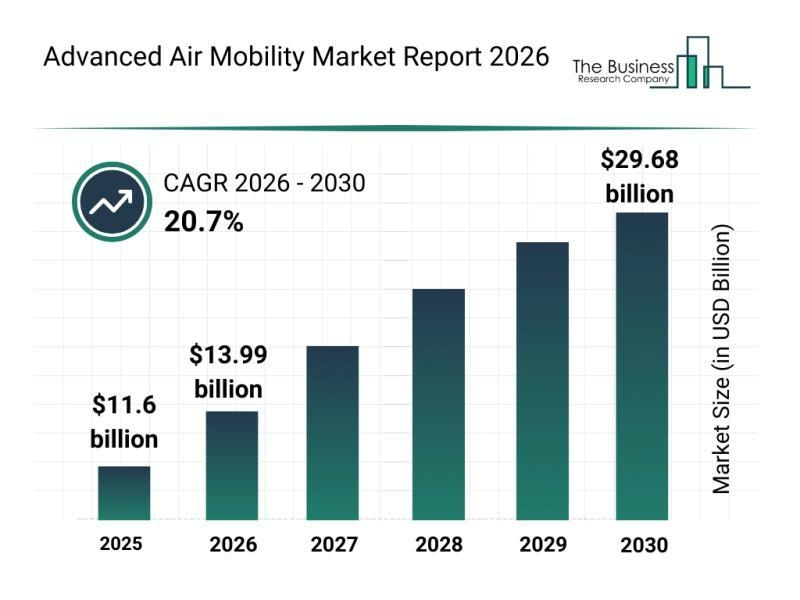
The AAM market is forecasted to reach a valuation of $29.68 billion by 2030, expanding at a compound annual growth rate (CAGR) of 20.7%. This robust growth is underpinned by accelerated regulatory developments in urban air mobility, widespread adoption of electric propulsion systems, progress in autonomous navigation technologies, and strategic airspace management within smart city initiatives. The commercialization of air taxi services, alongside increased investment in infrastructure, further propels market expansion.

Despite these promising trends, leading companies face challenges, notably the slower-than-expected deployment of commercial passenger services. This has led some industry players to recalibrate their strategies, placing greater emphasis on defense applications and cargo transport as more immediate opportunities. For instance, Embraer has shifted focus toward sales of its E2 aircraft rather than developing new airliners, while AirX’s recent order of two Eve Air Mobility eVTOLs—with options for an additional 48—highlights the growing significance of the Asia-Pacific region in urban air transport.

Industry Leaders and Strategic Developments

The AAM landscape is shaped by a diverse group of major corporations, including The Boeing Company, Airbus SE, Honeywell International Inc., Bell Textron Inc., Bristow Group Inc., Joby Aviation, Archer Aviation Inc., Lilium GmbH, Volocopter GmbH, Aurora Flight Sciences Corporation, Eve Air Mobility Inc., Wisk Aero LLC, Vertical Aerospace Ltd, Elroy Air Inc., Opener Inc., Urban Aeronautics Ltd, EHang Holdings Limited, Workhorse Group Inc., Pipistrel Co, and The Helicopter Company. These entities are at the forefront of innovation, investing heavily in research and development and forging strategic partnerships to advance the sector.

A significant milestone occurred in July 2023 when US-based Ampaire acquired Talyn Air, a specialist in eVTOL aircraft systems. This acquisition is intended to strengthen Ampaire’s position in aviation electrification and broaden its capabilities across defense, drone technology, and advanced air mobility solutions.

Digital Air-Traffic Management and Regional Initiatives

A critical area of focus within the industry is the deployment of urban air-traffic management (UATM) systems. These digital platforms are designed to coordinate the operations of drones and eVTOL aircraft in congested urban airspace, optimizing flight routes, preventing collisions, and ensuring safe and efficient air traffic flow.

In India, JetSetGo launched Air Mobility India in May 2025, an innovative platform dedicated to the AAM ecosystem. Built on four foundational pillars, it functions as a comprehensive hub for news, analysis, and global content related to advanced air mobility.

In the United States, the state of Ohio has submitted a proposal to the Federal Aviation Administration’s Electric Vertical Takeoff and Landing Integration Pilot Program. This initiative seeks to harness AAM technology for critical medical transport services, supported by more than $1.2 billion in aerospace investment and infrastructure. The program underscores the sector’s potential to address urgent societal needs through innovative transportation solutions.

Outlook

As the advanced air mobility industry continues to mature, companies are adapting their strategies to navigate a complex landscape of regulatory, technological, and commercial challenges. Sustained investment, cross-sector collaboration, and a balanced focus on both passenger and non-passenger applications position the sector to play a transformative role in the future of urban transportation worldwide.

More news
FAA Approves Increased Takeoff Weight for Boeing 787

FAA Approves Increased Takeoff Weight for Boeing 787

FAA Approves Increased Takeoff Weight for Boeing 787 The U.S. Federal Aviation Administration (FAA) has granted certification for an increased maximum takeoff weight (iMTOW) for Boeing’s 787-9 and 787-10 aircraft. This approval provides airlines with enhanced operational flexibility, allowing them to carry heavier payloads or extend the range of these Dreamliner variants by up to 400 nautical miles. The adjustment addresses evolving airline demands for greater efficiency and route versatility. Enhancing Operational Capabilities Boeing has begun equipping aircraft with the iMTOW capability, which are now progressing through ticketing and delivery stages. According to John Murphy, 787 Chief Project Engineer, the upgrade is a direct response to customer feedback and ongoing product development efforts. Airlines expressed a clear desire for increased flexibility: some sought longer mission capabilities for the 787-10, while others prioritized additional payload capacity for the 787-9, even if it meant some trade-offs in range. Boeing’s solution aims to accommodate both requirements, reflecting a tailored approach to diverse airline needs. Air New Zealand, the launch customer for the 787-9, is poised to be among the first operators to benefit from the enhanced takeoff weight. The airline anticipates that the upgrade will support its strategic network expansion, bolstering trade, tourism, and connectivity for New Zealand. Regulatory Oversight and Safety Considerations While the iMTOW certification represents a significant advancement, the FAA is concurrently proposing new inspection protocols for Boeing 787s. These measures are intended to address potential fatigue issues linked to manufacturing defects involving "shim gaps" between structural components. If unaddressed, these gaps could compromise the long-term durability of the aircraft, necessitating additional operational considerations for airlines as they integrate the upgraded models into their fleets. This dual focus on expanding aircraft capabilities and maintaining rigorous safety standards highlights the complex balance Boeing and its airline partners must navigate. As the 787 family evolves to meet market demands, ongoing regulatory oversight remains critical to ensuring the aircraft’s reliability and performance.
HSI Orders Three Airbus H125 Helicopters for 2026 Delivery

HSI Orders Three Airbus H125 Helicopters for 2026 Delivery

HSI Orders Three Airbus H125 Helicopters for 2026 Delivery Helicopter Services Inc. (HSI) has confirmed an order for three Airbus H125 helicopters, with deliveries slated for 2026. These aircraft will undergo completion at HSI’s facility in Spring, Texas, before being made available to operators engaged in a variety of mission profiles. The company intends to offer mission-specific customization options, enabling clients to tailor the helicopters to their operational requirements. Versatility and Market Position of the H125 The Airbus H125 is recognized globally as one of the most widely utilized single-engine helicopters. It supports a broad spectrum of roles, including public safety, mosquito abatement, utility operations, aerial firefighting, and VIP transport. HSI’s approach to mission-specific completions aims to enhance the aircraft’s adaptability, allowing operators to deploy the H125 effectively across diverse environments. Michael Crossland, General Manager of Helicopter Services, emphasized the strategic value of the order, stating, “Securing these delivery positions allows HSI to better support operators seeking the proven performance and versatility of the Airbus H125. HSI is pleased to continue strengthening our relationship with Airbus Helicopters.” Market Context and Industry Developments HSI’s order arrives amid a period of renewed optimism in the global helicopter market, which has experienced a 5.1% increase in orders compared to 2024. The competitive landscape is intensifying, with manufacturers such as Leonardo and Sikorsky securing significant new contracts from Asian customers and advancing the development of new helicopter models. Concurrently, the sector is witnessing rapid technological advancements in mission equipment. For instance, Davenport Aviation recently demonstrated weapon delivery capabilities with a modified attack variant of the H125, underscoring the helicopter’s versatility and the growing demand for specialized configurations. Recent transactions further highlight the H125’s prominence, including the New Mexico State Police’s acquisition of an Airbus H125 police helicopter from Davenport Aviation, reflecting the model’s strong appeal among public safety and law enforcement agencies. With favorable market conditions and ongoing innovation, HSI’s latest order positions the company to address evolving operator needs and maintain a competitive advantage as the helicopter industry continues to expand.
Pakistan Requests Foreign Airlines to Carry Return Fuel Amid Supply Concerns

Pakistan Requests Foreign Airlines to Carry Return Fuel Amid Supply Concerns

Pakistan Advises Foreign Airlines to Carry Return Fuel Amid Jet Fuel Supply Concerns Precautionary Measures Amid Supply Chain Disruptions ISLAMABAD — Pakistan has issued a formal advisory urging foreign airlines to carry sufficient fuel for their return journeys and to limit refueling at Pakistani airports. This directive, communicated through a Notice to Airmen (NOTAM) by the Pakistan Airports Authority (PAA) on March 13, reflects growing concerns over potential jet fuel shortages linked to escalating tensions in the Middle East. The government is taking these steps to conserve domestic fuel reserves amid ongoing disruptions in the global supply chain. The NOTAM specifically instructs foreign carriers to minimize their reliance on Jet A-1 fuel supplies within Pakistan, citing precautionary reasons due to interruptions in the availability of this aviation-grade fuel. It states, “Due to disruption in supply chain of Jet A-1 fuel, as a precautionary measure, airlines are advised to carry max fuel [from] abroad and minimize uplift of Jet A-1 fuel [from] Pakistan.” This advisory applies to flights operating through major airports across the country. A PAA official confirmed that local airlines would continue to receive fuel according to their operational needs. The measure aims to alleviate pressure on domestic jet fuel stocks as authorities closely monitor the evolving geopolitical situation. Regional Tensions and Economic Implications The advisory emerges amid heightened apprehension over the impact of ongoing conflicts in Iran and broader Middle Eastern instability on global oil supply routes, particularly the strategically vital Strait of Hormuz. Disruptions in these maritime corridors have already contributed to rising fuel prices and uncertainties in supply worldwide. Aviation experts warn that persistently high fuel costs could compel airlines—especially smaller carriers with limited financial resilience—to reduce or suspend flights to Pakistan, potentially disrupting connectivity and affecting the national economy. In response to volatile global energy markets, Pakistan has implemented a series of fuel conservation measures in recent weeks, including the latest NOTAM. While officials assert that adequate fuel reserves remain available for routine operations, the government recently increased petrol and diesel prices by Rs55 per liter to offset rising international costs. Authorities have also indicated that fuel rationing may be considered should the regional conflict continue. The government emphasizes that these steps are precautionary and that supply and consumption levels are under close surveillance. Nonetheless, the situation highlights the vulnerability of Pakistan’s aviation sector and broader economy to external shocks stemming from geopolitical instability in global energy markets.
12 Innovations Poised to Improve Customer Experience and Airport Operations

12 Innovations Poised to Improve Customer Experience and Airport Operations

Innovations Set to Transform Airport Operations and Passenger Experience At the recent Future Travel Experience (FTE) World 2026 event in London, industry leaders unveiled a range of cutting-edge technologies poised to revolutionize airport operations and enhance the passenger journey. With growing pressure on airports and airlines to boost efficiency and elevate customer satisfaction, innovations spanning autonomous vehicles, biometrics, digital identity, and artificial intelligence are emerging as key drivers of change. Advancements in Autonomous Baggage Handling and Operational Optimization A highlight of the event was Pattern’s integrated approach to baggage and ground handling solutions. As a partner of the FTE Baggage Innovation Working Group, Pattern introduced its autonomous baggage shuttle, Pathfinder, engineered to integrate seamlessly with existing airport infrastructure. Skyeler Smith, Growth Director at Pattern, described Pathfinder as more than an autonomous vehicle, emphasizing the importance of its tele-operation layer. This feature allows human operators to remotely monitor and intervene when obstacles such as construction zones arise, utilizing a 360-degree environmental view to minimize operational disruptions. In addition to Pathfinder, Pattern showcased Pulse, a dispatch and routing optimization platform designed to coordinate baggage movement across airports. Pulse manages both autonomous and human-operated systems, optimizing routing and dispatch decisions to close efficiency gaps and enhance operational quality. According to Smith, Pulse enables airports, airlines, and ground handlers to transition toward more autonomous operations while addressing current inefficiencies. These technologies also pave the way for innovations such as remote check-ins and more flexible baggage flows, promising a smoother travel experience. Challenges and Industry Implications Despite the promise of these advancements, integrating new technologies into airport ecosystems presents significant challenges. Airports must carefully navigate the complexities of merging novel systems with legacy infrastructure, while ensuring stringent data privacy and security standards. The financial implications of implementation and ongoing maintenance also require careful consideration. Furthermore, initial skepticism from travelers and staff regarding reliability and privacy concerns may temper early adoption. However, as these innovations demonstrate clear improvements in efficiency and convenience, broader acceptance is anticipated. The competitive landscape within the aviation sector is also shifting. Early adopters of these technologies may compel competitors to follow suit to maintain market relevance or to differentiate themselves through unique offerings. This dynamic is expected to accelerate innovation across the industry, fostering a more rapid evolution of airport operations and passenger services. The convergence of operational efficiency, enhanced passenger experience, and advanced technology is redefining the future of air travel. The innovations presented at FTE World 2026 underscore a trajectory toward a more streamlined, seamless, and intelligent travel environment, as airports and airlines continue to invest in digital transformation.
FTE Founder Announces Departure as Organization Marks 20 Years

FTE Founder Announces Departure as Organization Marks 20 Years

FTE Founder Steps Down as Organization Marks Two Decade Milestone As Future Travel Experience (FTE) commemorates its 20th anniversary, founder Daniel Coleman has announced his decision to step down from daily operational duties, ushering in a significant leadership transition for the global aviation innovation platform. Since its inception two decades ago, FTE has evolved from a fledgling startup into a multifaceted enterprise that connects thousands of aviation leaders worldwide. Reflecting on the organization’s journey, Coleman emphasized the dedication and teamwork that have underpinned FTE’s success. He remarked, “Building FTE has required immense hard work and sacrifice, and—most importantly—an incredible team around me. I am enormously proud of what we’ve created together and what FTE represents today: a platform that sparks meaningful innovation for airlines and airports, and drives unrivalled collaboration across the industry.” Under his stewardship, FTE has been instrumental in advancing transformative initiatives across the sector, including self-service technologies, biometric systems, digital retailing, robotics, and artificial intelligence. The organization has also played a vital role in supporting startups, facilitating market entry for suppliers, and championing pioneers shaping the future of air transport. Transition and Future Outlook Coleman’s departure marks the beginning of a new chapter for FTE, one that presents both opportunities and challenges. Leadership changes of this magnitude often prompt concerns regarding market stability and investor confidence, especially as competitors may seek to exploit the founder’s exit through intensified marketing efforts or strategic alliances. Industry analysts suggest that FTE’s ability to maintain momentum and reassure stakeholders will be critical in navigating this period of uncertainty. Expressing confidence in the organization’s trajectory, Coleman highlighted the recent appointment of Max Gosney as Managing Director. Gosney brings over 20 years of experience spanning events, journalism, and aviation, including his previous role as Portfolio Director and Conference Chairman at Ground Handling International. Coleman noted, “Max’s proven ability to drive engagement and collaboration aligns perfectly with FTE’s mission.” The leadership team has also been strengthened by the addition of new Advisory Board members from Virgin Atlantic and Munich Airport, signaling a commitment to sustained innovation and industry collaboration. Looking ahead, FTE is preparing to host the FTE World Innovation Summit in Tokyo from June 29 to July 1, 2026. The event, supported by Haneda Airport, will gather global industry pioneers to address pressing challenges, highlight technological and sustainability advancements, and underscore Tokyo’s emergence as a hub of innovation. With Japan’s strategic focus on tourism growth and leadership in robotics and autonomy, the summit is expected to reinforce FTE’s role as a catalyst for progress within the aviation sector. As FTE celebrates two decades of influence, the organization stands at a pivotal juncture. Its capacity to sustain innovation, uphold stakeholder trust, and respond effectively to competitive pressures will be closely observed as it embarks on its next phase under new leadership.
Eve’s Flagship eVTOL Achieves Milestone in Flight Tests for Brazil’s President

Eve’s Flagship eVTOL Achieves Milestone in Flight Tests for Brazil’s President

Eve’s Flagship eVTOL Achieves Milestone in Flight Tests for Brazil’s President Eve Air Mobility’s EVE-100 electric vertical takeoff and landing (eVTOL) aircraft reached a significant milestone this week by successfully completing a public flight demonstration attended by Brazil’s President Luiz Inácio Lula da Silva, senior government officials, and members of the media. This event, part of Eve’s ongoing flight test campaign, highlighted the progress of Brazil’s flagship eVTOL as it advances toward full certification and commercial deployment. Progress in Flight Testing and Technical Developments Since the campaign’s inception in December 2025, the full-scale EVE-100 prototype has completed 35 flights, accumulating nearly 1.5 hours of flight time. The aircraft has consistently met or exceeded key performance targets, particularly in battery efficiency and propulsion systems. Noise emissions have remained significantly lower than those of conventional helicopters, an essential factor for the adoption of urban air mobility (UAM) solutions. Currently, the EVE-100 is undergoing low-speed testing, with flights limited to 15 knots (28 kph). The program plans to incrementally increase speeds, aiming to reach full operational velocity at 30 knots (56 kph) as testing progresses. Despite these technical achievements, Eve faces considerable regulatory challenges. Authorities are still developing comprehensive frameworks for UAM operations, and Eve is actively collaborating with regulators to facilitate a smooth certification process. Market Position and Strategic Partnerships The eVTOL sector is becoming increasingly competitive, with companies such as Joby Aviation and Archer Aviation vying for regulatory approvals and market dominance, particularly in the United States. Both competitors are currently involved in legal disputes related to business connections with China, underscoring the complex and high-stakes nature of the emerging industry. In contrast, Eve has secured funding through 2028, providing financial stability as it continues development and navigates regulatory hurdles. To support its eVTOL operations, Eve has developed dedicated software platforms, including Eve Vector for urban air traffic management and Eve TechCare for operational support and aftermarket services. These solutions are designed to integrate seamlessly with the EVE-100, enhancing safety and operational efficiency in urban environments. Eve’s progress has been significantly strengthened by the expertise and backing of Embraer, Brazil’s renowned aircraft manufacturer. Leveraging Embraer’s extensive experience in aircraft design, Eve has incorporated enhancements such as “Embraer-optimized wings,” which further improve the EVE-100’s performance. The company is also targeting the U.S. market, having secured financing for key American suppliers, including BAE Systems, which will provide advanced battery packs for the eVTOL. As Eve Air Mobility continues its rigorous testing and certification campaign, the successful demonstration for Brazil’s president underscores the company’s commitment to innovation and signals its readiness to compete on the global stage, despite the regulatory and competitive challenges that lie ahead.
Bombardier Delivers First Global 8000 Aircraft to NetJets

Bombardier Delivers First Global 8000 Aircraft to NetJets

Bombardier Delivers First Global 8000 Aircraft to NetJets Bombardier has officially delivered the first Global 8000 business jet to NetJets, marking a pivotal moment in the ultra-long-range business aviation sector. As the world’s largest private jet operator, NetJets serves as the fleet launch customer for the Global 8000, having committed to acquiring 24 aircraft with options to expand its fleet further in the coming years. The inaugural delivery ceremony was held at Bombardier’s Laurent Beaudoin Completion Centre, attended by company employees, NetJets executives, and distinguished guests. Unmatched Performance and Innovation The Global 8000 distinguishes itself as the fastest civil aircraft since the Concorde, reaching a top speed of Mach 0.95 (627 mph) and offering an industry-leading range of 8,000 nautical miles, equivalent to 16.75 hours of flight time. Its cabin altitude of just 2,691 feet is the lowest in business aviation, significantly enhancing passenger comfort on extended journeys. The aircraft’s advanced wing design, which incorporates leading-edge slats, enables access to over 2,000 destinations—up to 30% more airports than its closest competitor—while maintaining takeoff and landing capabilities comparable to those of a light jet. NetJets plans not only to establish a 24-aircraft Global 8000 fleet but also to upgrade its existing Global 7500 fleet to the new model. Éric Martel, President and CEO of Bombardier, emphasized the aircraft’s transformative impact on business aviation, stating, “The Global 8000 is redefining the business aviation landscape with its unmatched performance, signature smooth ride, and innovative design. With this landmark first delivery, NetJets’ clients will now be able to experience the revolutionary performance attributes and unmatched luxury the Global 8000 delivers—the most impressive business jet in the skies.” Patrick Gallagher, President of NetJets Aviation, highlighted the strength of the partnership between the two companies, noting, “Our long-standing partnership with Bombardier has been built on a shared vision of excellence and innovation in business aviation. The Global 8000 is the ultimate expression of that partnership, and we are proud to be the first to bring this remarkable aircraft to our fleet.” Market Context and Industry Impact Bombardier’s delivery arrives amid intensified competition in the ultra-long-range business jet segment, where it contends with rivals Gulfstream and Dassault. In 2025, Bombardier delivered 38 Global 7500s alongside the single Global 8000, while Gulfstream and Dassault collectively delivered 66 G700s and G800s. The Global 8000’s superior speed and lower cabin altitude have reinforced Bombardier’s leadership position in business aviation, eliciting positive market responses and reflecting a broader rebound in aerospace demand. Notably, aircraft orders surged by 71% in January 2026, driven by growth in fractional ownership programs and increased flight hours. As competitors strive to enhance their own offerings to match Bombardier’s technological advancements, the Global 8000 establishes a new standard for performance, passenger comfort, and operational flexibility within the business aviation industry.
Oregon Department of Forestry Deploys Aircraft Equipped with AI Sensors for Wildfire Detection

Oregon Department of Forestry Deploys Aircraft Equipped with AI Sensors for Wildfire Detection

Oregon Department of Forestry Deploys Aircraft Equipped with AI Sensors for Wildfire Detection The Oregon Department of Forestry (ODF) has taken a significant step forward in enhancing its wildfire and emergency response capabilities through the deployment of a new Multi-Mission Aircraft equipped with advanced artificial intelligence (AI) sensors. This initiative, backed by a $13.23 million investment—comprising $12 million from state-approved bonds and an additional $1.23 million from other sources—represents a major advancement in the state’s ability to detect, monitor, and respond to wildfires and other emergencies. Advanced Technology and Enhanced Capabilities Replacing a 30-year-old Partenavia P.68 Observer, the newly acquired Twin Otter aircraft offers substantial improvements in endurance, range, and payload capacity. These enhancements allow for longer flight durations, wider area coverage, and the transport of more personnel and equipment when necessary. Central to this upgrade is the integration of $5.4 million worth of cutting-edge sensing technology and mission systems, which transform the aircraft into a sophisticated aerial intelligence platform. The aircraft is outfitted with AI-enabled wide-area mapping, high-definition thermal imaging, augmented reality mapping software, and night operations capabilities. These technologies enable crews to identify emerging wildfire incidents more rapidly, track fire behavior with greater accuracy, and maintain continuous situational awareness. Neal Laugle, ODF’s state aviation manager, emphasized that the new system builds on decades of experience while introducing capabilities that allow for earlier fire detection, real-time condition assessment, and the provision of critical intelligence to firefighters and decision-makers when every moment is crucial. During wildfire detection missions, crews utilize lightning strike data, weather forecasts, and onboard sensors to locate new fire starts, often before they become visible to the public. Once a fire is detected, dispatch centers are promptly notified to facilitate rapid deployment of suppression resources. The aircraft’s night vision capabilities, including the use of night vision goggles (NVGs), provide a vital advantage by enabling crews to detect subtle visual cues such as the flicker of a nascent fire that might otherwise go unnoticed. Broader Emergency Response and Security Considerations Beyond wildfire detection and response, the aircraft will support a variety of emergency operations including flood response, severe storm monitoring, search and rescue missions, and disaster damage assessments. By collecting and sharing geospatial intelligence, the platform is expected to enhance coordination among state agencies, local responders, and incident management teams, thereby fostering a faster and more unified emergency response. Sarah Prout, ODF’s state aviation coordinator, highlighted the importance of this capability in improving interagency collaboration during crises. However, the deployment of AI-equipped aircraft also raises broader security concerns. The dual-use nature of AI technology, underscored by the availability of AI-enabled drones on international markets, has sparked discussions regarding the potential risks and regulatory challenges associated with such systems. Industry observers have called for stricter regulations to prevent misuse, while competitors in the wildfire detection sector are anticipated to accelerate the development of their own AI-driven solutions, with a focus on safety and compliance. Based at Prineville Airport in central Oregon, the Multi-Mission Aircraft will support a wide range of missions including wildfire detection and reconnaissance, real-time situational awareness and mapping, Air Tactical Group Supervisor (ATGS) coordination, movement of personnel and equipment, and support for non-fire and natural resource missions. As wildfire seasons grow longer and more complex, ODF officials stress that ongoing investment in advanced technology will be essential to safeguarding Oregon’s communities and natural resources.
Airbus Shares Rise After $15.8 Billion Order from China Eastern Airlines for 101 A320neo Jets

Airbus Shares Rise After $15.8 Billion Order from China Eastern Airlines for 101 A320neo Jets

Airbus Secures $15.8 Billion Order from China Eastern Airlines for 101 A320neo Jets Airbus SE shares experienced a notable increase of over 2% on Euronext Paris following the announcement of a substantial order from China Eastern Airlines. The agreement, finalized within the last 24 hours, involves the purchase of 101 A320neo aircraft valued at approximately $15.8 billion at list prices. This transaction underscores the strong demand for fuel-efficient narrow-body jets in the Asia-Pacific region, which represents 28% of Airbus’s revenue and continues to expand despite prevailing economic uncertainties. The deal reinforces Airbus’s leadership in the single-aisle aircraft segment, where the A320neo family remains the company’s top-selling product and a critical contributor to its commercial aircraft division, responsible for over 70% of net sales. This significant order enhances Airbus’s revenue visibility for the coming decade and supports its ongoing production ramp-up strategy amid persistent supply chain challenges and broader industry headwinds. Market Response and Financial Implications The market reacted positively to the China Eastern announcement, with Airbus SE shares rising from 166.62 euros to 168.10 euros, reflecting a 2.15% intraday gain. This increase contrasts with the stock’s year-to-date decline of more than 15%, which has been influenced by supply chain disruptions and a slow start to 2026. Over the past week, shares fell by 1.87%, and the monthly performance showed a decline of approximately 9%. Airbus’s market capitalization currently stands near 130 billion euros, with forward price-to-earnings ratios projected at 22.4 times for 2026 and 18.5 times for 2027. Dividend yields are expected to rise from 2.04% in 2026 to 2.43% in 2027, making the stock attractive to income-focused investors. The company’s free float of 74.2% ensures broad institutional ownership. Industry Context and Competitive Dynamics The China Eastern order arrives as Airbus contends with a complex operating environment marked by supply chain disruptions, particularly in the Middle East, and potential production delays. Despite these challenges, Airbus maintains strong global order momentum. Analysts have noted a “soft start” to 2026, but this latest mega-order validates Airbus’s production ramp-up strategy and is likely to renew investor confidence. Competition within the commercial aviation sector remains intense. Boeing, Airbus’s primary competitor, has recently increased deliveries of its 737 MAX, 787, and 767 models, even as it addresses ongoing issues such as seat fitting problems on the 787. Additionally, AerCap, a leading aircraft lessor, placed an order for 100 Airbus A320neo jets, while Atlas Air Worldwide Holdings made a record purchase of 20 Airbus A350 freighters, further consolidating Airbus’s market position. Global Exposure and Strategic Outlook For U.S. investors, Airbus’s exposure to the North American market, which accounts for 17.7% of net sales, remains significant alongside expanding defense sector opportunities. The China Eastern order not only bolsters Airbus’s order book but also signals confidence in the company’s operational execution at a time when Boeing faces its own set of challenges. As Airbus continues to secure large-scale orders and navigate industry headwinds, its ability to fulfill its backlog and manage supply chain risks will be crucial to maintaining market leadership and supporting shareholder value.
Why Emirates Is Reluctant to Adopt the Boeing 737 MAX

Why Emirates Is Reluctant to Adopt the Boeing 737 MAX

Why Emirates Is Reluctant to Adopt the Boeing 737 MAX At first glance, the Boeing 737 MAX presents itself as an appealing choice for many major airlines due to its fuel efficiency, versatility, and suitability for short- and medium-haul routes. However, Emirates operates under a fundamentally different strategic philosophy. The Dubai-based carrier has established its global brand by transporting large volumes of long-haul passengers through a single, expansive hub—Dubai International Airport (DXB)—exclusively using widebody aircraft. Within this framework, the 737 MAX does not address a gap in Emirates’ network; rather, it serves a purpose the airline does not require. Emirates’ Focused Fleet Strategy This strategic distinction is key to understanding Emirates’ reluctance to incorporate the 737 MAX into its fleet. The decision reflects a commitment to a disciplined and focused fleet strategy rather than a rejection of Boeing as a manufacturer. Emirates’ current operations center on the Boeing 777 and Airbus A380, with the Airbus A350 recently introduced and additional Boeing 777X aircraft on order. The airline is also investing heavily in a multibillion-dollar retrofit program aimed at maintaining the competitiveness of its widebody fleet, underscoring its dedication to high-capacity, long-haul operations. Narrowbody aircraft, including the 737 MAX, are already managed within Dubai’s aviation ecosystem by flydubai, Emirates’ sister airline. Flydubai operates a fleet of 737s, including the MAX variant, serving thinner regional routes and higher-frequency short-haul markets that feed traffic into Emirates’ long-haul network. This clear division of labor enables Emirates to avoid the complexities associated with introducing narrowbody aircraft—such as additional pilot training, maintenance challenges, scheduling complications, and variations in cabin products—while preserving fleet commonality and maintaining a premium experience on its core routes. Impact of Boeing’s Production Challenges Recent developments in Boeing’s production schedule have further influenced Emirates’ cautious approach. Boeing has encountered setbacks, including delays in first-quarter deliveries of the 737 MAX due to wiring flaws, raising concerns about the aircraft’s delivery timeline and reliability. These issues compound ongoing challenges with premium class seats for the 787 Dreamliner, complicating Boeing’s broader production efforts. Although Boeing is actively addressing these problems by increasing 737 MAX production rates, planning to raise monthly output to 47 jets, and opening a new assembly line in Washington, the uncertainty surrounding delivery schedules and product quality adds an additional layer of hesitation for Emirates. Emirates’ fleet strategy remains distinctly clear: prioritize large widebody aircraft, build scale through a single global hub, and avoid unnecessary operational complexity. The introduction of the Airbus A350 and forthcoming 777X deliveries reinforce this approach. For Emirates, the 737 MAX does not align with its network design, brand positioning, or operational logic. As Boeing works to resolve its production challenges and restore confidence in the 737 MAX, Emirates appears content to adhere to its proven formula, delegating narrowbody operations to flydubai and maintaining its status as a leader in long-haul, high-capacity air travel.
line









