
Превращайте аналитические выводы ИИ в реальные действия

В тренде
Categories
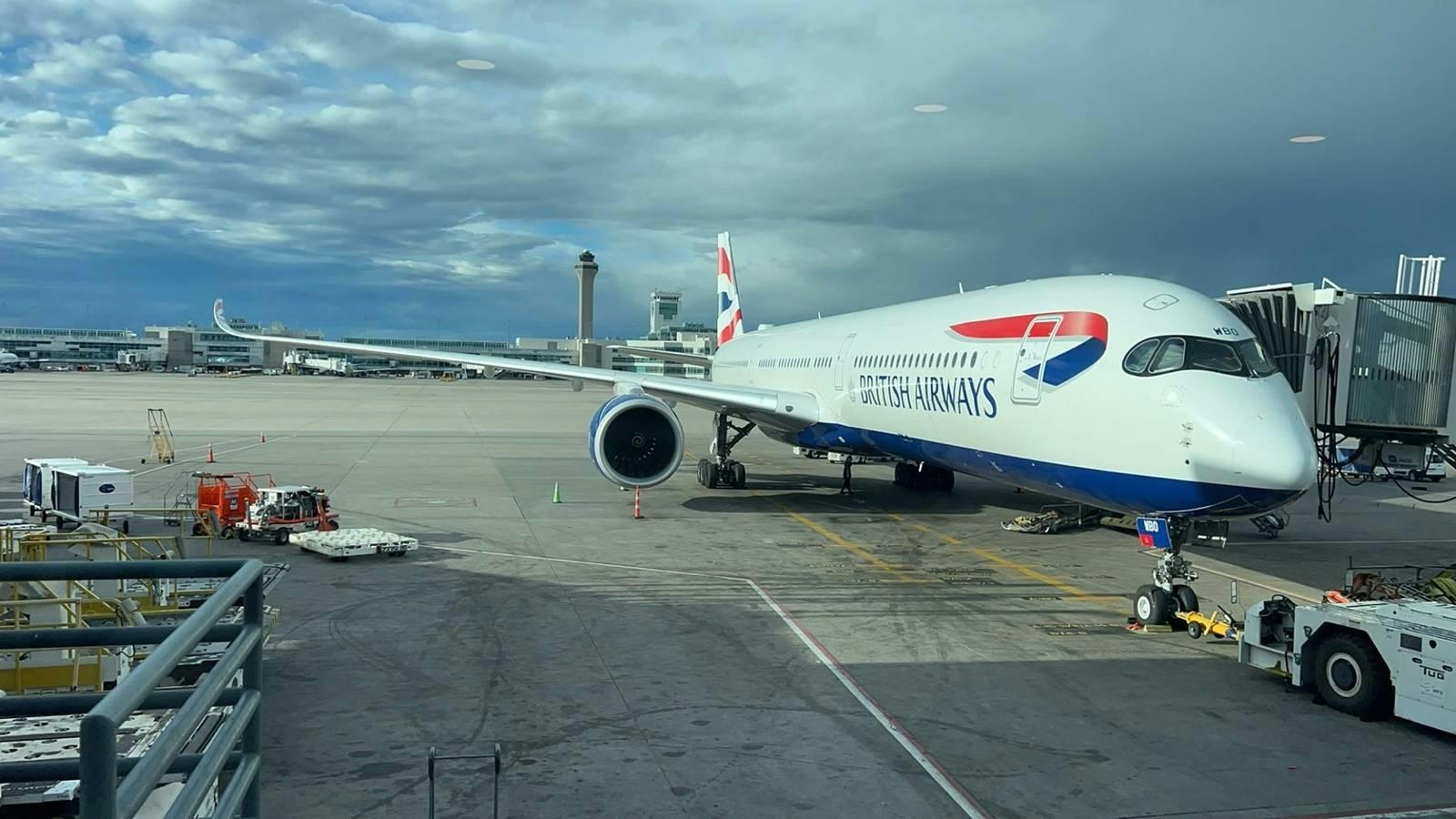
British Airways’ Longest Nonstop Routes Using the Airbus A350-1000 in 2025
British Airways’ Longest Nonstop Routes Using the Airbus A350-1000 in 2025
The Role of the Airbus A350-1000 in British Airways’ Fleet
British Airways continues to position the Airbus A350-1000 as its premier widebody aircraft, capitalizing on the jet’s extended range and operational efficiency to serve some of the most demanding long-haul routes worldwide. The aircraft’s ultra-wide cabin and advanced premium seating configurations make it particularly well-suited for markets with high capacity and a strong focus on premium passengers, an area where British Airways has sought to strengthen its competitive advantage.
Introduced from 2019 onwards, the A350-1000 fleet replaced the aging Boeing 747-400s and helped standardize British Airways’ premium product offering. The aircraft features a 1-2-1 business-class Club Suite with sliding doors, direct aisle access, and ample storage space. In addition to 56 World Traveller Plus (premium economy) seats, the cabin includes 219 World Traveller (economy) seats, bringing the total capacity to 331 passengers. Powered by Rolls-Royce Trent XWB engines, the A350-1000 delivers significant reductions in fuel consumption and noise emissions, enabling British Airways to comply with stringent environmental and operational regulations at its London Heathrow (LHR) hub.
Deployment and Operational Advantages
British Airways primarily deploys the A350-1000 on transatlantic trunk routes, long-haul flights to the Middle East and India, and select destinations in Africa and Asia where strong demand and limited airport slots necessitate both capacity and efficiency. The aircraft’s range and payload capabilities comfortably support missions lasting between eight and twelve hours, allowing British Airways to reassign Boeing 777-300ERs to other parts of its network. Passengers benefit from state-of-the-art in-flight entertainment systems with Bluetooth connectivity, high-capacity galleys, and advanced air pressure systems, all of which contribute to enhanced reliability and reduced turnaround times.
Challenges Amidst Growing Competition
As British Airways expands its longest nonstop routes with the A350-1000 in 2025, it faces an increasingly competitive environment. Airlines such as Qantas and Singapore Airlines are aggressively expanding their ultra-long-haul networks, offering more direct connections that challenge British Airways’ traditional market strongholds. Meanwhile, Gulf and Chinese carriers are adopting similar strategies, bypassing established hubs to capture premium demand.
These developments introduce new operational challenges. Extended flight durations place heightened emphasis on fuel efficiency and cost management, areas where the A350-1000’s performance will be closely scrutinized by both the market and environmental regulators. Logistically, British Airways must navigate the complexities of ultra-long-haul operations, including crew scheduling and maintaining passenger comfort over prolonged periods in the air.
Despite these challenges, the Airbus A350-1000 remains central to British Airways’ long-haul strategy. Its blend of efficiency, range, and premium cabin experience positions the airline to compete effectively on flagship routes, even as the global market for ultra-long-haul travel becomes increasingly competitive and dynamic.

Etihad Airways Suspends Airbus A380 Flights on Key Route

Aditya Birla Group Seeks Approval for Aircraft Leasing in GIFT City

Qatar Airways Highlights Innovation and Connectivity at Arabian Travel Market 2026

Hong Kong's Five-Year Plan Includes Andrew Fan's Aircraft Parts Processing Hub Proposal

ACIA Aero Leasing Delivers ATR72-600 to Air Nostrum

RTX Appoints Jill Albertelli as Head of Pratt & Whitney

TAT Technologies Joins Beyond Aero Hydrogen Aircraft Program

AURAK Study Highlights Barriers to Air Taxi Adoption in Emerging Economies

Xiamen Air Selects Altitude for 787 Maintenance at Heathrow

Etihad and Swissport Extend Global Partnership
