
Превращайте аналитические выводы ИИ в реальные действия

В тренде
Categories
RTX Wins $3.8 Billion Contract for F-35 Engine Production
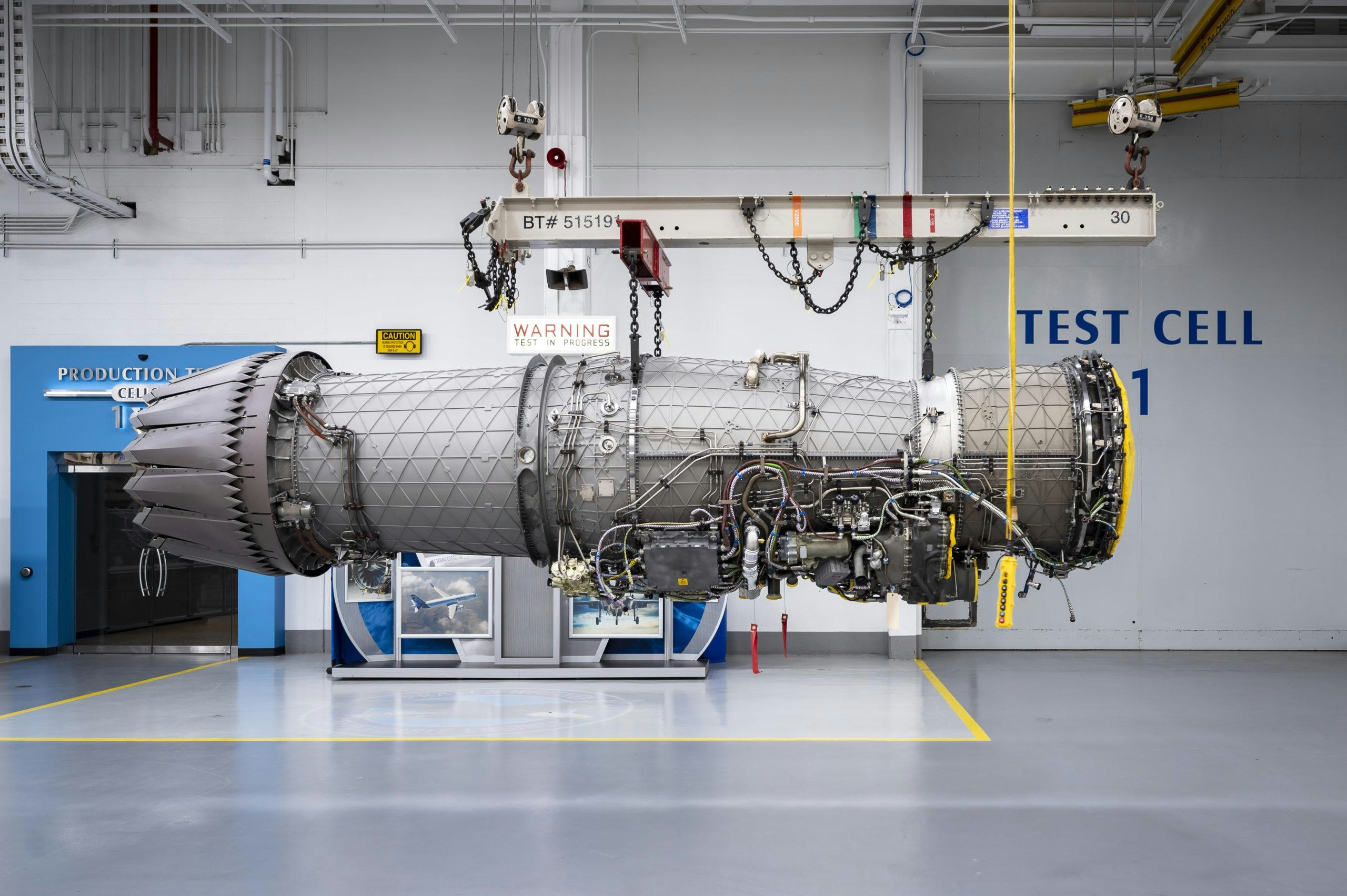
RTX Secures $3.8 Billion Contract for F-35 Engine Production
The U.S. Department of Defense announced on March 30 that RTX has been awarded a $3.81 billion contract modification to produce F135 propulsion systems for Lot 18 and Lot 19 F-35 Lightning II fighter jets. This contract supports ongoing production for the U.S. Air Force, Marine Corps, Navy, international partners, and foreign military sales customers, with work scheduled to continue through March 2028.
The contract finalizes production for Lot 18 engines and initiates manufacturing for Lot 19, ensuring the continued delivery of propulsion systems critical to the global Joint Strike Fighter program. Funding for this award spans fiscal years 2024 and 2025, incorporating contributions from partner nations and foreign military sales, which represent approximately $1.47 billion of the total contract value.
Production and Strategic Importance
Engine production will be distributed across multiple U.S. locations, with East Hartford, Connecticut, responsible for 17 percent of the work. Additional manufacturing activities will take place in Indiana, Washington, Maine, California, Michigan, Oregon, Georgia, Virginia, New Jersey, and other domestic and international sites.
The F135 engine powers all three variants of the F-35: the conventional takeoff F-35A, the short takeoff and vertical landing F-35B, and the carrier-based F-35C. It remains a cornerstone of the fifth-generation fighter program. RTX reports that over 1,300 F135 engines are currently in service worldwide, having recently surpassed one million engine flight hours. The engine delivers more than 40,000 pounds of thrust and incorporates advanced thermal management alongside integrated control systems optimized for modern air combat.
Continued procurement of F135 engines is vital for sustaining new aircraft production, replacing spare parts, and supporting expanding international fleets. Engine production directly influences aircraft delivery schedules and fleet readiness, with propulsion performance affecting range, survivability, and mission endurance—factors that are increasingly critical as F-35 deployments grow across Europe, the Indo-Pacific, and the Middle East.
Industry Competition and Broader Context
Despite RTX’s leadership in the F-35 engine market, the company faces competitive pressures. Airbus, for instance, is reportedly seeking damages from Pratt & Whitney, an RTX subsidiary, over engine delivery delays. This dispute highlights the intense competition within the aerospace sector, where manufacturers vie for priority access to engine supplies and contracts.
Beyond the F-35 program, RTX maintains a broad presence in defense and commercial aviation, including advanced optics and hybrid-electric propulsion technologies. Although the company’s stock has experienced volatility, reflecting the inherent risks of the defense sector, RTX’s ongoing innovation and diversified portfolio position it to navigate industry challenges and market fluctuations.
The latest F135 contract underscores RTX’s central role in sustaining the F-35 program and emphasizes the strategic importance of propulsion technology in modern airpower.

Etihad Airways Suspends Airbus A380 Flights on Key Route

Aditya Birla Group Seeks Approval for Aircraft Leasing in GIFT City

Qatar Airways Highlights Innovation and Connectivity at Arabian Travel Market 2026

Hong Kong's Five-Year Plan Includes Andrew Fan's Aircraft Parts Processing Hub Proposal

ACIA Aero Leasing Delivers ATR72-600 to Air Nostrum

RTX Appoints Jill Albertelli as Head of Pratt & Whitney

TAT Technologies Joins Beyond Aero Hydrogen Aircraft Program

AURAK Study Highlights Barriers to Air Taxi Adoption in Emerging Economies

Xiamen Air Selects Altitude for 787 Maintenance at Heathrow

Etihad and Swissport Extend Global Partnership
