
Превращайте аналитические выводы ИИ в реальные действия

В тренде
Categories
Software Issues Delay Full Delivery of Rafale Jets to India Despite Full Payment
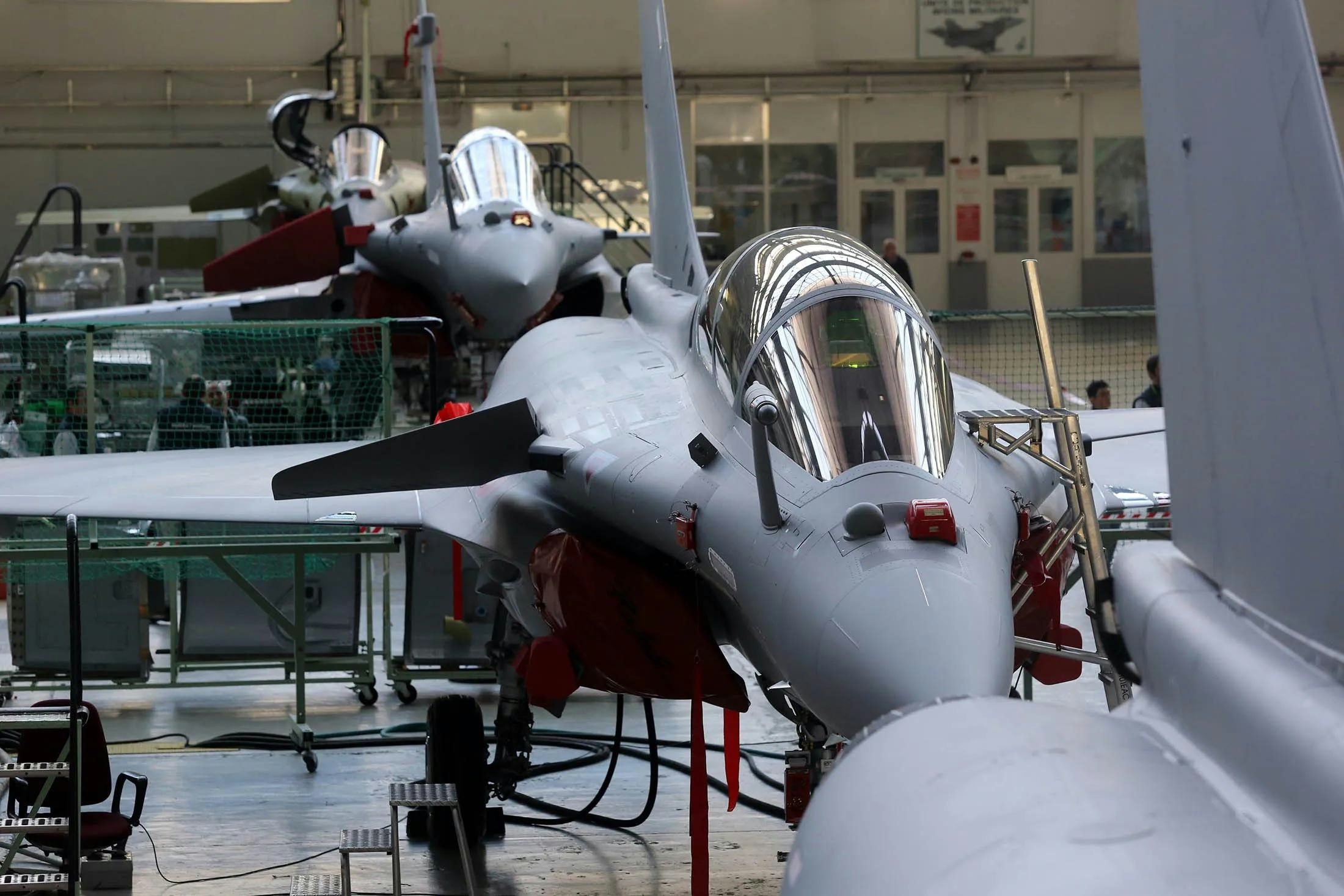
Software Issues Delay Full Delivery of Rafale Jets to India Despite Full Payment
The complete delivery of Rafale fighter jets to India has been postponed, despite the country having fulfilled its financial obligations in full. Central to this delay are software-related complications and the French government’s reported refusal to grant India access to the source code for critical systems, including the Thales RBE2 AESA radar, the Modular Data Processing Unit (MDPU), and the SPECTRA electronic warfare suite. This impasse has ignited a vigorous debate within India concerning the terms of the Rafale agreement and the broader ramifications of software dependency in contemporary defense acquisitions.
The Integral Role of Software in Advanced Fighter Jets
In modern fighter aircraft such as the Rafale, software constitutes an estimated 30 to 40 percent of the total cost, a figure expected to increase as technology advances. Without access to the underlying source code, purchasing nations effectively receive only a fraction of the aircraft’s full capabilities, despite having paid the entire price. This situation fosters a significant reliance on the original equipment manufacturer (OEM) for future software updates, integration of new weapon systems, and adaptation to evolving combat requirements.
For instance, should India seek to integrate third-party weaponry, such as Russian R-37M missiles, onto the Rafale platform, it would require Dassault Aviation’s cooperation to implement the necessary software modifications. In the absence of such support, operational flexibility is severely constrained, limiting the aircraft’s effectiveness in diverse combat scenarios.
Global Context: Software Challenges in Defense Procurement
India’s experience with the Rafale jets is emblematic of a wider pattern affecting defense procurement worldwide. Several major programs have encountered similar delays and complications due to software and integration issues. Taiwan’s F-16V fighter deliveries have been postponed owing to software problems, underscoring the complexity of integrating advanced avionics and mission systems. Commercial aviation has also faced challenges, as evidenced by the Boeing 737 Max jets, whose deliveries to India and other countries were hindered by wiring and software faults.
The US-led F-35 program has repeatedly struggled with software updates, impacting both operational readiness and delivery schedules. Meanwhile, Switzerland is reportedly contemplating the cancellation of its purchase of the US Patriot air defense system, citing severe delivery delays largely attributed to software and integration difficulties. These cases collectively highlight a growing trend: as military and aerospace platforms become increasingly software-driven, delivery timelines and operational autonomy are increasingly contingent upon access to proprietary code and the OEM’s willingness to cooperate.
The Complex Architecture of Fighter Jet Software
Software in modern fighter aircraft is structured in hierarchical layers. The low-level layers manage direct hardware interactions, interfacing with sensors, actuators, and data buses. Mid-level layers provide essential operating system services, mathematical libraries, and certified middleware, abstracting hardware details from higher functions. The high-level layers implement mission-specific logic, including sensor fusion, target tracking, and electronic warfare responses, effectively defining the aircraft’s operational “personality.”
Original equipment manufacturers rarely, if ever, grant full access to these layers—particularly the uppermost ones—to foreign buyers. This practice ensures continued control over the platform and restricts the purchaser’s ability to independently upgrade or modify the aircraft, thereby maintaining the OEM’s strategic leverage.
Conclusion
India’s ongoing difficulties with the Rafale delivery underscore the strategic significance of software in modern defense procurement. As the global defense and aerospace sectors confront similar challenges, the debate over operational sovereignty versus technological dependency is poised to intensify, carrying profound implications for future acquisitions.

Etihad Airways Suspends Airbus A380 Flights on Key Route

Aditya Birla Group Seeks Approval for Aircraft Leasing in GIFT City

Qatar Airways Highlights Innovation and Connectivity at Arabian Travel Market 2026

Hong Kong's Five-Year Plan Includes Andrew Fan's Aircraft Parts Processing Hub Proposal

ACIA Aero Leasing Delivers ATR72-600 to Air Nostrum

RTX Appoints Jill Albertelli as Head of Pratt & Whitney

TAT Technologies Joins Beyond Aero Hydrogen Aircraft Program

AURAK Study Highlights Barriers to Air Taxi Adoption in Emerging Economies

Xiamen Air Selects Altitude for 787 Maintenance at Heathrow

Etihad and Swissport Extend Global Partnership
