
Превращайте аналитические выводы ИИ в реальные действия

В тренде
Categories
South Korea Implements AI-Driven Plan to Enhance Aviation Safety
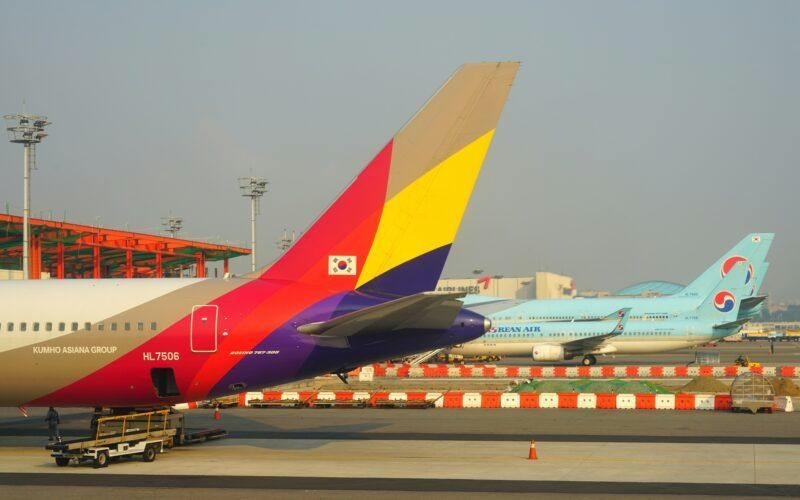
South Korea Implements AI-Driven Plan to Enhance Aviation Safety
South Korea has announced a comprehensive five-year strategy aimed at elevating aviation safety through the integration of artificial intelligence, strengthened regulatory oversight, and market reforms. The Ministry of Land, Infrastructure and Transport (MOLIT) unveiled the Fourth Basic Aviation Policy Plan on June 10, marking the first significant policy update since the Jeju Air crash at Muan Airport last December.
Overhauling Safety Systems and Infrastructure
Central to the new plan is a thorough modernization of the country’s aviation safety framework. MOLIT will introduce an AI-powered platform designed to analyze national aviation safety data in real time, enabling early detection of potential risks and proactive accident prevention. Additional safety measures include enhanced bird-strike prevention protocols at major airports and continuous monitoring of runway hazards.
To meet evolving international standards, the government will revise qualification requirements for pilots and aviation personnel. The air traffic management system is slated for substantial upgrades to accommodate increasing flight volumes and the opening of new airports. This will involve re-segmenting national airspace to improve efficiency and deploying additional Korean Augmentation Satellite System (KASS) satellites to enhance navigation precision. Furthermore, an integrated platform will be developed to synchronize aircraft scheduling with real-time weather information.
Market Reforms and Regional Development
In response to the recent merger of Korean Air and Asiana Airlines, regulators will implement measures to prevent market monopolization by encouraging new entrants and closely monitoring competition. Support mechanisms will be introduced for financially vulnerable domestic carriers to ensure continued investment in safety and consumer protection.
The policy also emphasizes the revitalization of regional airports by promoting local industry participation and attracting sectors such as duty-free retail, logistics, and maintenance, repair, and overhaul (MRO) services. These airports are expected to expand charter and domestic flight operations, evolving into multifunctional hubs that support urban air mobility (UAM), maintenance, and training activities.
Passenger protection regulations will be updated to include stricter standards for managing delays, improved accessibility for travelers with mobility challenges, and enhanced support for accident victims. In alignment with global climate goals, the government plans to implement a roadmap mandating the use of sustainable aviation fuel (SAF) in the near future.
Advancing Future Aviation Technologies
The strategy also prioritizes the development and localization of emerging aviation technologies. South Korea aims to expand the application of drone technology across delivery, infrastructure, and leisure sectors. For urban air mobility, the government will establish operating standards and safety frameworks in preparation for anticipated commercial operations by 2028.
Despite the ambitious scope of the AI-driven initiative, challenges remain, including the need for significant investment in technology and infrastructure, ensuring compatibility with existing systems, and navigating complex regulatory environments. The plan is expected to attract increased interest from international aviation companies and may prompt neighboring countries to accelerate their own AI adoption efforts, reflecting a global trend toward sovereign AI initiatives. South Korea’s approach positions it alongside the United States and China as a leader in this rapidly evolving domain.
“Aviation safety is the foundation of the entire industry,” stated Minister Kim Yun-duk. “If safety falters, the sector contracts. We will place the highest priority on advancing safety management.”

Etihad Airways Suspends Airbus A380 Flights on Key Route

Aditya Birla Group Seeks Approval for Aircraft Leasing in GIFT City

Qatar Airways Highlights Innovation and Connectivity at Arabian Travel Market 2026

Hong Kong's Five-Year Plan Includes Andrew Fan's Aircraft Parts Processing Hub Proposal

ACIA Aero Leasing Delivers ATR72-600 to Air Nostrum

RTX Appoints Jill Albertelli as Head of Pratt & Whitney

TAT Technologies Joins Beyond Aero Hydrogen Aircraft Program

AURAK Study Highlights Barriers to Air Taxi Adoption in Emerging Economies

Xiamen Air Selects Altitude for 787 Maintenance at Heathrow

Etihad and Swissport Extend Global Partnership
