Изображение

Превращайте аналитические выводы ИИ в реальные действия

Присоединяйтесь к списку ожидания AeroGenie уже сегодня!

В тренде

Categories

United Airlines' New Polaris Boeing 787-9 Grounded Twice in Five Days
May 1, 2026By ePlane AI
United Airlines' New Polaris Boeing 787-9 Grounded Twice in Five Days
0
0
United Airlines
Boeing 787-9
Aircraft Grounding

United Airlines’ New Polaris Boeing 787-9 Grounded Twice Within First Week of Service

United Airlines’ latest Boeing 787-9 Dreamliner, featuring the carrier’s new Polaris premium cabin, has encountered significant operational challenges shortly after entering international service. The aircraft, tail number N61101, was grounded twice within its first five days, disrupting schedules and raising concerns about passenger experience and the airline’s standing in the competitive long-haul market.

Early Technical Issues and Operational Disruptions

The initial incident occurred last week when the Dreamliner was forced to return to Singapore Changi Airport just 30 minutes after departure due to a strong electrical odor detected by both crew and passengers. After circling in a holding pattern for two hours, the aircraft landed safely, but maintenance teams were unable to resolve the issue before the crew reached their maximum duty limits. Consequently, the aircraft was grounded overnight, and affected passengers were rebooked on alternative flights. The jet was then ferried back to San Francisco without passengers.

Following preliminary troubleshooting in San Francisco, the aircraft was flown to Houston for more extensive maintenance and inspections focused on the air conditioning system, suspected to be the source of the electrical fumes. Flight tracking data revealed a two-and-a-half-hour test flight around George Bush Intercontinental Airport; however, the problem persisted. Industry sources reported an additional mechanical issue arose before a subsequent departure, further delaying the aircraft’s return to service.

Significance of the Aircraft and Market Implications

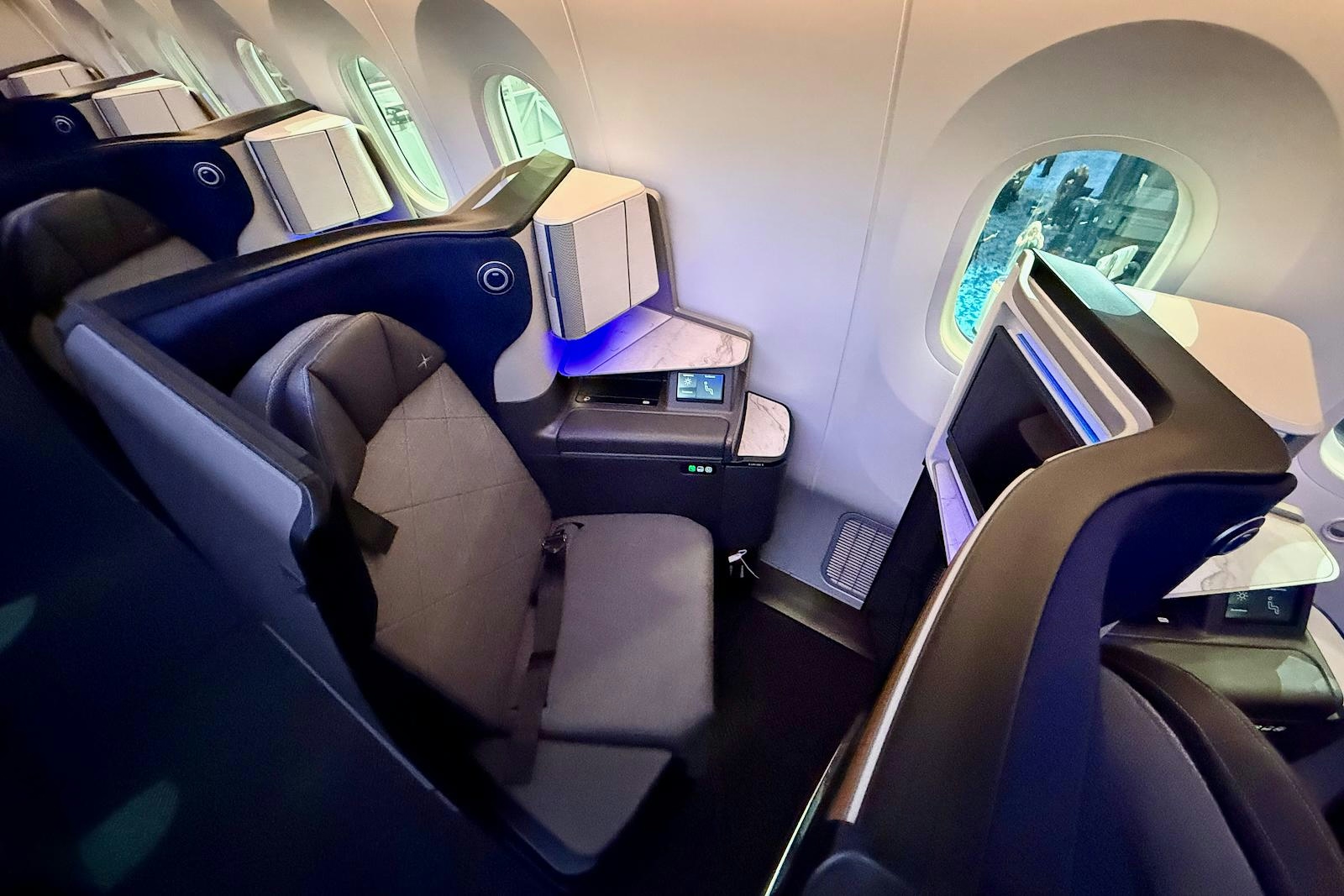
N61101 serves as the flagship of United’s new 78L subfleet and showcases a 222-seat configuration designed to enhance passenger comfort. The aircraft introduces the Polaris Studio, featuring eight spacious front-row suites and 56 business class seats equipped with sliding privacy doors. The Premium Plus cabin offers 35 seats with upgraded amenities, while economy class is limited to 123 seats, making this one of the least-dense 787-9 configurations currently in operation.

These operational setbacks come at a critical juncture as United aims to establish this Dreamliner as the centerpiece of its premium long-haul routes to Singapore and London. The incidents have attracted scrutiny from travel agencies and passengers alike, some of whom may consider alternative carriers. Competitors such as Delta Air Lines and American Airlines, both offering advanced business class products, stand to benefit from United’s difficulties in attracting premium travelers.

Despite these challenges, the Boeing 787 remains a key asset for airlines worldwide. Ethiopian Airlines recently announced plans to expand its 787 fleet, and Austrian Airlines is contemplating increasing its long-haul 787 operations, reflecting sustained industry confidence in the aircraft model.

United Airlines has affirmed its commitment to resolving the technical issues promptly and returning the aircraft to full operational status. Nonetheless, the troubled debut of its new Polaris Dreamliner underscores the operational and reputational risks airlines face when launching flagship products in a highly competitive environment.
More news
LATAM Selects SES for In-Flight Connectivity on 60 Airbus and Embraer Jets

LATAM Selects SES for In-Flight Connectivity on 60 Airbus and Embraer Jets

LATAM Selects SES for In-Flight Connectivity on 60 Airbus and Embraer Jets SES, South America’s leading provider of inflight connectivity, has announced a major expansion of its partnership with LATAM Airlines Group. The agreement will see over 60 Airbus and Embraer aircraft equipped with SES’s advanced multi-orbit inflight connectivity (IFC) solution, which utilizes electronically steerable antenna (ESA) technology. This installation program includes Airbus A320neo and A321XLR models, as well as Embraer E195-E2 jets, with deployments scheduled over the coming years. Deployment Timeline and Technology Integration The first Embraer E195-E2 aircraft fitted with the new connectivity system are expected to join LATAM Airlines Brazil’s domestic fleet in the fourth quarter of this year. Meanwhile, the initial Airbus A321XLRs covered by the agreement are anticipated to enter service in 2027. The IFC solution integrates Gilat Satellite Networks’ Stellar Blu Sidewinder ESA and operates through SES’s geostationary satellites, complemented by Eutelsat OneWeb’s Low Earth Orbit (LEO) satellite network. SES serves as a distribution partner for the LEO network within the aviation sector, enhancing the system’s global reach and performance. Currently, SES supports inflight connectivity on more than 250 LATAM aircraft, primarily from the A320 Family, using its 2Ku technology. This latest contract further solidifies SES’s dominant position in the Latin American market amid intensifying competition. Notably, Viasat recently secured the contract to provide connectivity for LATAM’s widebody fleet, underscoring the competitive dynamics among satellite service providers. Market Context and Industry Challenges Paulo Miranda, vice president of customers at LATAM Airlines Group, emphasized the airline’s commitment to enhancing passenger connectivity. He stated, “By bringing next-generation multi-orbit connectivity to more of our fleet, we will offer our passengers a faster, more reliable onboard internet experience, helping them stay connected wherever they fly while continuing to raise the standard of travel across Latin America.” SES’s multi-orbit IFC solution is gaining momentum across the region. The company recently signed an agreement with the Abra Group—which owns Avianca, GOL, and Wamos Air—to equip over 100 aircraft with its LEO/GEO connectivity system. GOL is already a customer of SES’s 2Ku technology. Additionally, SES announced plans last month for Mexican ultra-low-cost carrier Viva to install the ESA-based system on 100 A320 Family aircraft. Despite these advances, SES and its airline partners face significant challenges. Regulatory issues such as spectrum clearance remain a critical hurdle, alongside the increasing risk of cyber-attacks targeting satellite networks and onboard systems. The rapid evolution of the inflight connectivity market is also driving competitors to accelerate fleetwide upgrades. For example, several U.S. carriers are intensifying retrofit programs for their narrow-body aircraft, while international airlines like Japan Airlines are adopting SES’s multi-orbit solutions, reflecting a broader global shift and heightened competition in the sector. As LATAM and SES proceed with this ambitious rollout, their collaboration highlights both the promising opportunities and the complex challenges involved in delivering next-generation inflight connectivity to passengers throughout Latin America.
NARMA Introduces PXN Security-Hardened Flight Control Software for U.S. Drone Industry

NARMA Introduces PXN Security-Hardened Flight Control Software for U.S. Drone Industry

NARMA Introduces PXN Security-Hardened Flight Control Software for U.S. Drone Industry Launch of PXN: A Security-Focused Flight Control Platform CORPUS CHRISTI, Texas, July 30, 2026 — NARMA, a leading developer of advanced autonomous flight systems, has unveiled PXN, a security-hardened flight control software platform compatible with the PX4 ecosystem. This launch addresses the increasing cybersecurity and regulatory demands faced by the U.S. drone industry, particularly from agencies such as the FAA, FCC, and national security bodies. PXN is engineered to enhance cybersecurity, software provenance, operational safety, and supply chain integrity while maintaining compatibility with existing drone architectures. By building on the established PX4 framework, the platform offers drone manufacturers, system integrators, and enterprise operators a licensable alternative that supports compliance without disrupting current workflows or hardware configurations. This approach allows stakeholders to integrate PXN seamlessly into their operations while benefiting from improved security and traceability. Features and Industry Implications NARMA reports that PXN has undergone rigorous static and dynamic code analysis to identify and remediate vulnerabilities, resulting in a robust and predictable flight control baseline. The software remains compatible with existing ground control systems and operator procedures, facilitating straightforward adoption. Kijung Kwon, CEO of NARMA, emphasized the platform’s role in meeting the U.S. market’s demand for trusted flight software. He noted that PXN preserves the flexibility of PX4 while addressing heightened requirements for cybersecurity, software assurance, and regulatory compliance. Unlike traditional open-source flight control software, PXN is offered as a licensable platform with direct support from NARMA for hardware integration, software hardening, system validation, and certification-oriented development. PXN is also being advanced as a Part 108 Ready platform, incorporating advanced Detect-and-Avoid capabilities to enable safer Beyond Visual Line of Sight (BVLOS) operations. One notable feature is an autonomous landing safety function that aborts landings if a person is detected in the landing zone, thereby reducing ground risk during remote operations. The platform targets a broad range of users, including public safety agencies, university UAS programs, critical infrastructure operators, and commercial drone manufacturers seeking a security-focused, non-Chinese flight control software option aligned with Green UAS initiatives and emerging cybersecurity standards. Market Context and Future Outlook NARMA’s introduction of PXN arrives amid several industry challenges, including the increasing sophistication of cyberattacks, persistent cybersecurity skill shortages, and budgetary constraints faced by some organizations. These factors may influence the pace of adoption and implementation. Nevertheless, demand for robust security solutions is expected to grow as cyber threats escalate and regulatory compliance becomes more stringent. Competitors in the drone software market are likely to respond by enhancing their security measures and addressing cost concerns to maintain competitiveness. As the U.S. drone ecosystem evolves, NARMA encourages manufacturers, system integrators, and operators currently using PX4-based platforms or transitioning from restricted software to consider PXN as a secure, scalable, and long-term solution. PXN is now available for purchase or licensing through the NARMA website. --- **About NARMA US** NARMA specializes in the development and manufacture of uncrewed aircraft systems (UAS), focusing on electric dual tilt-rotor VTOL technology for government and enterprise applications. Further information is available at https://narma.co.kr.
Seventh Boeing 777-9 Enters Flight-Test Program

Seventh Boeing 777-9 Enters Flight-Test Program

Seventh Boeing 777-9 Enters Final Phase of Flight-Test Program A seventh Boeing 777-9 test aircraft has successfully completed its maiden flight, marking a significant advancement in the certification campaign for the long-delayed widebody jet. The approximately three-hour flight took place on July 24, departing from Paine Field in Everett, Washington. The aircraft traversed the skies over Washington, Idaho, and Oregon before returning to its point of origin, according to Boeing. Progress in Certification Testing This latest test aircraft will be dedicated to Extended-range Twin-engine Operational Performance Standards (ETOPS) and function-and-reliability testing, two of the final and most critical stages in the Federal Aviation Administration (FAA) certification process. ETOPS certification is vital for twin-engine jets to operate safely on long-haul routes that extend far from diversion airports, including transoceanic flights. Function-and-reliability testing requires manufacturers to demonstrate that the aircraft can perform dependably under conditions simulating daily airline operations. With the addition of the seventh test aircraft, Boeing reports that the 777-9 test fleet has now accumulated more than 4,800 flight hours. Over 55 percent of the certification flight testing is complete, marking a key milestone as the program enters its final phase. In addition to dedicated test aircraft, production-standard airplanes are also participating in the certification effort. Challenges and Financial Implications Despite this progress, Boeing continues to face significant challenges. The 777X program, which encompasses the 777-9, the smaller 777-8, and the 777-8 Freighter, has experienced repeated delays due to evolving certification requirements, design modifications, and production issues. The company is conducting rigorous fatigue testing to validate the aircraft’s durability, but the extended certification timeline has intensified financial pressures. The cost of the 777X’s delayed certification is reported to have exceeded that of the entire Airbus A350 program. These certification setbacks have broader ramifications for Boeing’s financial health. The company is simultaneously managing the long-delayed certifications of the 737-7, 737-10, and 777-9, contributing to a mounting long-term debt estimated at approximately $50 billion. Delays in the 777X program introduce execution risks, including additional costs and potential customer compensation. Boeing’s capacity to maintain uninterrupted cash flow and profitability from its production lines remains critical to funding future aircraft development and reducing its substantial debt burden. Outlook for the 777X Program Despite these hurdles, Boeing continues to target certification and first deliveries of the 777-9 in 2027, approximately seven years later than originally planned. The 777X family has attracted more than 650 orders from customers worldwide, underscoring the high stakes as the program moves closer to commercial service.
The Advantage of Dual Certification for Pilots and A&P Mechanics

The Advantage of Dual Certification for Pilots and A&P Mechanics

The Advantage of Dual Certification for Pilots and A&P Mechanics In the aviation industry, possessing multiple certifications significantly enhances employability, particularly for individuals who hold both a pilot certificate and an Airframe & Powerplant (A&P) mechanic license. This dual certification not only broadens career opportunities but also provides considerable flexibility, enabling professionals to move fluidly between piloting and maintenance roles. Career Flexibility and Industry Demand At the Fixed Base Operator (FBO) level, A&P mechanics who are also current pilots are consistently sought after. Many professionals begin their careers in maintenance and later develop an interest in flying, exemplified by Corey Sampson. Sampson, who holds both an A&P with Inspection Authorization (IA) and a pilot certificate, currently serves as a senior specialist for technical services at Delta Air Lines. His combined qualifications have afforded him access to a diverse range of roles within the aviation sector. The importance of dual certification is further highlighted by persistent labor shortages affecting both pilots and mechanics. As the industry anticipates continued growth through 2026, the demand for qualified personnel in business aviation remains robust. Individuals with both pilot and A&P credentials are uniquely equipped to address these workforce gaps, providing them with a distinct advantage in a competitive job market. Navigating Industry Challenges The aviation sector is also confronting emerging challenges, such as the transition to unleaded aviation fuel. This change introduces a fragmented market and increases the risk of misfueling, issues that require a combination of technical knowledge and operational insight. Professionals holding dual certifications are particularly well-prepared to manage these complexities, ensuring safe and efficient operations amid evolving industry standards. Holding both pilot and A&P certificates not only enhances personal career trajectories but also delivers essential support to an industry in need of adaptable and skilled professionals. As aviation continues to evolve, those with dual certification will remain integral to meeting the demands of this dynamic and challenging field.
BNDES Finances Porter's Next Series of E2 Deliveries

BNDES Finances Porter's Next Series of E2 Deliveries

BNDES Finances Porter’s Next Series of E2 Deliveries Porter Aviation Holdings, the parent company of Porter Airlines, has secured financing from the Brazilian Development Bank (BNDES) to support the acquisition of up to 19 additional Embraer E195-E2 aircraft. This financing arrangement, which extends through December 2030, is backed by export credit insurance from Brazil’s Export Credit Guarantee Fund (FGE) and covers aircraft from Porter’s existing firm order of 75 E195-E2 jets. To date, Porter has taken delivery of 54 of these aircraft, with three previously financed through BNDES. Expansion and Strategic Importance of the E195-E2 Porter Airlines introduced the E195-E2 to its fleet in 2023, leveraging the aircraft to accelerate its network expansion across Canada, the United States, Latin America, and the Caribbean. The airline has underscored the E195-E2’s critical role in its growth strategy, particularly highlighting the aircraft’s advanced technology and reduced emissions as key factors in enhancing its premium economy offering. The integration of these jets has been central to Porter’s efforts to strengthen its market presence and operational efficiency. Implications of BNDES Financing Aloizio Mercadante, President of BNDES, emphasized that the financing arrangement not only facilitates Embraer’s expansion in the North American market but also encourages the adoption of more environmentally sustainable aircraft. This deal exemplifies Embraer’s continued reliance on government-backed financing to secure significant international orders, a practice that has attracted both industry support and scrutiny. While the financing is expected to bolster investor confidence in Porter Airlines, it also raises potential challenges. Regulatory scrutiny may increase regarding BNDES’s role in international transactions, especially given Brazil’s economic volatility, which could affect the bank’s capacity to maintain such support. Furthermore, concerns have been voiced about the broader market implications of Embraer’s dependence on government assistance, with some analysts questioning the long-term sustainability of this model. Market Impact and Competitive Dynamics The financing is poised to influence competitive dynamics within the North American aviation sector. Rival carriers may pursue similar financing arrangements or expedite their own fleet expansions to preserve market share, potentially intensifying competition. As Porter continues to expand its network with the E195-E2, the broader market is likely to experience increased activity as competitors respond to the airline’s enhanced position. This BNDES-backed financing deal represents a significant milestone for both Porter Airlines and Embraer, reinforcing their partnership and shaping the evolving landscape of regional aviation across the Americas.
Enstrom Delivers First New 480B Helicopter to South Africa's Safomar Aviation

Enstrom Delivers First New 480B Helicopter to South Africa's Safomar Aviation

Enstrom Delivers First New 480B Helicopter to South Africa's Safomar Aviation Enstrom Helicopter has achieved a significant milestone with the delivery of its first newly produced 480B helicopter to Safomar Aviation, its long-standing authorized distributor for sub-Saharan Africa. The handover, conducted at Enstrom’s Menominee facility, marks the company’s first customer delivery since resuming production of the 480B light turbine single. This event signals a renewed manufacturing momentum for Enstrom and highlights its commitment to supporting both commercial and military operators across the African continent. Deployment and Operational Challenges The aircraft is scheduled to arrive at Safomar’s headquarters near Johannesburg, where it will serve as a demonstration model. It is intended to tour the region, showcasing its capabilities and strengthening relationships with potential customers. However, the delivery process involves navigating South Africa’s stringent regulatory environment, requiring the 480B to meet all local operational and safety standards. Additionally, logistical complexities—including international shipping, final assembly, and certification—are critical factors in ensuring the successful handover of the helicopter. Strategic Partnership and Market Outlook Chuck Wade, Enstrom’s Senior Vice President of Product, Sales, and Customer Excellence, emphasized the significance of the partnership with Safomar Aviation. He noted that the delivery represents more than the transfer of an aircraft; it embodies the enduring strength of their collaboration and a shared commitment to supporting customers throughout South Africa and the broader African market. Wade also highlighted that this delivery marks an important milestone for Enstrom as it re-establishes its ability to serve both commercial and military clients worldwide. Echoing this sentiment, Shai Shalem, Founder and CEO of Safomar Group, described the relationship between Enstrom and Safomar as a testament to trust, collaboration, and a focus on delivering superior products and support. He underscored their mutual dedication to customer safety and continuous improvement, with a joint objective to expand the African market by leveraging Enstrom’s advanced helicopter solutions. The market response to the new 480B has been largely positive, with Safomar Aviation emphasizing the helicopter’s advanced features and reliability. Nonetheless, competition in the region remains robust. Regional players such as The Helicopter Company in Saudi Arabia are expected to respond by highlighting their own technological innovations and intensifying marketing efforts to maintain competitive positioning. As Enstrom reasserts its presence in the global helicopter industry, the successful delivery to Safomar Aviation not only paves the way for further expansion across Africa but also heightens competition among regional and international manufacturers.
Icelandair Adds A320neo Aircraft Through Aircastle Agreement

Icelandair Adds A320neo Aircraft Through Aircastle Agreement

Icelandair Expands Fleet with Six Airbus A320neo Aircraft Through Aircastle Lease Icelandair has entered into an agreement to lease six Airbus A320neo aircraft from Aircastle, marking a pivotal advancement in the airline’s ongoing fleet renewal programme. These Pratt & Whitney-powered jets, manufactured between 2018 and 2020, are slated to enter service before the summer of 2028, reinforcing Icelandair’s commitment to modernizing its fleet with more fuel-efficient aircraft. Strategic Fleet Renewal and Expansion This latest lease agreement follows Icelandair’s recent arrangement to acquire four A320neo aircraft from AviLease, expected to join the fleet in spring 2027. Alongside the arrival of three Airbus A321LRs later this year, these additions will increase Icelandair’s Airbus fleet to a total of 20 aircraft. The expanded Airbus presence is central to the airline’s strategy to phase out its older Boeing 757 and 767 models, replacing them with newer-generation aircraft that offer significant improvements in fuel efficiency and operational performance. Icelandair plans to retire its 757 and 767 passenger operations by January 2027. The transition to the Airbus A320neo family is projected to reduce fuel consumption by up to 30% per seat, a critical factor in supporting both network growth and fleet simplification. This shift aligns with broader industry trends prioritizing sustainability and cost efficiency. Operational Challenges and Market Implications Despite the clear benefits, Icelandair faces potential challenges in executing its fleet renewal strategy. Persistent supply chain disruptions and shortages of airport personnel may affect the timely integration of new aircraft and overall operational efficiency. These industry-wide constraints could necessitate adjustments to rollout schedules and workforce management to ensure service reliability. The airline’s fleet expansion is also attracting close scrutiny within the competitive transatlantic market. The introduction of more efficient aircraft by Icelandair may intensify pressure on rival carriers to upgrade their fleets or modify operational strategies to maintain market share. This dynamic underscores the strategic importance of Icelandair’s investment in modern aircraft as it seeks to strengthen its position in a rapidly evolving aviation landscape. Through these new leases, Icelandair demonstrates a clear focus on enhancing operational efficiency, sustainability, and customer experience, positioning itself to capitalize on future growth opportunities despite the challenges ahead.
LaGuardia Terminal B Introduces Robotics Pilot Program

LaGuardia Terminal B Introduces Robotics Pilot Program

LaGuardia Terminal B Launches Robotics Pilot Program to Enhance Operations LaGuardia Airport’s Terminal B has introduced a pioneering robotics pilot program aimed at advancing facility operations and passenger services. This initiative, a collaboration between ABM and LaGuardia Gateway Partners, deploys a range of autonomous systems including inspection robots, floor scrubbers, and vacuum units to support the terminal’s maintenance and operational efficiency. Advanced Robotics Integration The pilot program features several cutting-edge robotic platforms. Among them is a four-legged inspection robot, developed in partnership with Skild AI, which is one of the first robotic “dogs” to operate within a U.S. airport terminal. This quadruped robot patrols Terminal B, continuously monitoring the facility and identifying maintenance issues that require human intervention. Passengers may observe the robot as it assists ABM personnel in maintaining a safe and orderly environment. Complementing the inspection robot are autonomous floor scrubbers and vacuum units supplied by CenoBots. These machines utilize three-dimensional LiDAR navigation and intelligent mapping technology to clean terminal floors and high-traffic areas efficiently. The scrubbers can operate independently for up to six hours before returning to recharge, while the vacuum units are designed to collect both fine dust and larger debris. Both systems feature self-charging capabilities, ensuring consistent cleanliness and allowing staff to concentrate on other operational and passenger-focused responsibilities. This deployment builds upon ABM’s existing Performance Solutions integrated facilities model and ABM Connect for Aviation platform, which harness sensor data, Internet of Things (IoT) technology, and artificial intelligence to monitor and optimize airport operations. The integration of these robotic platforms with AI and operational data represents a significant step forward in Terminal B’s facility management framework. Innovation Amidst Challenges Terminal B, managed by LaGuardia Gateway Partners, holds the distinction of being the first airport terminal in North America to earn a five-star rating from Skytrax and was named the World’s Best New Airport Terminal in 2023. The robotics pilot program aligns with ongoing efforts to expand automation, artificial intelligence, and data-driven systems within the terminal. Despite the program’s innovative promise, it has raised concerns among employees regarding potential job displacement as automation assumes tasks traditionally performed by staff. Additionally, questions remain about possible operational disruptions during the pilot phase and the financial implications of increased investments, with uncertainty surrounding the long-term return on investment. Industry observers have noted the novelty of deploying a quadruped robot in a U.S. airport setting, anticipating that competitors may adopt similar technologies to maintain market relevance. Sean Bromfield, President of Aviation at ABM, addressed these concerns by emphasizing that the initiative aims to empower rather than replace employees. He stated, “Airports are among the most dynamic environments in the world, and Terminal B is the perfect stage to demonstrate how robotics, AI, and data integration can transform facility operations. This pilot underscores ABM’s leadership in anticipating our clients’ evolving needs and investing in real, ROI-driven innovation. Robotics and AI are not about replacing people but empowering them—freeing our teams to focus on higher-value tasks.” The pilot program will continue to be closely monitored to assess its impact on operational efficiency, passenger experience, and workforce dynamics as LaGuardia Terminal B explores the future of airport facility management.
Boeing Completes Final Certification Flight for 737-10

Boeing Completes Final Certification Flight for 737-10

Boeing Completes Final Certification Flight for 737-10 Amid Heightened Regulatory Scrutiny Boeing has successfully concluded the final planned certification flight test for its 737-10 aircraft, marking the end of an extensive flight test campaign. This rigorous program encompassed 976 flights, over 2,060 flight hours, and approximately 1,040 hours of ground testing. Throughout the campaign, Boeing validated critical certification requirements, including landing gear performance, braking effectiveness on wet runways, engine anti-ice systems, and enhancements to the angle of attack system. The concluding flight specifically evaluated cabin safety features, such as the audibility of the lavatory smoke detector and the cabin speaker system. Prolonged Certification Amid Increased Oversight This achievement occurs against a backdrop of intensified regulatory scrutiny following the challenges Boeing faced with the 737 MAX series, which was marred by two fatal crashes and subsequent production difficulties. The certification process for the 737-10 has been notably extended, with regulators enforcing more stringent safety and compliance standards. Boeing is now transitioning to final development assurance reviews, system safety assessments, and the preparation of comprehensive documentation for submission to the US Federal Aviation Administration (FAA). The company aims to secure certification by 2026. Market Response and Competitive Challenges Reactions from the market have been mixed, ranging from cautious optimism to skepticism, reflecting persistent concerns about Boeing’s capacity to deliver a safe and reliable aircraft. The company’s reputation and market confidence remain under significant pressure, particularly as Airbus has capitalized on Boeing’s delays to expand its market share. Airbus’s gains highlight the competitive hurdles Boeing must overcome as it strives to restore trust and reestablish its position within the commercial aviation industry. Boeing’s ability to regain market confidence and competitive advantage will depend on its execution of the remaining certification steps with transparency and rigor. As the company advances toward FAA approval, industry stakeholders will closely monitor whether Boeing can satisfy regulatory expectations and reassure both customers and regulators regarding the safety and reliability of the 737-10.
Israir Receives Regulatory Approval for Widebody Operations Following A330 Acquisition

Israir Receives Regulatory Approval for Widebody Operations Following A330 Acquisition

Israir Receives Regulatory Approval for Widebody Operations Following A330 Acquisition Israir, the Israeli leisure airline, has secured regulatory approval from the country’s civil aviation authority to operate Airbus A330-200 aircraft. This authorization, granted on 29 July, marks a pivotal moment for the carrier as it embarks on its first widebody operations under its own license. The airline has described the clearance as a “significant regulatory milestone” that broadens its operational scope and enables it to expand its international reach. Expansion of Operational Capabilities With the new approval, Israir is now authorized to deploy the twin-engine A330-200 on scheduled, charter, and ad hoc flights across multiple regions, including Europe, the Middle East, Asia, and Africa. This development represents a substantial enhancement of Israir’s capabilities, allowing the airline to diversify its route network and enter new markets that were previously beyond its operational range. The airline completed the acquisition of two former American Airlines A330-200 aircraft—registered 4X-BAK and 4X-BAL and equipped with Rolls-Royce Trent 700 engines—at the end of April. The $74 million purchase was partially financed through a $41 million loan from a financial institution. Israir had previously indicated plans to commence widebody operations in the latter half of the year, with ambitions to significantly expand its long-haul services, targeting destinations in Asia and the United States. Challenges and Market Implications While the regulatory approval clears a major hurdle, Israir faces several operational challenges as it integrates the widebody aircraft into its existing fleet. The transition requires comprehensive crew training, adjustments to maintenance protocols, and the adaptation of operational procedures to accommodate the larger aircraft. These logistical complexities will test the airline’s capacity to manage a more diverse fleet. Moreover, Israir’s entry into the widebody market is likely to intensify competition within the Israeli leisure travel sector. Rival carriers, particularly Arkia, may respond by revising their fleet strategies or adjusting pricing structures to protect their market share. This competitive dynamic could lead to increased rivalry on long-haul routes, potentially resulting in more competitive fares and expanded service offerings for consumers. Israir’s move into widebody operations signals a new chapter for the airline, positioning it for growth in international markets. However, its success will depend on how effectively it manages operational integration and navigates the evolving competitive landscape.
line