
Превращайте аналитические выводы ИИ в реальные действия

В тренде
Categories
U.S. Plans to Resume Civil Supersonic Flights with Industry Support
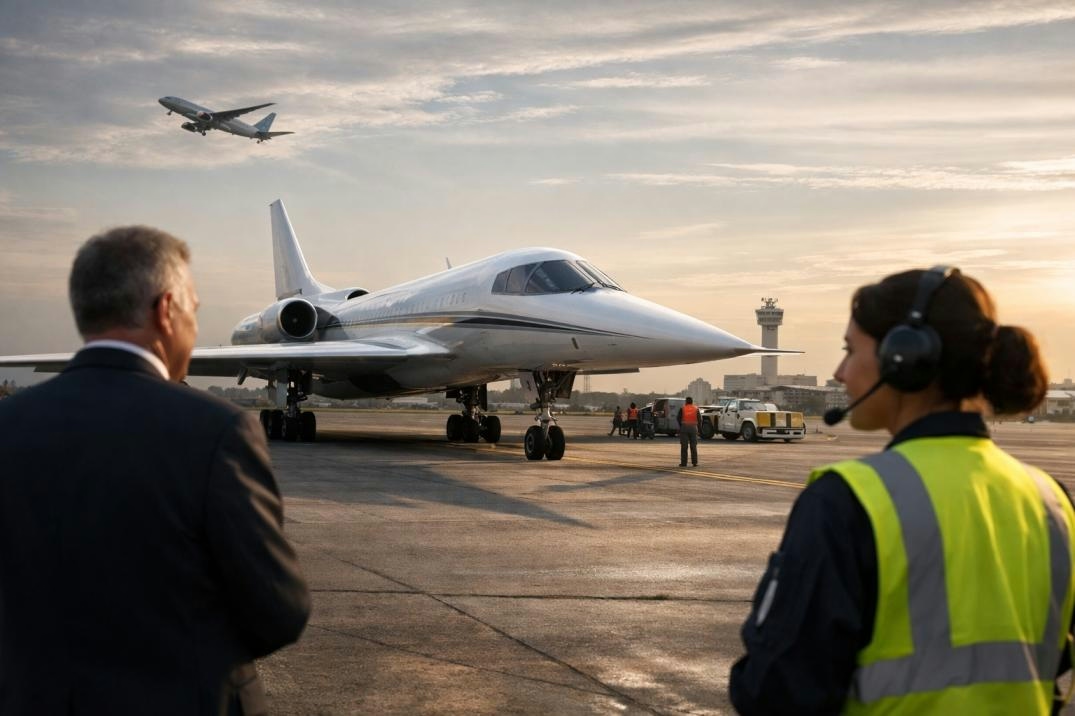
U.S. Moves to Reintroduce Civil Supersonic Flights with Industry Backing
The United States is on the verge of a significant shift in aviation policy as lawmakers advance efforts to reestablish civil supersonic flight over domestic airspace. The House Transportation and Infrastructure Committee’s Subcommittee on Aviation has progressed H.R. 3410, known as the “Supersonic Aviation Modernization Act.” This legislation mandates the Federal Aviation Administration (FAA) to formulate regulations that would permit civil supersonic flights, contingent on the condition that no sonic boom is audible on the ground.
This legislative initiative, strongly endorsed by the National Business Aviation Association (NBAA), signals a potential revival of supersonic travel in the U.S. for the first time since 1973, when the FAA prohibited such flights due to concerns over the disruptive noise generated by sonic booms. The NBAA, a prominent advocate for business aviation, has expressed support for the bill, emphasizing the prospects for faster, more efficient travel and the importance of sustaining American leadership in the global aviation industry.
Balancing Innovation with Public Safety
Ed Bolen, President and CEO of the NBAA, characterized the legislation as a prudent approach that harmonizes technological innovation with public safety considerations. He pointed to recent advancements that have significantly diminished the intensity of sonic booms to a near-imperceptible “thump,” thereby reducing disturbances to communities below flight paths. Bolen underscored that legalizing civil supersonic flight represents a vital step toward enabling rapid point-to-point connectivity and fostering transformative progress in aviation technology.
Technological Advances and Industry Momentum
In recent years, there has been notable progress in the design of supersonic aircraft, particularly in mitigating the impact of sonic booms. NASA’s successful inaugural flight of the Lockheed Martin X-59 QueSST, an experimental aircraft engineered to produce a sonic boom comparable in sound to a car door closing, exemplifies the feasibility of quieter supersonic travel. This milestone could establish a foundation for future commercial supersonic operations.
Private sector innovation is also accelerating. Boom Supersonic, a leading manufacturer in the field, is applying its technology not only to aviation but also to support artificial intelligence data centers, generating revenue streams that help finance its supersonic projects. These developments highlight the growing momentum and investment driving the resurgence of supersonic flight.
Regulatory and Market Challenges
Despite the enthusiasm within the industry, considerable challenges remain. The FAA faces a demanding timeline, as the proposed legislation requires the agency to issue new regulations within one year. Addressing regulatory complexities will be essential to ensure safety, manage noise concerns, and establish clear operational standards for supersonic flights.
Market responses are expected to be mixed. While some investors are optimistic about the potential for accelerated travel and emerging business opportunities, others remain cautious due to concerns over noise pollution and environmental impacts. Competitors in the aviation sector are closely monitoring these developments, with some exploring alternative funding strategies and technological collaborations to maintain competitiveness.
As the United States moves closer to reinstating civil supersonic flight, the forthcoming months will be pivotal in shaping the regulatory framework and determining the pace and manner in which supersonic travel returns to American skies.

Etihad Airways Suspends Airbus A380 Flights on Key Route

Aditya Birla Group Seeks Approval for Aircraft Leasing in GIFT City

Qatar Airways Highlights Innovation and Connectivity at Arabian Travel Market 2026

Hong Kong's Five-Year Plan Includes Andrew Fan's Aircraft Parts Processing Hub Proposal

ACIA Aero Leasing Delivers ATR72-600 to Air Nostrum

RTX Appoints Jill Albertelli as Head of Pratt & Whitney

TAT Technologies Joins Beyond Aero Hydrogen Aircraft Program

AURAK Study Highlights Barriers to Air Taxi Adoption in Emerging Economies

Xiamen Air Selects Altitude for 787 Maintenance at Heathrow

Etihad and Swissport Extend Global Partnership
